Politics & Government
New Hampshire's Pine Tree Riot: Don't MASS Up U.S. History
Long before tea was dumped in Boston Harbor, NH colonists were already taking matters into their own hands — violently, if necessary.

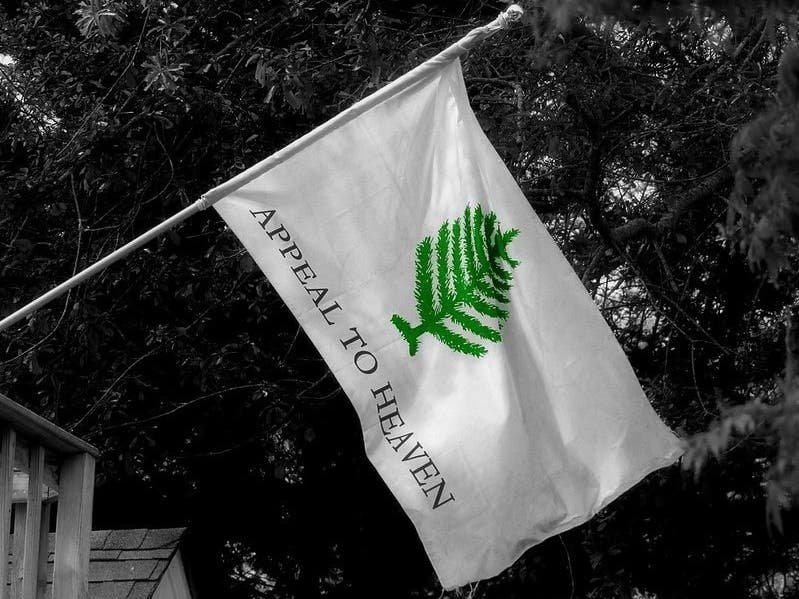
Boston got the history books. New Hampshire got the riot.
On Saturday, roughly 150 Granite Staters convened in Weare to celebrate the anniversary of the Pine Tree Riot, an often-overlooked moment in America’s founding that historians say was one of the first acts of violent resistance against the British crown.
Find out what's happening in Bedfordfor free with the latest updates from Patch.
Long before tea was dumped in Boston Harbor, New Hampshire colonists were already taking matters into their own hands — violently, if necessary. For modern Granite Staters, the Pine Tree Riot of 1772 is more than history; it’s an origin story for a state that still prides itself on resisting mandates, rejecting top-down control, and living up to its “Live Free or Die” reputation.
 Greg Moore of Americans For Prosperity addresses the Pine Tree Riot commemoration on April 18, 2026.
Find out what's happening in Bedfordfor free with the latest updates from Patch.
“As we get ready to celebrate the 250th anniversary of our nation’s founding, we cannot tell that story without the Pine Tree Riot,” Greg Moore with Americans for Prosperity told the gathering. “Without that early act of resistance against the British in New Hampshire, there is no Boston Tea Party, no Declaration of Independence, and no American Revolution as we know it.”
Hints of the event’s importance are scattered through revolutionary symbolism. Remember the controversy over the “Pine Tree” flag— sometimes called the “Appeal to Heaven” flag — that flew over the New Jersey vacation home of Supreme Court Justice Samuel Alito? A version of that flag flew over Patriot soldiers at the Battle of Bunker Hill. And when the Massachusetts legislature created a state navy in 1776, it formally passed a resolution adopting the Pine Tree flag as the official colors.
The AFP event in Weare, an annual tradition, celebrates the origin of this symbol of defiance against British oppression.
The British Navy was the primary source of the empire’s power. Because Britain was obsessed with using tall Eastern White Pines for ship masts, the tree became a “middle finger” to the Crown after the British Parliament passed laws claiming all large pines for the King.
On April 13, 1772, a sheriff and his deputy fined and arrested a sawmill owner in Weare, Ebenezer Mudgett, for possessing cut white pine wood from one of those large pines.
The Weare townsfolk were outraged by the arrest. After Mudgett was released on bail that night, a group of men attacked the sheriff and his deputy at the inn where they were staying, the Pine Tree Tavern, in the dawn hours of April 14, 1772. The Weare rebels beat the law enforcement officers nearly to death and maimed their horses. Then they sent the sheriffs out of town.
 Tom Thomson addresses the Pine Tree Riot commemoration, April 18, 2026.
“I’m absolutely positive there was probably some hard cider involved,” Tom Thomson told the crowd. Thomson, a tree farmer, is also the son of legendary New Hampshire Gov. Meldrim “Mel” Thomson Jr.
“The only thing that I totally disagree with on what they did that night was what they did to the horses. Everything else was above board.”
Eight of the men who attacked the sheriffs, including Mudgett, were later arrested and charged with assault, rioting, and going “against the peace of our Lord the King, his crown and dignity.” The men pleaded guilty in September 1772 before a judge in Amherst who was sympathetic to the colonists’ hatred of the pine tree laws. The men’s only punishment was a small fine of 20 shillings, plus court costs — less than what the crown had fined Mudgett in the first place.
“Twenty shillings is like getting a parking ticket for beating a sheriff and a deputy. So it sent a clear message that unjust laws being enforced, regardless of whether they are on the books or not, did not comport well with the notion that we as Americans — or proto-Americans — held dear,” Moore said.
Granite Staters hold their reputation as a libertarian-leaning, “Live Free or Die” state dear as well. The annual Pine Tree Riot celebrations draw both elected officials and candidates on the campaign trail. This year, U.S. Senate candidate Scott Brown and 2nd Congressional District GOP candidate Lily Tang Williams were on hand for the festivities.
New Hampshire House Majority Leader Jason Osborne (R-Auburn) and former House Speaker Bill O’Brien stressed the significance of the Pine Tree Riot in fomenting revolutionary rebellion months before events like the Boston Tea Party.
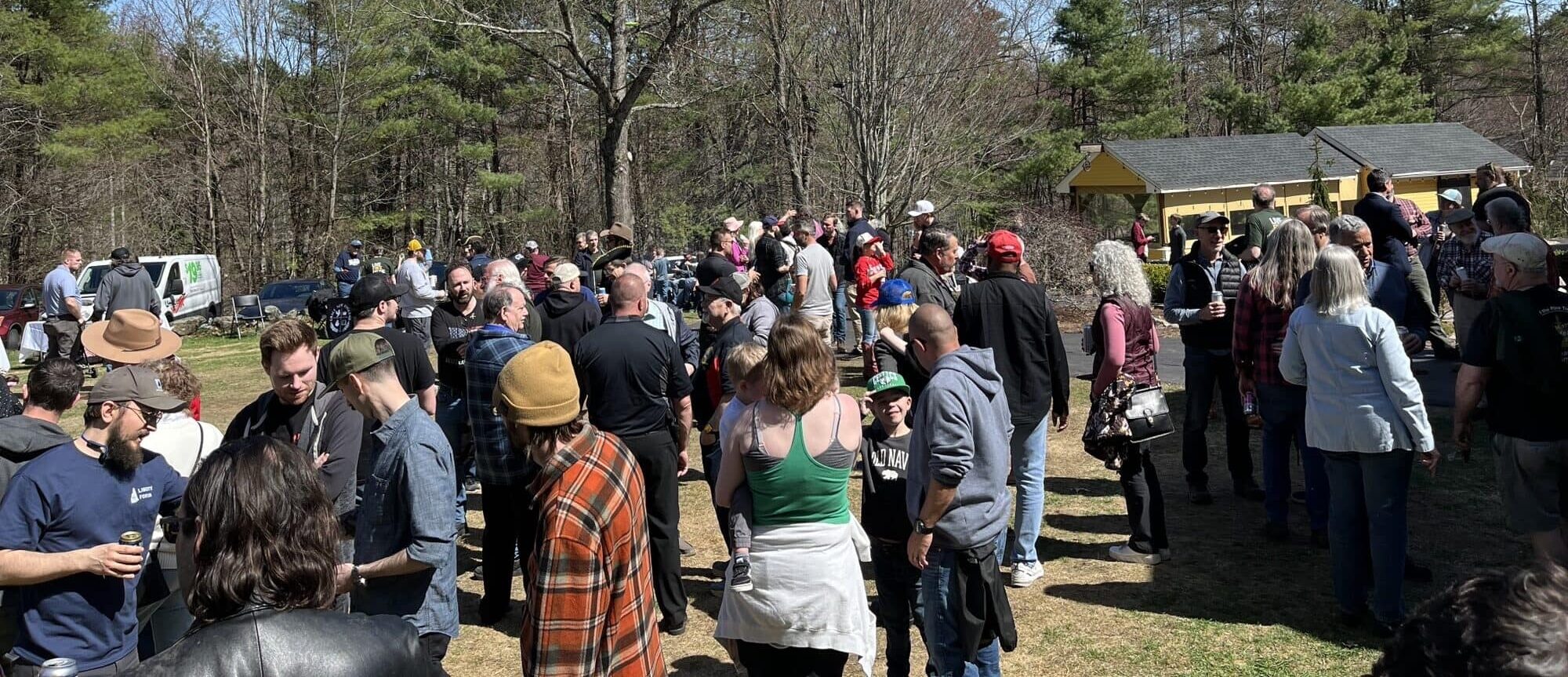 The Pine Tree Riot commemoration in Weare, N.H., on April 18, 2026.
“The pine tree has become such a powerful symbol of defiance, a reminder to all of us that free people do not bow down to far away rulers who try to say, ‘Hey your stuff is my stuff,’” Osborne said.
The Pine Tree Riot wasn’t New Hampshire’s only significant contribution to the Revolution.
One year after the Boston Tea Party, Paul Revere rode up to Portsmouth to warn John Langdon and the Sons of Liberty that the British might reinforce Fort William and Mary on New Castle Island. As a result, some 400 men stormed the fort, overpowered the six British soldiers stationed there, and seized 97 barrels of gunpowder.
It was the first organized, large-scale armed attack against the British Crown. Much of the gunpowder captured during this raid was later used by the colonial militia during the Battle of Bunker Hill.
The Crown’s appointed governor, John Wentworth, fled his home in Portsmouth six months later.
“We were abandoned,” Moore said of the Royal Governor’s departure. “They left us, because we were considered to be as a state ungovernable.”
On January 5, 1776, New Hampshire became the first colony to declare independence from Britain and enact its own constitution.
The motto “Live Free or Die” did not yet exist in 1776, but that freedom-fighting spirit animated the colony. Boston and Philadelphia often get the most credit for their role in the Revolution, but if you look at Massachusetts and Pennsylvania today, it’s clear the 1776 spirit lives stronger in the Granite State.
The pine tree is an enduring symbol of liberty. There aren’t many flags with bags of tea.
“The only reason why the ‘Rebellion’ at Portsmouth and the ‘Boston Tea Party’ are better known than our Pine Tree Riot,” wrote Weare historian William Little in 1888, “is because they have had better historians.”
This story was originally published by the NH Journal, an online news publication dedicated to providing fair, unbiased reporting on, and analysis of, political news of interest to New Hampshire. For more stories from the NH Journal, visit NHJournal.com.