Business & Tech
New Rail Study: New Jobs, Up to $256M in Startup Costs
Next stop for New Hampshire commuter rail extension plan: More studying and figuring out on how to pay for the capital, operating costs.


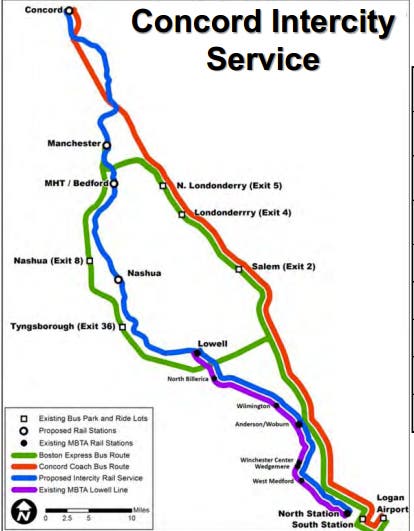
The preliminary study by the New Hampshire Capitol Corridor Rail and Transit is out and after two years of looking at extending rail from Massachusetts to Concord, the information available is pretty much what everyone expected: A new rail line might bring “significant” economic benefits to the state of New Hampshire but it’s going to cost a lot to get started.
The report estimates that establishing four commuter rail stops between Nashua, Manchester, and Lowell would add a minimum of about 2,500 new passenger trips per day, would create about 5,600 permanent jobs, and 3,600 new housing units in the area, as well as new jobs and housing annually created after the rail system begins operation in 2020.
Capital costs to upgrade rail beds, construct the stops, and other expenses between Manchester and Lowell would run about $246 million initially with about $11 million in maintenance and operating costs annually.
Find out what's happening in Bedfordfor free with the latest updates from Patch.
The system would be an extension to the existing Massachusetts Bay Transit Authority (MBTA) system and would be operated by a vendor bidding to run the service.
Extension into Concord, however, gets a bit tricky.
Find out what's happening in Bedfordfor free with the latest updates from Patch.
According to the study, another 946 passenger trips would be added with a potential of another 3,700 jobs created in the capital region. However, only Amtrak – not the MBTA – has access rights to the Pan Am system between Concord and Manchester, meaning that if the rail line were extended to Concord, there would be higher operating and sharing costs because the entire line would have to be run by Amtrak.
The capital costs would be an additional $10 million for upgrades with $8 million additional annual operating and maintenance costs. There would also be fewer trains – about eight trips a day – between Concord and Boston whereas Manchester to Boston would see about 34 trips per day.
The annual cost per rider to the state of New Hampshire would be as low as $10 per rider with just the extension to Manchester to $61 per rider for the extension to Concord, according to the study.
The study is also looking at other options including expansion of express bus service routes and highway shoulder construction, a Nashua loop to Lowell, an MBTA extension from Lowell to South Nashua, and bus lanes along I-93.
“There is simply no economic development opportunity on the horizon that could transform New Hampshire’s economy like the expansion of passenger rail could offer,” said Thomas Mahon, chairman of the New Hampshire Rail Transit Authority. “While preliminary, these initial results demonstrate the positive impact rail could deliver to New Hampshire. Once the final report is submitted in December, policy makers will have all the evidence they need to make a choice. We firmly believe that the options are clear – invest in passenger rail or choose the status quo and face the negative consequences associated with our young people fleeing the state while our existing population ages and in-migration continues to decline.”
In a statement, U.S. Rep. Ann McLane Kuster said she was “pleased” by the findings and she looked forward to learning more about various options for rail lines in the future.
“I remain committed to working with my colleagues in Congress to provide support and funding for expanded transportation options across our communities,” she said. “We must continue to invest in our public infrastructure in order to support our local businesses and help our economy grow.”
- To read the report brief in .pdf, visit the New Hampshire Department of Transportation website
- Here is a link to the New Hampshire Rail Transit Authority website
- Here’s the AP’s story about the report: New Hampshire rail study outlines costs, benefits of expanding service to Concord, Manchester
- New Hampshire Public Radio also has an audio report here: Capital Corridor Rail Study: Rail To Manchester a Good Deal, Concord Only So-So
What do you think? Is it time to bring commuter rail back to the central part of New Hampshire? Leave a note in the comment section.
Get more local news delivered straight to your inbox. Sign up for free Patch newsletters and alerts.