Health & Fitness
Bill McKibben Sees Climate of Change in Local Food Movement
Eco-activist author Bill McKibben speaks about how global climate change and Washington politics affects the local economy, but how the local economy could also be the impetus of change.


350: More than a just a number
On October 17th, 2009, Maldivian President Mohamed Nasheed and the ministers of his cabinet held court 16 feet below the surface of the Indian Ocean. In the presence of a dying coral reef, they communicated via writing slates and hand signals as they ratified a resolution to do their part to reduce the amount of carbon dioxide in the atmosphere to 350 parts per million (ppm) and to make their country carbon neutral by 2020.
350 PPM is no arbitrary figure: numerous studies and leading climatologists agree it’s the safe upper limit for CO2 in our atmosphere. Two hundred years ago, before the Industrial Revolution, the amount of CO2 in the earth’s atmosphere was well below that level, at 275 ppm. Today, we’re at 392 ppm and adding two ppm every year.
Find out what's happening in Exeterfor free with the latest updates from Patch.
That’s a frightening figure for the citizens of the Republic of Maldives, a country situated on an archipelago located off the coast of India that sits barely five feet above the ocean. After all, more carbon dioxide means more global warmer and rising sea levels. It’s so frightening in fact that President Nasheed has reached out to the governments of nations like Sri Lanka, India, and Australia about the possibility of buying land for his people to live on should the islands become uninhabitable.
Nasheed’s foresight stands in stark contrast to attitudes among politicians in the U.S., many of who act as though the jury is still out on the science behind global warming. A small victory when considered in the context of the global climate crisis, Nasheed’s underwater summit nevertheless served as an important reminder about the perils of a warming climate, and helped to propel New England’s own green author and activist Bill McKibben into the global spotlight.
Find out what's happening in Exeterfor free with the latest updates from Patch.
The Maldivian resolution was presented at the 2009 U.N. climate change summit in Copenhagen, and was the first response to a call-to-arms issued by 350.org, the advocacy group founded by McKibben. Within one week of the undersea signing ceremony, people in 181 countries responded by holding a mind blowing 5,200 simultaneous 350-themed demonstrations, the largest ever coordinated rally of any kind.
Global Warming, Local Impacts
On Janurary 27th, McKibben addressed a standing room only crowd at the Congregational Church in Exeter, NH. His resume may be draped in a bouquet of scholarly laurels, but he lived up to his reputation for boiling down complex topics. McKibben’s first book, The End of Nature, was published in 1989 and is widely recognized as the first book to introduce climate change to a general audience.
“This is a different planet,” said McKibben. “We’ve moved out of that 10-thousand years of benign climatic stability that undergirded the rise of human civilization and we’re moving into something else. The only question is how far into it we’re going to move.”
As a Vermont resident, McKibben has witnessed first-hand the devastation that global warming can inflict. Last summer, Hurricane Irene brought torrential rains to the Green Mountain state, which caused rivers to swell and crippled the farming community.
“The showcase of Vermont’s local agriculture is a place called Intervale, an old city dump,” McKibben began. “It’s 120 acres, divided up into 10 farms. You can apply and you get to farm a plot for three years, learn your trade, and build a market. Then you go off and farm on your own. It’s a like a battery, and it supplies 10% of the fresh food to Burlington.
“When Hurricane Irene came and dumped all that rain on Vermont, it was by far the largest natural disaster we’ve ever had,” he said. “Bridges that had been there for 200 years, those covered bridges taking everything that nature had to throw at them, washed away down the river. And at Intervale, nothing got harvested there this year. The flood plain of the Winooski River was under six, seven, eight feet of water.”
McKibben explained that, statistically, it’s extremely unlikely that a new record for a single day of rain could exceed the old by more than one percent, wherever you are. Due to unique geography and weather patterns, tropical storms that make their way up the east coast are frequently corralled into Vermont skies. This unexpected bond between Caribbean and New England weather increases Vermont’s rainfall – sometimes by 25 or 30 percent.
“I was really taken aback by the human toll,” commented one audience member, Dave Anderson of Portsmouth, after the event. Anderson works as Assistant Director of the Green Alliance, a local organization that works to connect eco-conscious businesses and consumers using a unique combination of discounts and storytelling.
“McKibben’s words serve as a potent reminder of the fact that global warming is real and these increasingly massive storms that form in much warmer climates do have an impact on our local economy,” he said. “And, likewise, our local economy can have an impact on what happens globally.”
Mr. McKibben goes to Washington
Although much of the debate about our access to oil revolves around our country’s tumultuous relationship with the Middle East, only 18 percent of U.S. oil imports come from the Persian Gulf while 25 percent comes from Canada. This trend is in large part a result of TransCanada’s Keystone Pipeline, which transports oil from Alberta to refineries in Illinois, before it heads on to a distribution hub in Oklahoma.
Not all oil can be found in liquid form, waiting in underground wells to be drilled and tapped. Canada is rich in another form of oil: bitumen. But bitumen isn’t exactly oil. It’s solid and is only found mixed in with clay or sand, earning it the nickname “tar sands.” Even after excavation, bitumen must be extracted and refined into synthetic crude oil through an expensive, lengthy and highly inefficient process.
“It’s disgusting,” said McKibben. “If you have Google Earth you can look at it quite easily. It’s probably the biggest manmade feature on the planet now. They’ve only got three percent of the oil out of these tar sands, but they’ve already moved more earth than they moved to build the Great Wall of China and the Suez Canal and the ten biggest dams on earth. It’s insane.”
By 2011, when TransCanada proposed to expand the pipeline down to the Texas and the Gulf of Mexico as part of a project dubbed “Keystone XL”, McKibben and his friends at 350.org had had enough.
“We’d been spending our passion and spirit and creativity, and that’d gotten us a pretty good ways, but not far enough. We thought we’d better spend our bodies, too,” said McKibben. “So we wrote a letter and sent it out as far and wide on the Internet as we could and we said ‘Come to Washington, prepare to get arrested.’”
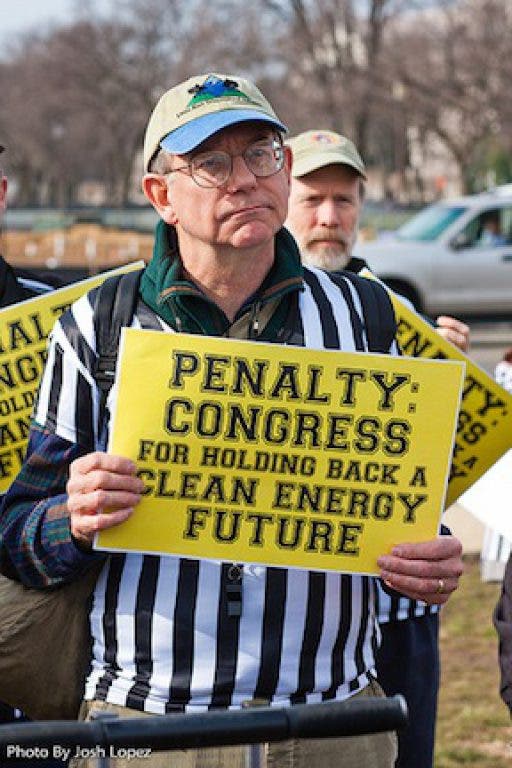
As it turned out, 1,253 of the people who joined McKibben in the nation’s capital to camp out and protest the Keystone XL oil pipeline were arrested over two weeks. That’s a huge success for any activist, but it didn’t end there. 350.org called for an even larger protest, and on November 6th, 2011 over 12,000 people showed up. Together, they joined hands and circled the White House, five bodies deep, imploring President Obama to follow through on his campaign promise to “end the tyranny of oil.”
And it worked. President Obama first decided to delay his decision on Keystone XL, effectively killing the project for the near term. Republicans in the U.S. House of Representatives then intervened, voting 234-193 to demand Obama announce his decision on the oil pipeline within 60 days. The President responded by rejecting the Keystone XL proposal in January, stating that not enough time had been giving to understand the potential impacts of the project on public health and the environment.
McKibben’s victory brought into sharp focus the polluted nature of politics in America today. The 234 members of Congress who attempted to force approval of the Keystone XL oil pipeline have collectively taken $42 million from the fossil fuel industry. Jack Gerard, President and CEO of the American Petroleum Institute, stood before Obama and threatened “huge political consequences” if the pipeline was not built.
“Bill made it clear that it’s in nobody’s interest for corporations to fund congressmen,” said Micum Davis, owner of Cornerstone Tree Care in Portsmouth. “He suggested our representatives have to wear coats like NASCAR drivers with corporate logo patches on their jackets and it would show who’s paying their way to congress.”
“I spent a lot of years thinking that the way we were going to get change was the logical, rational way,” said McKibben. “That we would have our scientists explain, over and over and over again, to our political leaders that the most dangerous thing that ever happened was happening and that they would do something about it. That’s how the system should work. That would make a lot of sense. But we didn’t realize that the fossil fuel industry would be bellowing in their other ear, this kind of toxic mix of threats and promises.”
“We’ve got to stop playing defense,” McKibben explained. “We’ve got to play offense for a while, match the power of those guys. It will only happen if we’re willing to be involved.”
Putting the “culture” back in agriculture
Weaning off of fossil fuels means more than just driving electric cars and installing solar panels, according to McKibben. It means a cultural shift from the bottom up.
“We’re beginning the work of reknitting back together the kind of communities we sacrificed over the past five or six decades,” he said. “Those five or six decades were spent under the understandable delusion that what we wanted most to do in our society was build big houses farther apart from each other, that that would constitute the American Dream. And that particular dream turned out to be environmentally ruinous. It’s why we pour more carbon into the atmosphere than anybody else will ever come close to. And it also turned out to be socially ruinous.”
“The pollsters have asked Americans ‘Are you happy with you life?’ every year since World War II. The highest percentage of Americans answering ‘Yes’ to that question came in 1956 and went downhill since,” he noted. “Only about a quarter of Americans today will answer ‘Yes’.”
One way to reclaim our happiness and save the planet at the same time is to reconnect with our nation’s agricultural roots, McKibben problaimed.
The USDA reported a 17% increase in the number of operating farmer’s markets across the country from 2010 to 2011. That number has been increasing steadily every year from 1,755 in 1994 to 7,175 in 2011. Concerns about health problems related to factory farming methods and rising costs of transporting food across continents and oceans are just part of the reason why.
In a study titled “Home Grown: The case for local food in a global market,” sociologist Brian Halweil reported that people have ten times as many conversations at a farmer’s market than at supermarkets. That’s a meaningful figure in today’s world, where despite the illusion of being more connected through online social networks like Facebook, the average American has only half as many friends as they did 50 years ago.
“It does not surprise me that we are starting the search to come back together again,” said McKibben.
McKibben’s message rang true with many members of the audience, many of whom own local businesses and frequent local farm stands.
“People are not just sitting around waiting for politicians to act,” said Anderson. “There’s this huge shift towards buying local these days. The Green Alliance is just one example of how small businesses are joining together to keep money in our local economy. And when you buy local, you almost always end up being more green.”
And changing the buying habits of many, little by little, does add up.
“We’re beginning to see the next thing in our society starting to take shape,” said McKibben. “And it’s really beautiful to see it happening. You couldn’t have predicted it a little while ago.”
To help lower the amount of carbon in the atmosphere, visit 350.org
Learn about what your local businesses are doing to keep things green and local at:
Support your local farmers at www.nofa.org