Health & Fitness
Brixham Montessori a Template for 21st Century Education, Green Awareness
More than 12 years on, Brixham Montessori Friends School -- located in York, Maine -- continues to grow, thanks to a unique, and green-tinged, educational philosophy.

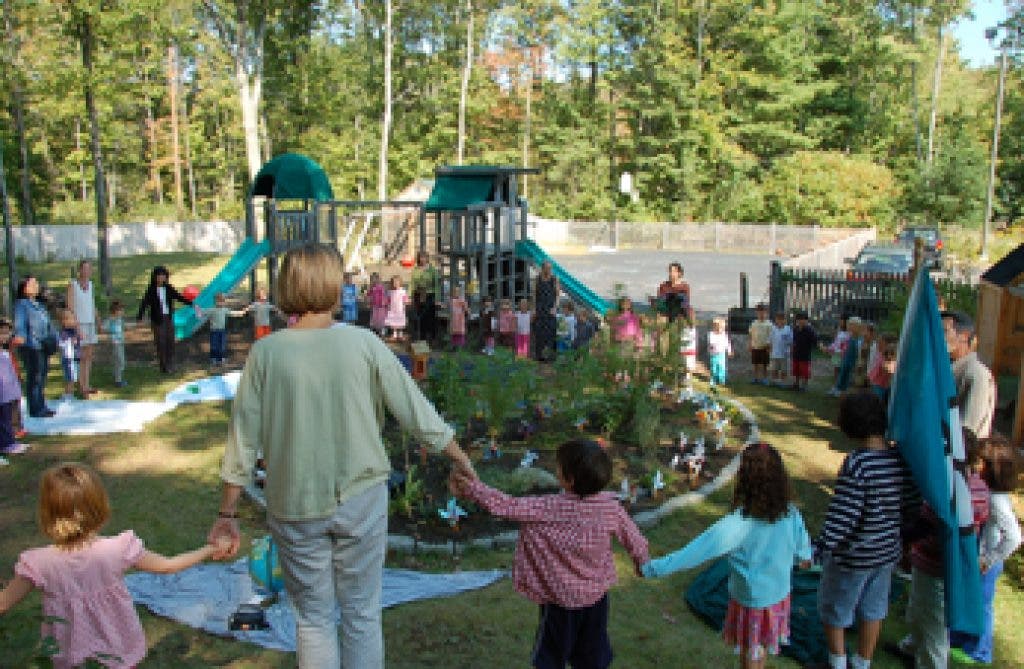
Eager to expand her growing Orchard Montessori Friends School, in 2000 Alica Johnson-Grafe took over a turn of the century historic grange hall in York, Maine. Rechristening it Brixham Montessori Friends School (BMFS), Alica – with the help of a group of dedicated parents – established the school as a nonprofit in 2001. Five years later, the space now fully outgrown, BMFS purchased and moved the school to a two-story, 9000-plus square foot building in York previously owned by a small software company.
After weeks of wall-tearing and shape-shifting, the space was transformed into what it remains today: A simple yet sense-piquing testament to a career’s work and philosophy, and the educational tradition from whence it sprang. As of this past school year, Johnson-Grafe’s thriving charge boasts 85 students, six classrooms, and a staff of 18 educators dedicated to helping the thriving school continue to serve as a regional model for alternative childhood education.
For those unfamiliar with the movement, Montessori has its roots in the late 19th century, when Maria Montessori first developed her educational model pivoting on ideals of auto-education, independence and responsibility-guided freedom. Instead of bureaucratically regimented classrooms, stock textbooks, and curricula tailored primarily towards test preparation – the big box store model, if you will – Montessori schools, and Brixham in particular, seek to provide more community-oriented, dynamic experience. Such distinctions are apparent as soon as you step inside the school’s front door, where on the other side you can’t help but feel you’re inside a home – a child’s dream home at that – arather than the brick and mortar primary schools of our youths.
Find out what's happening in Exeterfor free with the latest updates from Patch.
Inspired in equal measure by Montessori and the Quaker-inspired Friends movement, Johnson-Grafe – who alsocites her degree in Family Studies and experience attending a quaint, six-grade school in rural New Hampshire as major impetuses for her eventual educational path – says she wants her school to be a beacon of simplicity, equality, community, and peace. While public school systems around the country struggle with the fallout from ever-ballooning class sizes, Brixham’s 7:1 student-to-teacher ratio assures that ever student gets the attention, and the creative encouragement, they deserve.
“It goes beyond just having small classrooms,” explains Johnson-Grafe in a voice at once calming and assured. “It’s also about having a classroom that’s multi-age, so you’re spending several years with the same teacher and developing a real relationship that allows the student to grow at his or her own rate. We think it’s a model that serves the children well.”
Find out what's happening in Exeterfor free with the latest updates from Patch.
While taking a tour of the Brixham grounds, it’s impossible to not be charmed by the sense of play hanging in ever nook, from the open, light-filled classrooms and common areas to the spritely woodlands surrounding the school. Indeed, this is not the playground of your typical public school, where activities are often sequestered to blacktop, woodchips, or cut grass.
“We’ve installed smaller gardens, but we’re excited by the idea of putting a more expansive one where that open space is right now,” exclaims Johnson-Grafe, pointing to a sunlight knoll no more than 20 yards from the school’s six-resident chicken coop.
The thought of children running around the same grounds as chickens may make some parents do a double take. But, as with many of her school’s unconventional ways and means, Johnson-Grafe says it’s as much about educating Mom and Dad as it is fostering their charges.
“What would you rather have: the chickens eating the ticks and bugs, or us having to spray the sensitive ecosystem with chemicals to keep the bugs away?” Johnson-Grafe asks, in a manner that’s more assured than simply rhetorical. “Like a lot of things here, it’s a natural solution.”
To be sure, Brixham’s eco-consciousness doesn’t start and stop with their flock of feathered bipeds. Whether they’re composting (some of which they use to feed the chickens, it should be noted), recycling, or infusing their curricula with environmental overtones, the Brixham staff is constantly aiming to develop the next generation of green-minded citizens.
Of course, all the familiar courses and classes – math, language, fine arts, music, as well as before and after-school programs – are at the fore. They’re just conducted, well, differently.
“We pride ourselves on a well rounded program designed to nurture ‘the whole child,’” explains Johnson-Grafe. “How can you do that when you have one teacher responsible for 20 or 25 students?”
Class size. It’s one of the chief issues at the forefront of the education reform movement. But where local funding issues have caused student-teacher ratios to trend gradually upward, many private schools are managing to sustain or even reduce class sizes, and in some cases even expand. That’s exactly the case with Brixham, which Johnson-Grafe says will add an upper elementary program – grades 4-5 – next fall.
By then, Johnson-Grafe will have new students – the school’s already booked solid for the coming school year, which lasts from after Labor Day until mid June – and educators eager to teach them. More importantly, she’ll be that much closer to proving the efficacy of a movement grown more and more popular, and more and more in tune with a public increasingly jaded by the lack of educational options.
“There have always been misconceptions about Montessori – it’s as if people think the children are allowed to do whatever we want. That’s just not the case,” says Johnson-Grafe. “Of course children need structure and lots of consistency and predictability, but they also need ownership of their learning, so they’re not just waiting for the next thing to do.”
A cursory scan of the first floor classroom where Johnson-Grafe now sits – the recycled toys, bountiful books, and myriad stations of creation at once leaving little to the imagination and giving everything to it – makes it clear that, at Brixham, “waiting for the next thing to do” is seldom, if ever, a problem.
Learn more about Brixham at www.brixhammontessori.org