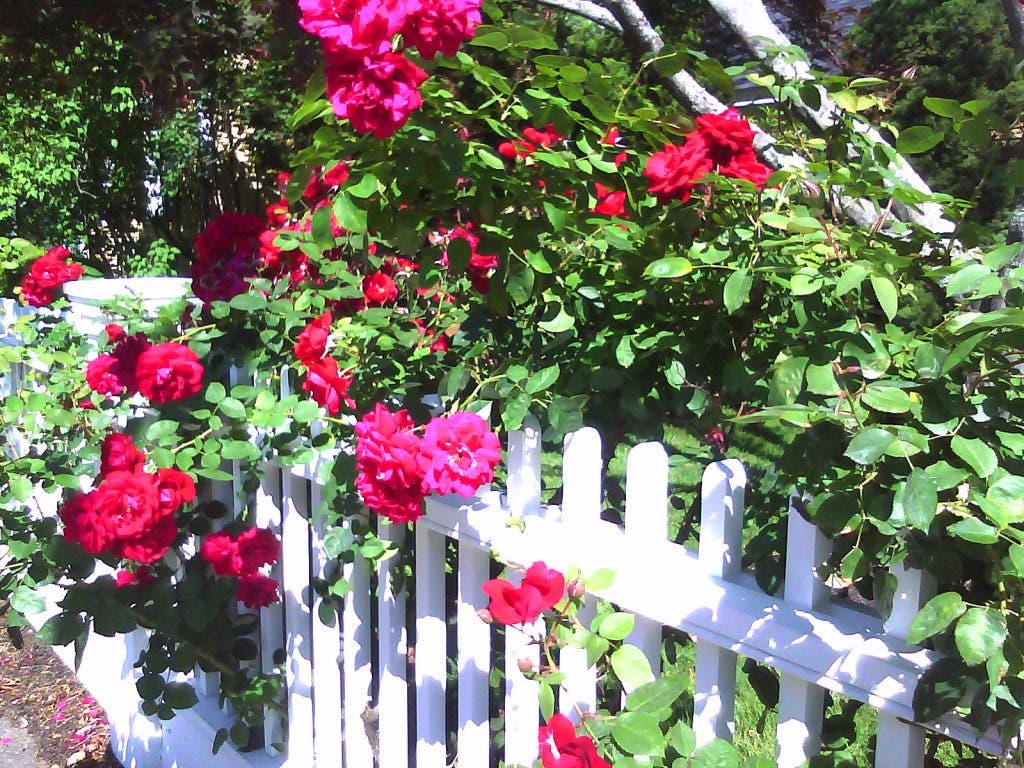
The roses on Front Street are blooming. Have you been by to see (and smell) them?
You know which house it is—the yellow colonial a few doors up from Phillips Exeter. The one place in town where, when we all begin to think winter will never be finished, the first daffodils push their way up through the leaves and open their sunny faces in defiance.
Find out what's happening in Exeterfor free with the latest updates from Patch.
As I walked past the other day admiring the garden, it occurred to me that it was really there for me, for you, or for whoever happens to wander by, but the garden wasn't really for the homeowners themselves. Every window facing the street (and the roses) has a drawn shade or closed shutter, so no one who lives in the house can enjoy these seasonal celebrations.
As I walked on, I noticed this was true of many houses and their respective gardens and yards. Colorful window boxes, blooming trees, tirelessly planted fields of blooming bulbs, rambling vines and myriad flowers were on display to the public, but barely visible to the occupants inside. It stuck me as a lot of work for the benefit of strangers. But then I remembered why they do it…
Find out what's happening in Exeterfor free with the latest updates from Patch.
When I was in graduate school in Maryland, my classmates and I conducted a study to determine whether poverty rates were an accurate indicator of neighborhood quality. According to the Department of Housing and Urban Development (HUD), they are the only indicator and a lot of important policies are based on this assumption. For a poverty riddled city like Baltimore, that meant thousands of people who received housing assistance were excluded from living in a large number of perfectly lovely neighborhoods—including the one in which I lived—because the poverty rates were too high.
So my classmates and I fanned out over the city with our clipboards and a checklist of physical characteristics we thought might be better indicators of neighborhood quality. We looked for things like the presence of working street lights, the amount of litter in the streets and on the sidewalks, the condition of the roads, and yes, you guessed it: gardens, window boxes and mowed lawns. In other words, curb appeal.
One of the neighborhoods I surveyed had more than 50% of its population living below the poverty line, but we ranked it as one of the nicest neighborhoods, in large part because of its high scores in the curb appeal category.
Residents cut the grass, planted window boxes, weeded their gardens, picked up trash that blew into their yards and generally put their best face on for the street. The efforts of one person inspired the next. The love and care they put into their properties demonstrated their commitment and connection to both their neighbors and their community. It was somewhere we’d all have been content to live.
Now as I walk, drive, ride or run past a particularly lovely hanging basket, a bed of daylilies by the curb or roses climbing on a white picket fence, I am grateful to each of you for taking the time to put your best face on for the street and to make sure your house has curb appeal.
I appreciate your commitment to our community. Keep up the good work.
And please let me know if you need help weeding.