Choosing the right college is one of the most important decisions a young adult makes. For prospective students who work hard, and take advantage of local resources, they truly can be in a position to “choose” their college.
Broadly speaking, there are two key points of control during the college admissions process: academic performance and the application itself. If your child still has a few years to go before college, encourage them to take a challenging course load and to not settle on lower-level classes. It’s better to fall behind and have to get extra help from a teacher or tutor than to float through high school taking easy classes.
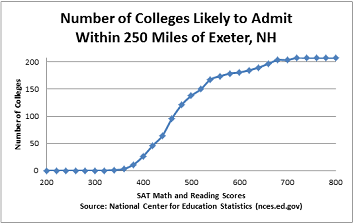
Even if your child’s academic record isn’t perfect, he or she still has a chance to shine via standardized testing. That’s right: encourage your child to view the SAT as an opportunity and not a burden. A higher SAT score can open doors for your child. The accompanying graph illustrates how the number of 4-year colleges likely to admit increases dramatically with even a small increase in score. Local SAT prep courses and private tutoring are offered by Knowledge Roundtable throughout the year.
Now to the second point of control during the admissions process: the application. Long gone are the days when students fill out each application by hand, meticulously choosing their ideal schools. Today, many colleges (but not all) use what is known as The Common Application. This is a universal application that allows students to submit their credentials to as many schools as they want. The upside? It allows for a more streamlined application process, ultimately allowing students to apply to more schools. However, as a result, colleges now receive more applications per available seat than ever before. This drives admissions officers to be ever more scrutinizing.
Find out what's happening in Exeterfor free with the latest updates from Patch.
So start planning early to ensure that your child’s credentials will make the cut. Class rank, course selection, level of difficulty, and the number of years each subject is taken are just some of the factors that may make or break a student’s application. Extra curricular activities, teacher recommendations, and a personal essay can offer admissions officers a glimpse into the student from a character-based perspective, and should be leveraged to demonstrate your child’s unique character and how it will contribute to the diversity of the campus.