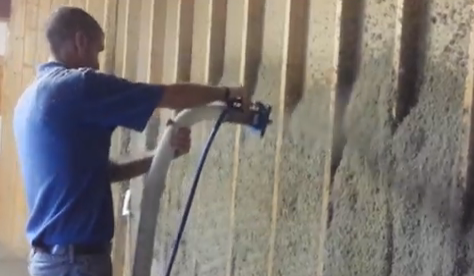
For all the recent strides made in the realm of home energy efficiency – and there are many – the development of new, ultra-green insulations has been one of the most impressive.
But while resources like solar, wind, and geothermal remain the green revolution’s eye-catching totems, there’s a growing recognition that true energy efficiency begins with what’s lining the home’s walls, nooks, and crannies – the “envelope”, in green-speak.
“It’s sort of ‘out of sight, out of mind,’ but people are starting to realize how important having the right kind of insulation can be,” explains Candace Lord, General Manager for The Green Cocoon, Inc., a Salisbury company specializing in green insulation alternatives. “If heat or cold is escaping from your home at a high rate, what difference does having solar panels on your roof make?”
Find out what's happening in Exeterfor free with the latest updates from Patch.
For years, the insulation industry found itself playing catch-up on the green calculus front: while homeowners could offset the costs of alternative energy systems by way of federal and state tax credits and rebates, the middle road between maintaining that old, tired pink insulation and installing a hyper-efficient green alternative was far more slight.
Not anymore.
Find out what's happening in Exeterfor free with the latest updates from Patch.
“We’ve been pretty lucky to have started and grown just as the range of insulation options has expanded,” Lord says. “People no longer have to go all-in or not at all.”
Lord is particularly excited about her company’s newest option: RockWool insulation. Manufactured by US Fireproofing, RockWool represents a revolutionary industry nexus of sorts, where safety, efficacy, and green bona fides are all meticulously balanced.
“It’s incredibly fire-resistant, and contains sound really well, which can be a rare combination,” Lord notes. “But the big thing is how green it its. That’s what we’re trying to sell.”
Trying and succeeding.
Epitomizing the mantra of “right place, right time,” The Green Cocoon was launched in 2007 by plastics engineer Jim Materkowski and his business partner, the late Peter Strattner, both of whom saw in the ever-growing green insulation industry room for a company committed to more options. In the six years since, the company has grown to include a wide range of green insulation options including spray-foam made from soy beans and recycled plastic bottles, BATT insulation made from recycled denim, as well as a line of cellulose insulation made from recycled newspapers.
Not only doe spray foam remain the top green option on the insulation market; it also boasts a host of residual benefits – offering air and vapor barriers and hurricane-grade strength that helps make it the ideal option for coastal-lying buildings. Indeed, all of Green Cocoon’s options boast their own unique qualities – qualities that meet the highest standards of durability and green quality.
In the dozens upon dozens of projects they’ve spearheaded – some small, others impressively large – the folks at Green Cocoon have used them all. Lately, however, Lord and Materkowski have found themselves striking a happy balance between the pricier closed-cell spray foam and its more cost-effective kin.
Just last month, a local green contractor, Eco Sound Builders, commissioned the Green Cocoon to install a mix of sprayfoam and recycled newspaper-based cellulose in a early 19th century farmhouse in Rye, New Hampshire. Though the project proved quite the formidable renovation, Green Cocoon was able to weave a common, green thread between the home’s two functionally disparate wings.
“When we first came on to the project, we thought it was going to be fairly small,” recalls Green Cocoon’s Candace Lord. “But as the scope of the project got bigger and bigger, it was clear that they needed something more comprehensive. Which was a challenge. A fun challenge, but still a challenge.”
According to Lord, balancing closed and open-cell insulations depends on two factors: the depth of the home’s rafters and bays; and the desired R-Value, or the wall’s thermal resistance. Because many older homes tended to feature 2x4 boards, achieving an R-value of 30 – which is quite high – means you’d have to use the tighter, more expensive closed-cell spray foam. If the home is new or has otherwise incorporated 2x6s, 2x10s, or 2x12s, the ratio of open to closed cell can be adjusted, and more affordable.
“More new homes are using the deeper plies, so people have more options,” Lord says. “It’s just another example of how the building industry is starting to prepare more for possible energy efficiency upgrades.”
Indeed, Lord credits the recent popularity surge in green insulation to a growing recognition that the up-front cost – itself getting more and more competitive all the time – is more than made up for in down the road savings.
“The fact that we can grow and thrive in this kind of economy is pretty encouraging,” says Lord. “I think people are finally starting to grasp the big picture.”
Learn more about The Green Cocoon at www.thegreencocoon.com
For more info on Green Alliance, visit www.greenalliance.biz