Politics & Government
Rubens: Constitutional Convention Needed for Balanced Budget Amendment
The ONLY path to a BBA is through the state-led amending process laid out in Article V of the Constitution.


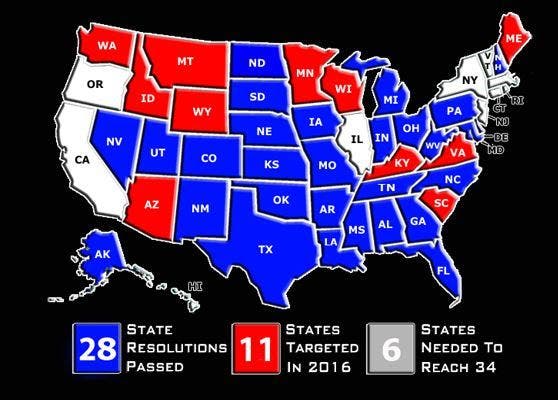
Now would seem to be a perfect time for Republicans to stand tall for fiscal sanity. Our federal government is almost $20 trillion in debt … $100 trillion underwater long-term. We are at or near the peak of an economic cycle, so there is no justification for counter-cyclical Keynesian stimulus.
And thankfully, Republicans control the Washington agenda.
But Washington Republicans are well known for talking balanced budgets, then voting for more spending and more debt to satisfy interest groups and to stay in power. You don’t need to be a cynic to know that there won’t be any credible proposal from Republican leadership for a balanced budget for any of the coming eight years (Credible for me means a budget with no one-time gimmicks, no debt increase and no net tax increase).
Find out what's happening in Exeterfor free with the latest updates from Patch.
This is why I support a balanced budget amendment to handcuff the big spenders and debt addicts in both parties. Because of Nancy Pelosi and progeny, Congress will never reach the minimum two-thirds threshold to send a BBA to the states for ratification. In their remarkable wisdom and knowing the potential for corruption and self-interest by Congress, our Constitution’s framers voted unanimously to include a second and never-yet-used path for amendments. The ONLY path to a BBA is through the state-led amending process laid out in Article V of the Constitution.
The legislatures of 28 of the needed 34 states, including New Hampshire, have already adopted the needed BBA resolutions. With six states to go and the GOP in control of the legislatures of 33 states (the most in almost 100 years), BBA backers are bullish about reaching the two-thirds threshold in 2017. Here is how a state-led convention to propose a BBA would work.
Find out what's happening in Exeterfor free with the latest updates from Patch.
As required by Article V and by practice during the 260-plus pre-constitution multi-state assemblies and state-level constitutional conventions, Congress will set a date and location for an amending convention limited to the subject of federal fiscal restraint. The legislatures of the 50 states will appoint convention delegates in any number, with each state having one vote during the convention process.
Delegate proposals and debate during the amending convention will be limited to the subject of the state resolutions launching the BBA process, that is, federal fiscal restraint. If delegates are able, they will agree upon specific BBA language. Delegates will weigh the various conceptual approaches to federal fiscal restraint, ranging from Congressional supermajority or state legislative approval for deficits; spending and taxing limited to an economic and population growth formula; or a constitutionally fixed federal debt limit, with a two-thirds Congressional supermajority override (my preference). Agreed BBA language will then be sent to the states, three-quarters or 38 of which are required for ratification. This final step is our ultimate safeguard against a too-radical or unworkable BBA, because thirteen state legislatures have absolute veto power. Strangely, Democrats are not the greatest barrier to a federal BBA. Decades of polling show about 85 percent public backing for a BBA.
The roadblock is conservative activists who fear a hypothetical “runaway convention,” where a majority of delegates take up subjects not authorized by the state BBA convention resolutions. As noted, this has never happened over American history. The U.S. Constitution makes no provision for a constitutional convention where delegates can propose a new constitution.
Delegates appointed by the most Republican state legislatures in almost 100 years would have to breach their sworn oaths to defend the Constitution and abandon their personal allegiance to conservative principles. In even this exceedingly unlikely circumstance, the legislatures of 13 constitutionally-conservative states (for example, Alabama, Idaho, Arkansas, North Dakota, Utah, Mississippi, Wyoming, Louisiana, Oklahoma, South Dakota, South Carolina, Kentucky and Missouri) would all have to vote to ratify fear-mongered amendments to repeal the 2nd Amendment or subject us to United Nations rule. Talk to Mike Lee or Rand Paul if you need comfort that delegates from Utah or Kentucky will do anything less than stand at the barricades to stop this.
You can help in the fight for fiscally responsible, constitutionally-limited government by joining or contributing to one or both of these organizations:
The Balanced Budget Amendment Task Force: bba4usa.org/report/
Convention of States: conventionofstates.com/.
Jim Rubens is a former state Senator.
Get more local news delivered straight to your inbox. Sign up for free Patch newsletters and alerts.