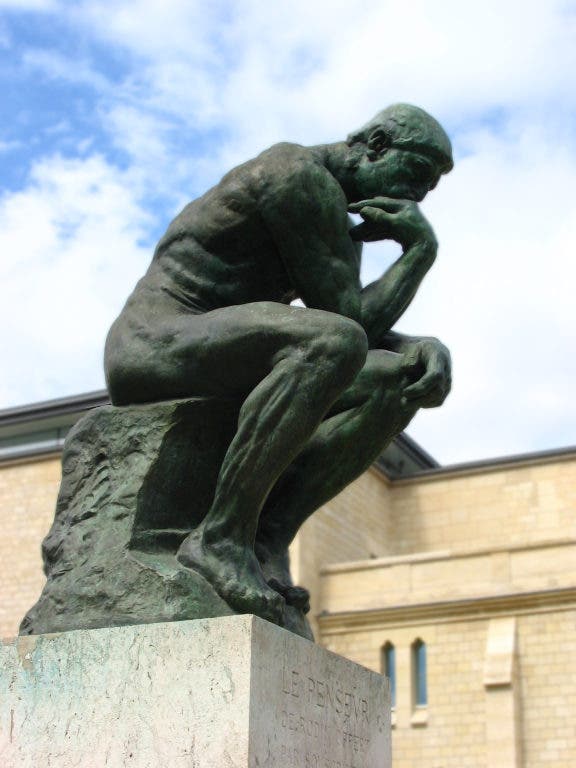
Are you a thinker or a doer? Trick question. I’m sure you consider yourself both, a kind of philosopher king/queen who’s capable of translating thought into action. We’re all tempted to believe that. But at some very basic level, you’re more one than the other. Either thought or action dominates your life, and me, I’ve always been a thinker.
It’s pretty easy to tell if someone’s a thinker, but it can be hard to admit to yourself that you are one. When you go to a party, are you the first one on the dance floor, or do you look around a bit at first to see what everyone else is doing. Do you need to analyze the situation before jumping in? When you’re contemplating a purchase, do you read infinite reviews online? Do you like retreating into your mind when you’re uncomfortable? Would you rather sit with a book and ponder sometimes, rather than go out to bars and clubs?
If you answered yes to all or any of those questions, it might be safe to say you’re a thinker as opposed to a doer. And that’s fine. You’re in good company. The mind can be an amazing place. It doesn’t conform to the dictates of the outside world. It provides us pretty much unlimited freedom. Are you an intellectual? The term has become pejorative as of late. Intellectual has become equated with egghead. Politicians and pundits from both sides of the aisle criticize “ivory tower,” intellectualism, and advocate moving funding to science, technology, engineering, and math programs, and away from “useless,” fields of inquiry, like literature, fine art, and history. In a sense, no one really wants to adopt the intellectual moniker. It marks you as out of touch. Head in the clouds. Most of all elitist, our new most hated word, in an era of “participation ribbons,” and “no one is smarter than anyone else, people are just smart in different ways.” So the question is, do you have the audacity to call yourself an intellectual? Do you have the courage? If so, then keep reading, and we’ll take a journey into our minds together.
Find out what's happening in Hampton-North Hamptonfor free with the latest updates from Patch.
To start, I’d like to say that an intellectual is no more and no less than a person who likes ideas, and thinking about them. It typically has something to do with intelligence as well, but not always. It’s easy to be condescending towards non-intellectuals, but I’d caution against it. I’ve known absolutely brilliant individuals who have exactly zero interest in the intellectual life. They go to work, do what they have to, and come home to watch T.V. And that’s fine. No one is going to force them to think if they don’t want to. On the flip side, I know many individuals who may not have intelligence in spades, but who are tremendously curious about the world around them. They ask questions. They may get Kant’s idea of a priori knowledge wrong five times before they understand it, but they want to understand it. So, to me intellectualism isn’t about cognitive superiority. Indeed, I see intellectualism as a sort of compulsion. I think people who are motivated by ideas and their consideration can’t help but be that way. Conversely, people who take little interest in such trifles can’t be blamed either. You can’t force anyone to take an interest in intellectual matters any more than you can force them to take an interest in baseball. And we should refrain from making any judgments about their intelligence or lack-thereof based on their interest in ideas.
But I am interested in ideas. Very much so. I consider myself an intellectual, and I’m proud of it. If you’re still reading, you probably are too. But what drives us? What is so inherently interesting about the world of the mind, the world of ideas? I think a large part of it is that ideas can be very beautiful. They’re pure in a way that reality isn’t. When we see an idea that squares with how we think, it’s an exhilarating experience. Have you ever read a book that so perfectly captured something you were thinking that you wouldn’t change one word, one period, one paragraph indent? To me, that’s more than just intellectualism, that’s art. Sometimes an artist gives voice to an idea we have in a way that we never could. It’s more beautiful, more refined, and more developed than what we were thinking.
Find out what's happening in Hampton-North Hamptonfor free with the latest updates from Patch.
That sense of elation when we come across a work of art like that cannot be replicated. It’s a mental high like any other. It’s also tremendously personal. Brahms’ Cello Sonata in Em so perfectly evokes a rainy day I remember from my childhood, that it seems he must have been there to write down each note as I lived it. But he wasn’t and that makes it all the more beautiful. Further, there have been countless others who have listened to the same piece, and found something completely different in it, but something no less compelling.
In order to have this type of connection with a work of art though, we have to have ideas percolating in our head. If an artist is to give voice, or expression to our deepest thoughts, we have to have thoughts to begin with. And it’s not just art that requires thought of us, if we’re to truly engage with it. If you had no opinions, reading a newspaper would be incredibly boring. But if you’ve thought about the world around you, you’ll invariably think something about that world. To me, that’s the value of intellectualism. Not the ability to remember an endless list of historical dates. Not an arsenal of literary allusions at your fingertips. Not even the ability to tell the difference between Expressionism and Impressionism. Those things are all great, but they’re just the trappings of intellectualism. They’re the symbols, that make intellectualism look nice and impressive. But the real value, is the increased enjoyment that the world of ideas brings to one’s life.
Someone who has ideas, who ponders them, and turns them over in his head, is infinitely more engaged with the world around him. He sees his ideas, or their refutation in the world. The world gives him new ideas as well. It’s a multi-directional flow of information and thought from the internal to the external and back again as each world influences the other. When you have ideas, everything takes on a new shape. You’re no longer bored reading a book, or in a museum, because everything speaks to you. Maybe not directly, and you certainly won’t agree with everything, but you’ll still be engaged, and that’s what’s important.
The United States has always had a strain of anti-intellectualism. And it’s not surprising considering our national myths. American has ever been the motley collection of individuals, on the rugged road to liberty. Our heroes are folk-heroes, clever in their own way, but not intellectual powerhouses. We’ve only ever had one president with a P.hD, Woodrow Wilson. The myth of the self-made man, the self taught man, has endured in America for generations. The frontier mentality brought with it a respect for self-reliance and rugged individualism as well. All of these are good values in their own way, but intellectualism has always been marginalized in American society as a result.
Especially in recent years, intellectuals have been pushed even further away from the center of the American imagination. The financial crisis and its associated belt-tightening across the board seriously called into question any pursuits not deemed practical. You must be crazy to be an art major, or an English major, or pretty much anything not finance, accounting, nursing, or science related. Even pure mathematics hasn’t escaped the scrutiny of “practicality.” The underlying question seems to be, that’s great that you’re interested in (whatever), but how are you going to get it to make money for you?
Look, I get it. Times are tough and people need to be self-sufficient. You need a marketable skill to compete on the global job marketplace. And I’m admittedly biased. I had two supposedly “useless,” majors. I’m a head in the clouds type of person. But it worries me to hear certain professions denigrated to such an extent. The anger I heard in people’s voices as they denounced the Occupy protestors as a bunch of layabouts who should have known better than to get an art degree, was a little unnerving. Whether or not you agree with their politics, it’s hard to justify that level of resentment. Everyday we hear calls for more engineers and more scientists. And that’s great, we need them. They make life incomparably better with their innovations. And it’s also not to say that scientists and engineers aren’t intellectuals in their own ways. However, even within the practical fields, the emphasis has been completely shifted towards practicality, and how the research can pay for itself quickly. Ask anyone in scientific research and they’ll tell you, that as government grants become more scarce, the scientific community has to rely more and more on the private sector, who demand practical results in the here and now. There’s a problem there though, in that it provides little hope for pure research. Pure research may not have a direct application now, or even ten years from now, but the theoretical mathematics of the early twentieth century became quantum physics, which has even given us quantum computers. Practicality is a very relative term.
I worry about a world that sneers at artists, poets, historians, and even scientists who look further ahead than the next few fiscal quarters. Once we devalue something enough, it eventually disappears. If no one wants it, why pursue it? Everyone needs to be valued in some way. When we devalue all these people, we’re implicitly asking for a world without artists, without poets, without writers, without thinkers, or visionaries. Without people of the mind, without intellectuals. It’s a world that’s given way to the calculators, the flunkies, the order-takers, the rubber-stampers. It’s a world that refuses to think. It’s a world that doesn’t look at itself, because it can’t. It’s become dead inside, too horrible to look at. the And that my friends, sounds like no world I want to live in.