Health & Fitness
Heroes and Traitors: America's Idols
Some thoughts on why we need heroes, and why we're unfair to them.
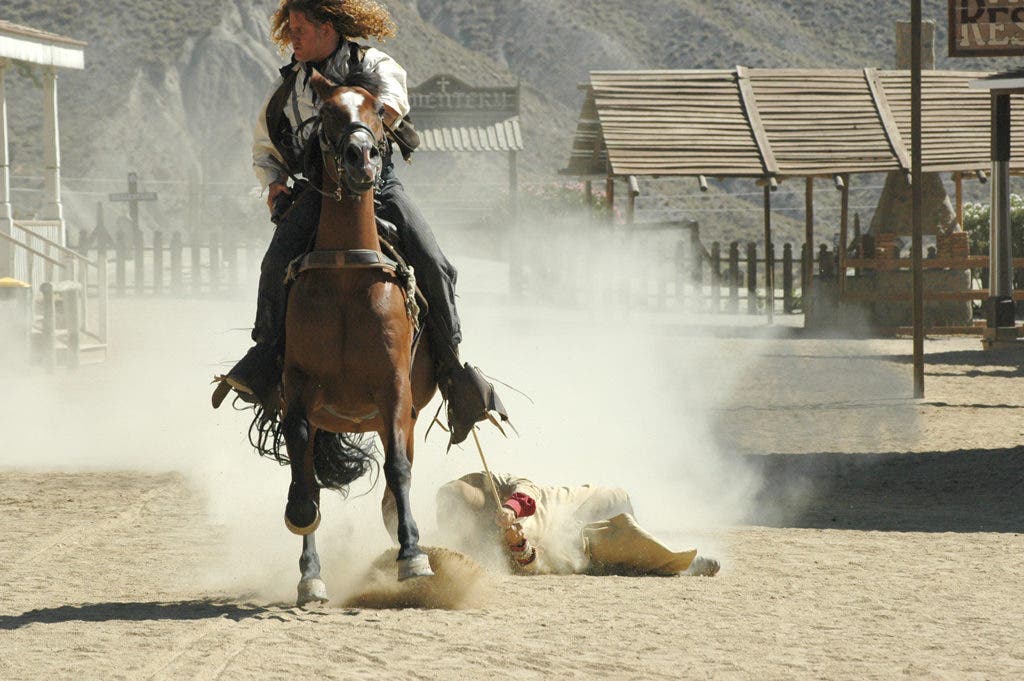
Cowboys vs. Indians. Cops vs. Robbers. Americans vs… well, pretty much everyone. When I was growing up, there were pretty clear distinctions between the good guys, and the bad guys. The world was painted in moral black and white, there were heroes, and then there were villains, and we all wanted to grow up to be heroes.
From the time I was very young, I always wanted to be strong. Like most kids, my father was my first hero. I couldn’t imagine anyone being bigger or stronger than him, and I knew I wanted to be just like him when I grew up. I wanted to be able to crush a walnut in my hand. I wanted to be able to drive a nail with one swing of the hammer. So, by age four, I was following my dad around as he did work on our house, with my own little tool belt and hammer, causing more trouble than I was worth. By five, I had decided that I wanted to become a cowboy to the extent that I refused to wear anything but boots, spurs, chaps, a vest, and of course, a pair of shiny, (plastic) pearl handled revolvers. I loved watching rodeos, the brave cowboys facing down the fearsome bulls, as the massive beasts tried to buck the rider, who held on as long as he could, and to my amazement, even kept his hat on.
I had many more heroes as I grew up. I was eight when Mark McGwire and Sammy Sosa duked it out for homerun king. I was also incidentally on the Cardinals Little League team that year, so naturally, I was entranced with McGwire, as he smashed homer after homer. I always looked up to sports figures, but I was never so entranced as the first time I saw Arnold Schwarzenegger in Pumping Iron. I was fifteen years old, and for whatever reason, that old, grainy, very 1970s documentary, spoke to me on a deep level. I had always admired strong people, and here was; what to me, looked like the world’s strongest. In one scene, before the Mr. Olympia, Arnold walks into a room filled with the other competitors. He completely owns the room. Everyone defers to him, while Arnold makes jokes, slaps people on the back, and even self- deprecates. Here was a man who was truly, larger than life, in so many ways. Of course Arnold’s physique was insane, but I was even more impressed by his personality, his confidence, and dedication. It seemed like the world conformed to what he wanted, and not he to it. To me, a powerless teenager, in the world of no license, no job, and parents who I felt just didn’t understand, this was extraordinary. For a kid like me, who felt like he had no control, to see Arnold in control of everything and everyone around him, well, it was breathtaking. I wanted that confidence, I wanted that charisma, but most of all, I wanted that power. And it seemed like all I had to do to get it was make some sacrifices, work hard, and purge myself of even the thought of failure. Arnold always harped on a true champion’s ability to go through the “pain period,” that allows him to grow bigger and stronger. I thought I was strong willed, that I could do this.
Find out what's happening in Hampton-North Hamptonfor free with the latest updates from Patch.
And so, after watching Pumping Iron, I knew I couldn’t just sit on the couch and be like Arnold. I bought some weights, and started working out in my room. I had a whole plan set out in front of me, long and short term goals, just like all the best bodybuilders said I should have. I knew I wanted to go to a real gym, but I had to make sure I was ready. After a year of working out at home, I tenuously set foot in a local gym finally. It was like Christmas morning had come, and this time, instead of visiting relatives, I could play with all my new toys as much as I wanted. I did everything that day, back, abs, chest arms, even legs. It worries me that I may never feel as good as the first time I walked out of a gym from my first real workout. The next day was a completely different story. I hadn’t really heeded Arnold’s words about the “pain period,” as much as I should have. I could barely move. Every muscle in my body ached in a way I’d never experienced before. I remember having to pick up each leg with my arms to drape it over the bed, just so I could get out and stumble to the shower. Putting on my backpack was a Herculean task, one which I had to repeat every fifty minutes as I switched periods in high school. But getting through that pain period was doable for me, because I knew that if I got through it, there was light at the end of the tunnel. I think that was probably the first time that I ever really sacrificed comfort in the short term, for a greater satisfaction in the long term. Human beings are very poor at doing that, which is what makes people with immense dedication to a goal impressive. Offer someone ten dollars today, or one hundred ten years from now, and he is most likely going to take that ten dollars today. Our brains are hardwired to take what we can while the getting is good. And that’s why heroes are so important for us. By example, they can teach us to do things that we wouldn’t normally do. In fact, that’s the definition of a hero; a deviant. Heroes aren’t normal, or run of the mill. They’re special. They’re bigger, faster, stronger, smarter than the rest. Average is a dirty word in America. Our heroes are winners, George Washington, Michael Jordan, Bill Gates. We’re all supposed to be exceptional, or “gifted,” or whatever buzz word teachers start using to describe how Billy is by far the best Lego builder in all of Kindergarten. Indeed, we’re expected to excel, to have something that makes us stand out as “individuals,” and we’re expected to achieve success no matter what.
Which is why, I think, I was most struck by Arnold’s absolute dedication to winning at any cost. At one point, Arnold explains some of his psychological tactics he uses on opponents. He plants seeds of doubt in them before the competition. He even goes so far as to give his friend and fellow competitor Franco Colombo the “wrong advices,” in Arnold’s words, helping Arnold’s cause right along very nicely. Arnold was willing to do whatever it took to win, up to and including, taking steroids as he later admitted. Now, I won’t get into the morality of taking steroids or not, especially during the 1970 in bodybuilding. However, like another of my heroes, Arnold’s reputation was somewhat tarnished by the fact that he took anabolic steroids. But the crazy thing was, these athletes were being derided for doing the very thing that we loved them for, the reason I looked up to them so much: they would do anything to win. We get a little lost in the woods when we try to square this very American ideal of success no matter what the cost, no matter what the sacrifice, with ideas of fair play, and honor. We seem to want to have it both ways, fierce competitors, and honorable sportsmen.
Find out what's happening in Hampton-North Hamptonfor free with the latest updates from Patch.
But it’s not just sports we do this with either. More so even than having big muscles, as Americans, we’re driven to have big bank accounts. Again, the demand to succeed no matter what, encourages morally questionable behavior. While I don’t think we should excuse bankers who pillaged grandma’s pension fund to run a Ponzi scheme, I think we should be aware of the mixed messages we’re sending people in America, and especially kids. I don’t think it’s any coincidence that we see more and more reports of kids coming up with ever more elaborate ways to cheat on exams. There’s so much attached to the SAT or the PSAT or the LSAT that cheating is kind of understandable. Not morally justified, but understandable nonetheless. We hear a lot from the Conservative Right in America about “personal responsibility,” and the need for people to fail or succeed on their own. And on some level, I still buy into that ideology, even as a jaded twenty something. I don’t want to give up what I earned on my own, to someone who didn’t. But that ideology also says the message that you’re on you’re own. And while I don’t think adults should be dependent on the government or mommy and daddy for support, that sense of “me against the world,” is fertile ground for morally ambiguous behavior. It tells us that you rise our fall all on your own. But if you’re really alone, what does it matter how you get to the top? You just have to get there.
Our heroes have ever been rugged individuals in America. The image of the cowboy, riding lonesome on the prairie is evocative for us. It’s him against the wilderness, just as it’s each one of us against the prospect of unemployment, underemployment, or poor health. Cowboys operate outside the law sometimes. They bend the rules to catch the desperado, but that’s ok, because he’s a good guy. He has to do whatever it takes, again. In such systems, results rule. Cowboys, pioneers, athletes, and of course politicians, all became heroes on their own, and sometimes bent the rules to get there. We marvel at the frontier justice dispensed by the cowboys. Arnold manipulated anyone he had to into thinking they couldn’t win against him. Even Abraham Lincoln suspended the writ of habeus corpus, during the Civil War, effectively allowing prisoners to be detained without cause in Maryland. The writ can be suspended “in cases of rebellion or invasion the public safety may require it,” but Lincoln suspendedit when Congress was not in session. To differing degrees, all these heroes “won,” by doing whatever it took. Now for some, like Lincoln, who have ascended into the pantheon of American deities, we forgive and forget. We can of course find much greater outcry at Jefferson Davis, because, as we all know, history is written by the winners.
Once the steroid scandals broke, across baseball, and several other major sports, former heroes were re-branded traitors overnight. Just as Lincoln’s legacy was whitewashed by history, so many of the heroes I grew up with have been “blackwashed,” by it. Barry Bonds will forever have an asterisk next to his name in the record books. My mental image of Mark McGwire is no longer of him hitting number 70, but of him being hauled before Congress and taking the fifth. The same can be said for the man who played Rocky Balboa, and of course, Arnold himself. And it’s certainly not just sports. There’s a special part of your soul that dies when you realize that most of your favorite musicians were high, drunk or both during most of their performances. If you spend any time in a women’s studies class, you’ll learn quickly that women in the media are typically portrayed as innocent, virginal creatures, or whores. I think our male heroes suffer from a similarly cruel dichotomy. They’re either perfect paragons of virtue, or dastardly, wife beating steroid abusers who cheat on their taxes. They’re either heroes or traitors, and most importantly, winners or losers. Never both. The most potent example of such a shift from winner to loser that comes to my mind, is Bill Buckner. Buckner was a great player, a strong contact hitter who rarely struck out, and who held the record for most assists by a first baseman until Albert Pujouls broke it in 2009. But Buckner was fated to be remembered for that fluke ground ball that rolled through his legs in game six of the 1986 World Series against the Mets. In that one moment, an entire career was wiped out. People would forever remember Buckner for that one fluke play, and not for all the great things he did for the Red Sox.
The fans needed a scapegoat. Buckner had the most visible failing, but by no means did he cause the Red Sox to lose that World Series. A lot of people forget, that there was still an entire game seven to be played. But that didn’t seem to matter. Everyone had seized on that one moment of loserdom, and it seemed to infect the team, making it impossible for them to win. And so, because Buckner wasn’t a winner in that moment, the fans turned him into a loser. What else could he be? Our heroes are on a larger than life stage, and unfortunately, we expect them to be characters on that stage, instead of real people. When we look at our heroes, we revert to our childish impulse to brand everything as black or white, good or bad. We need our heroes, but especially as we grow up, we’re only too willing to see their faults. Cynicism becomes cool when we get older. It makes you look smart, and edgy. Cynicism is the kid who always sits outside the student union with a copy of A Portrait of the Artist as a Young Man, and a look of desperation, hoping to God that someone will ask him what he’s reading. In a word, cynicism tries too hard, and at the end of the day it’s pretty boring and predictable. Cynicism is the same kid who think’s he’s blowing everyone’s mind in History 101 when he brings up that Thomas Jefferson owned slaves, or that Ben Franklin was a little too into the ladies on his diplomatic trips to Paris. Even the fact that everyone who’s had a high school history class after the 1960s has been beaten over the head with the shortcomings of America’s patriots. It’s cool to “burst everyone’s bubble,” or “destroy false consciousness,” or whatever pseudo-intellectual drivel pours from someone who’s taken a lot of classes but hasn’t really thought too much. I don’t advocate the mindless hero worship of our youth, but at the same time, I think we should be careful not to completely negate the value of a hero because of his bad qualities. Did Arnold do steroids? Yes. Did he have some questionable dealings in the lady department? Oh yes. But in the end, his example can still be a good one for kids, and even adults. To work hard, to refuse to be broken down, is a good value. The real value of our heroes is not in blindly mimicking them, but rather in seeing where they faltered, and knowing that we too might experience that weakness, and wondering how we might overcome it, and do better than even they could. We don’t need to see them in a one sided way. People, even heroes, are some strange concoction of good and evil. We can pick people apart from our glass houses, point out every flaw, as if we have none. Or, we can look at what’s still worth salvaging, even in a hero who’s fallen.
P.S. I still watch Pumping Iron before every workout.