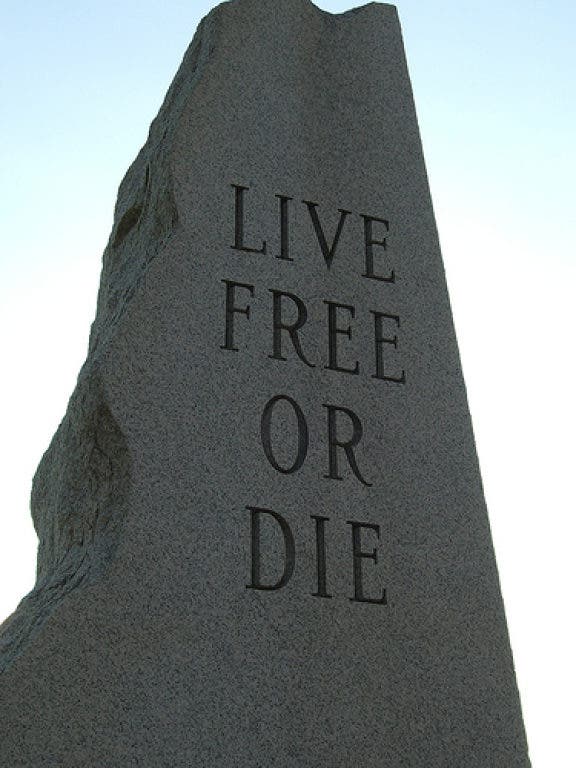
"Live Free or Die" is a pretty hardcore motto for a state. Indeed, some might interpret it as New Hampshire saying "YOLO," in spiffier language. If all the states were at a wedding, they might have to worry about New Hampshire abusing the open bar and hitting on the waitresses. When you put it next to mottos from other states, like Ohio's "With God, all things are possible," or New Jersey's "Liberty and Prosperity," it becomes even more apparent that there is something a little special about New Hampshire. There's a certain rebelliousness to such a motto, a headstrong attitude, that says the people here have their own ideas about how to do things. And that's how they'll do them. But I don't think the motto is a call to do as we please, and follow our hedonistic impulses. No, I think it's a lot more complex than that, and it reflects New Hampshire's very unique character and history.
I don't claim to be a well traveled or worldly man, yet. But I will say, I can almost always pick out someone from New Hampshire when I'm abroad, or even just in Boston. While in college, I always found that people who grew up in New Hampshire were pretty unique. Most of us didn't have any accent to speak of. We all took a little time to adjust to city life, and for those who grew up on the Seacoast, it was a big surprise to be away from the beach. But the things that stood out the most were the work ethic and quirkiness. Now I'm not saying that every single person in New Hampshire is a go-getter or a future president. On the contrary, I can give you many examples of people I know who never amounted to anything. But on the other hand, all my college friends from New Hampshire worked at least one job from the time they were kids. In addition, everyone I know from New Hampshire has a wide range of talents and interests. We aren't just focused in on one thing. Now this is definitely a self selecting sample. People with a good work ethic are more likely to do well in school and consequently attend an elite college. Still, in my opinion, there seems to be a certain hustle in Granite Staters.
I went to prep school in Massachusetts, and the culture is noticeably different, even only an hour away. Everyone I knew from New Hampshire was more down to earth, more apt to surprise me with their contrarian and interesting views. You could pretty much tell a New Hampshire kid right off. There was just something a little quirky about all of us. I think that quirkiness is a reflection of New Hampshire culture as a whole. We have a quirky tax structure. We generally shun sales tax (except for meals) and income tax (except for dividends and interest.) New Hampshire votes quirky too. Although we've voted Democrat in four out of the five past presidential elections, New Hampshire continues to be a swing state. All of those past elections were fairly close. We also host one of, if not the most important important primaries.
Find out what's happening in Hampton-North Hamptonfor free with the latest updates from Patch.
I've never quite been able to put my finger on what makes New Hampshire so special, but I've recently been delving into the history of the state for my job, and I think a lot of its special character goes back to the men and women who first came to settle this area from Europe.
New Hampshire, and Portsmouth in particular, were always destined to have a special place in colonial history, simply because of their geography. British sailor Martin Pring was one of the first Europeans to map the coast of New England and Canada in detail in 1603. He sailed up several rivers along the coast, including the Saco, Kennebec, and finally the Piscataqua. He noted the wonderful natural harbor, as well as the strong currents, and the river's long extent into seemingly endless forests. It wasn't until 1614 that Captain John Smith, of Jamestown Virginia fame, would scout and map the Isles of Shoals and their ledges, calling them, creatively, Smythe's Isles, although the name never stuck. Indeed, the map he produced when he returned home would be the first to bear the name "New England," on the advice of Prince, soon to be ill-fated King, Charles I.
Find out what's happening in Hampton-North Hamptonfor free with the latest updates from Patch.
The Piscataqua and its surrounding geography made a natural site for settlement, but why had the English come in the first place? Growing up in New Hampshire, with its harsh winters, and sometimes boiling summers, I often wondered, why did people give up so much to come live here? What attracted them?
As with all historical phenomena, we have to consider push, as well as pull factors. England had just announced its presence on the world stage with its lucky/ tactically magnificent defeat of the Spanish Armada in 1588. Elizabeth I had pursued a somewhat muted foreign policy for England, primarily because of poor finances brought on by bad harvests and the costs of the war with Spain, as well as several ill-conceived adventures abroad in the Netherlands and Ireland. It's no coincidence that Pring's journey occurred in 1603, the first year of James I Stuart's reign. England was entering an age of colonial expansion. Although most early endeavors were privately financed by merchants and nobles in port cities like Bristol, and Plymouth, they would not have gotten far without the King's willingness to grant charters for colonies. James was able to negotiate an end to the costly Anglo-Spanish War, and sold titles of nobility in order to raise money for the crown. James was also King of Scotland, and as such, creating a united empire was one of his primary goals. Everyone can get behind territorial expansion. So, it made sense to establish colonies in the New World, in order to compete with other empires like the French, and Spanish.
Geopolitics were certainly important for setting the stage for English colonial expansion. However, one, more earthly lure, would would trump any ideological draw to New Hampshire: money. As I stated, the King had to give authorization for colonies, but private individuals and enterprises funded them. As such, Pring, Smith, and the men who followed them were focused on filling their ship holds with valuable cargo. Timber to build England's future fleet to rule the seas. Furs, for clothing, and of course cod-fish caught off the aptly named, Isles of Shoals, all made their way back to England, and made the trips profitable.
As a consequence, there were more. Smith always wanted to return to New England, but was turned back by storms and pirates until his death. This commercial legacy would stay with New Hampshire. The first British warship built in modern day America, the Falkland, was constructed in New Hampshire in 1690-96. Shipbuilding would continue to be a major industry, both for the crown, and the fledgling Republic, right up until the 1960s. Indeed, the Naval shipyard still operates today, although as a refit station. I think this commercial heritage still runs strong in New Hampshire. It manifests in that special hustle I see in Granite Staters. It translates into them not allowing the state to take a cut of what they've earned. Unlike Massachusetts, or original settlers didn't come here on a religious basis, and that differentiates us from our neighbors to the south as well.
And finally, we come to New Hampshire's inherent quirkiness. I think that's a product of history to some extent as well. Quirkiness belies independence. It's a unique way of doing things, and thinking about them. The people that came over, and stayed, were fiercely independent. They had to be. That same bad weather that I always wondered about bred the very fabric of the state. Life was extremely difficult for early settlers. They had to be self-sufficient, because there was no help around the corner. Many of them also came because they wanted to control their own destiny by owning their own land. In aristocratic England, it could be difficult for a poor man to obtain and maintain his own plot. The vast expanse of the New World offered seemingly unlimited opportunity for a man of industry. Albeit, at the expense of native populations.This independence bred a certain rebelliousness. The fishermen on the Shoals were notorious for their refusal to pay taxes, and one of the first acts of treason leading up to the Revolution was a raid on Fort William and Mary in New Castle.
That independence, in my opinion, has bred the "Live Free or Die," spirit. And in it's own, rough around the edges, gruff Yankee way, it's very touching. To me, "Live Free or Die," means people are free to live their lives as they see fit. They'd rather have no life than one subject to control. There's a certain tolerance inherent in self-reliance too. So long as people aren't infringing on your rights, why bother to try to regulate what they do on their own? Such an ideology could make for a cold and uncaring society, but I don't think New Hampshire is like that at all.
On the contrary, I think that quirkiness breeds a special bond. We can all sort of spot someone from New Hampshire, and I for one always light up when I meet someone from my home state. And maybe that's all culture really is. An unspoken, and in some ways unspeakable bond. We can't really name it, it flits on the tip of our tongue, but we can never capture the idea completely. But we know it's there. It's comforting, and perhaps, that's all that really matters.