Schools
Safety Forum Good First Step, but Needs Child Involvement
Area towns are working together to find ways to increase student safety.




Most of the 50 or so parents, school administrators and social services officials that attended Tuesday's first-ever "Keeping Kids Safe" forum said they came away with positive feelings, although many also questioned the glaring omission from the session at Winnacunnet High School.
"We're missing a stakeholder here," Dave O'Connor, a parent and the principal of Hampton Academy, said during a small group activity in the middle of the forum. "I don't see one kid sitting here.
"We can set up procedures and we can set up programs, but unless we address the climate and the culture in that group... We need to find a way to reconnect with our kids and give kids ways to get involved."
Find out what's happening in Hampton-North Hamptonfor free with the latest updates from Patch.
Another man in the small breakout session — held as a way to generate ideas about what the schools, community, and individual students and parents can do to help reduce some of the alarming revelations from this year's WHS Youth Risk Behavior Survey — agreed with O'Connor, stating the children could be, and likely will be, the ones to find the "solution."
"We don't know better, but we think we know better," he said. "We need to have them involved with us. They're in the trenches. They want to be part of the solution... They have good ideas. I think we're missing the boat by not including their involvement."
Find out what's happening in Hampton-North Hamptonfor free with the latest updates from Patch.
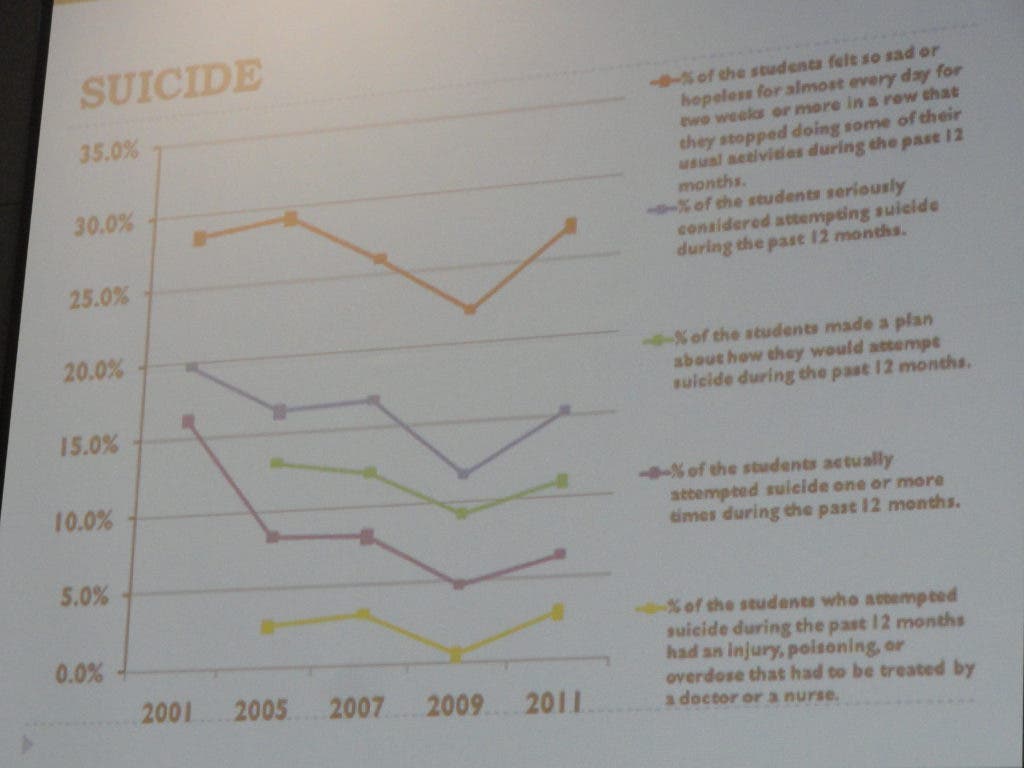
Many of those comments came after listening Tuesday night to a panel comprised of local and state experts, as well as North Hampton Police Chief Brian Page, comment on some of the positives and the negatives — including an increase in forced sex and the notion that marijuana is safe — revealed by the annual YRBS data trends.
Several panelists said many of Winnacunnet's statistics, compiled after an anonymous survey of 1,021 students, are favorable compared to the state.
[Editor's note: A slideshow presentation about those stats is attached to this article as a series of photographs.]
Tym Rourke, chairman of the N.H. Governor's Commission on Alcohol and Drug Abuse Prevention, Intervention and Treatment, said Winnacunnet also isn't the only district seeing spikes in concerning areas, nor is the WHS community alone in the efforts to work toward a solution.
"There’s good news and bad news in this data," he said. "The good news is you're in about the same place as every other community in New Hampshire. The bad news is, you’re in about the same place as every other community in the state of New Hampshire.
"So many of these communities are having the same conversation, and [because] we're in the same boat… we hope there are opportunities to learn from [and work with] the other communities to find out what works and in the long run make a difference."
There will be additional community meetings in the future about various efforts individuals can take to help, as one consensus made during Tuesday's forum — moderated by WHS social worker Talley Westerberg — was that as many people as possible should be engaged in public planning in order to help support efforts in the schools, local social service agencies, and at home.
"These are solvable issues that you can get involved in and help find solutions," said Olivia Korpi, the community outreach coordinator for the nonprofit Sexual Assault Support Services. "The dialogue starts at home and continues through the schools [and the community]."
Rourke reiterated Korpi's latter point, as he said the YRBS is a "very critical tool" to the state and can serve as great catalyst to bring together community members and those of different districts to help reduce some of the unfavorable trends.
"As much as there's not one drug, there’s not one solution," said Rourke. "To start, every section of the community needs to lead to play a role because there’s not just one solution, one 'silver bullet.' It requires everybody.
"There is a role for everybody here. Addiction is a chronic relapsing condition. It's a disease, and it's always preventable... Tonight what I hope to bring out is what this community needs, and what everyone here feels they can bring to the table. There's something you can all do... and somehow with this issue we need to get beyond the 'choir.'"
Get more local news delivered straight to your inbox. Sign up for free Patch newsletters and alerts.