Politics & Government
NH Rail Expansion: Bonanza or Boondoggle?
Critics, cheerleaders comment on plan that would expand rail from Massachusetts to Manchester.


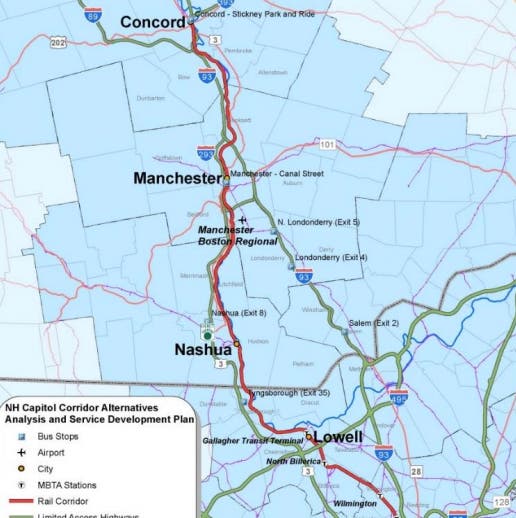
The state of New Hampshire released its NH Capitol Corridor Rail and Transit Study on Feb. 3, to much fanfare, some caution, and others who criticized the report.
The plan calls for spending nearly $250 million to bring commuter rail service from Massachusetts, through Nashua, up to Manchester, with maintenance costs of totaling about $11 million annually. Expanding rail beyond Manchester into Concord was not recommended, according to the report.
Most Democrats expressed support for the expansion plan with some concerned about the costs.
Find out what's happening in Londonderryfor free with the latest updates from Patch.
Gov. Maggie Hassan, D-Exeter, said that rail expansion would be a boon for 21st Century workers and keep young people in the Granite State.
“A solid, modern transportation infrastructure is critical to the success of our people and businesses,” Hassan said, “and bringing commuter rail from Boston to Nashua and Manchester is another important step in strengthening our transportation infrastructure.”
Find out what's happening in Londonderryfor free with the latest updates from Patch.
ALSO READ
- Hassan: Expanding Rail Service to Nashua, Manchester Will Keep More Young People in NH
- NH DOT Full Study
- New Rail Study: New Jobs, Up to $256M in Startup Costs
Executive Councilor Colin Van Ostern, D-Concord, who has championed rail expansion during his campaigns, called the report a blueprint for economic growth.
“Even citizens who never set foot on a train will benefit from the 5,600 new jobs that local businesses will grow around the rail corridor and the thousands of cars taken out of traffic on Route 3 and I-93 every day,” he stated. “Now it’s time for policy-makers to come together to find creative, low-cost ways to turn this blueprint into reality.”
U.S. Rep. Ann McLane Kuster, D-NH, also offered a bit of financial caution, saying that while expanding rail could bring thousands of jobs, she looked forward to learning more about the specifics.
“We must continue to pursue smart, fiscally sound improvements to our public infrastructure in order to support our local businesses and help our economy grow,” she added.
Other Democrats also commended the study.
“Today’s final report on the Capitol Corridor Study confirms what the citizens and businesses of New Hampshire have known for years: bringing commuter rail to NH will help maximize our regional position and spark economic growth for decades to come,” said state Sen. Bette Lasky, D-Nashua. “Commuter rail will benefit Nashua and the entire state by bringing new transportation and housing opportunities – the kinds of opportunities that our businesses and families are looking for.”
Lasky’s Senate colleague, state Sen. Dan Feltes, D-Concord, who also sits on the Senate Transportation Committee, agreed.
“With the release of the final report, we as legislators have a choice: invest in commuter rail as an economic engine and keep more of our young people here in New Hampshire or stick with the status quo,” he added. “Senate Democrats stand ready to work with stakeholders in the bussing industry, the business community, state transportation experts as well as our colleagues in the House and Senate to ensure we find a consensus, comprehensive way forward.”
Not everyone heard the “all aboard” call though.
Josh Elliott-Traficante of the Josiah Bartlett Center for Public Policy, the point person on transportation policy for the free market think tank, called the financial data “rosy” and “significantly overstated,” adding that no other system in the country had reported the level of revenue that was in the financial presumptions.
“The study guesses that this train would manage to recover 64 percent of operating costs and lose only $3 million per year,” he noted. “That rosy estimate would make it the best performing line in the country … it’s hard not to see these unrealistic assumptions as an effort to pretend the costs to the taxpayer are much smaller than a realistic estimate would show.”
Other lines, Elliott-Traficante noted, like the Downeaster and the Massachusetts Bay Transit Authority’s commuter rail system, which would be an integral part of rail expansion, only recover 49 to 53 percent of operating costs.
Another opponent, state Rep. Daniel McGuire, R-Epsom, told the New Hampshire Union Leader that rail expansion was not a cost effective way of transporting commuters, pointing to the $80,000 per daily rider cost to create the system, along with a $1,000 annual subsidy, per rider.
Privately, a number of people eyeing the issue and the report expressed disappointment that the expansion would not be made into Concord, which is sinking $10-plus million to revamp its downtown, to become a “destination city,” but is also badly in need of private sector investment creating new jobs in the area. Rail expansion enthusiasts had also hoped that it would eventually expand to the White Mountains, alleviating traffic on I-93, something that might never occur at this point.
What do you think? Is it time to expand rail in central New Hampshire? Leave a note in the comment section of this post.
Get more local news delivered straight to your inbox. Sign up for free Patch newsletters and alerts.