Politics & Government
20th Annual Black New England Conference, Black Voices Refusing To Be Silenced
Two major themes emerged: Avoiding erasure of Black history and encouraging around hundreds of attendees to vote in the Nov. 3 election.

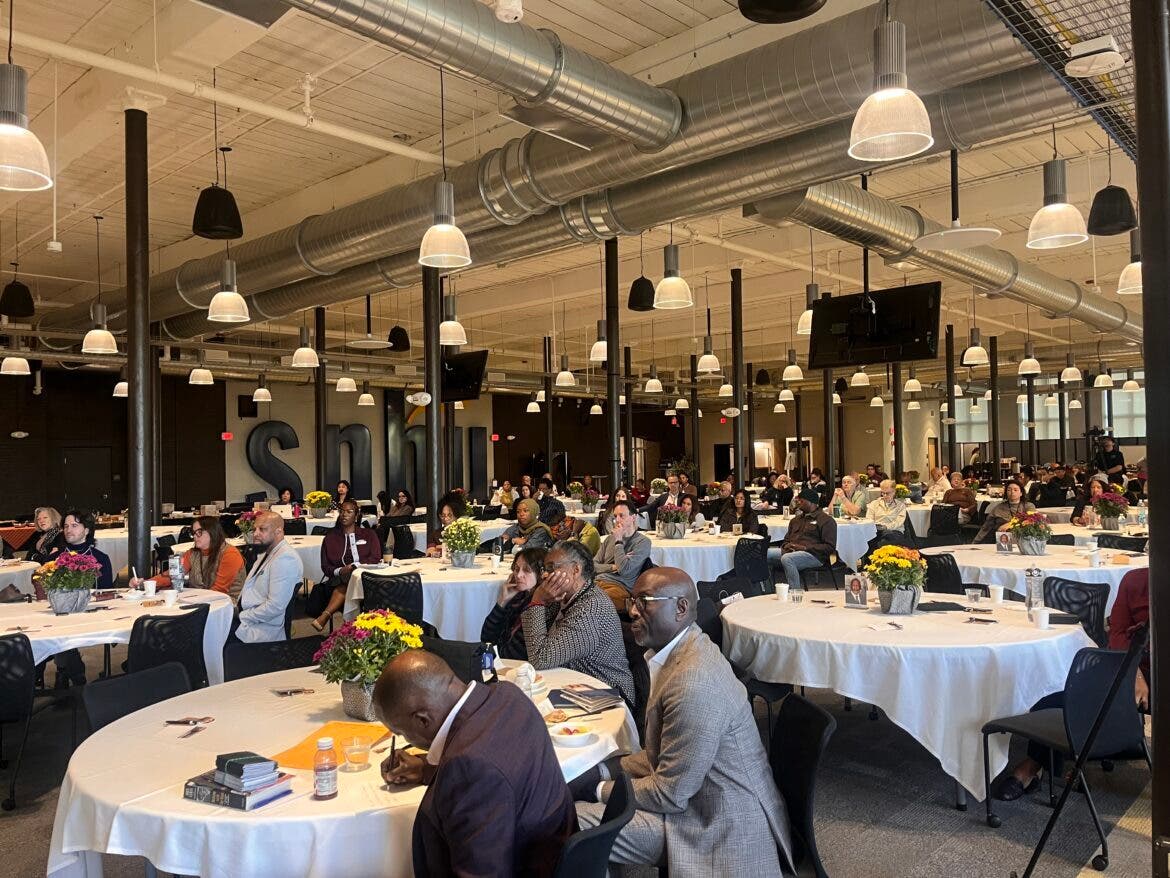
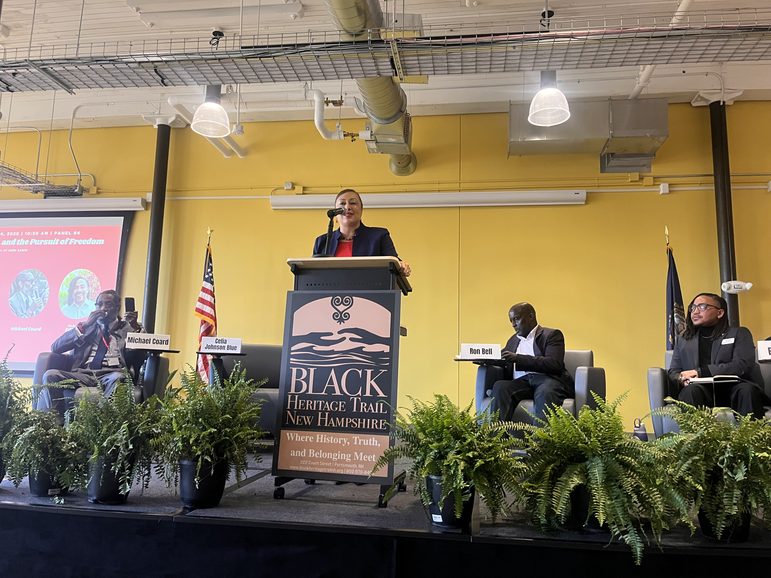
Above, Cecelia Blue, who runs the Massachusetts Women of Color Coalition, speaks at the 20th Annual Black New England Conference in Manchester. Behind her from left: Attorney Michael Coard, Ron Bell, founder of Dunk the Vote, and Moderator Ed Taylor, organizing director at ALCU-NH. ZACH LAIRD photo
Find out what's happening in Manchesterfor free with the latest updates from Patch.
MANCHESTER, NH — At the 20th Annual Black New England Conference at Southern New Hampshire University, two major themes emerged: avoiding erasure of Black history, and encouraging around 250 attendees to vote in the general election Tuesday, Nov. 3.
Hosted by the Black Heritage Trail of New Hampshire — a nonprofit organization dedicated to raising awareness of the history, contributions, and experiences of African Americans in the state — the goal was to showcase Black voices fighting back against being silenced. Throughout Oct. 23 and 24, the two days the conference was held, around 250 people attended, per the organization’s Executive Director JerriAnne Boggis.
Find out what's happening in Manchesterfor free with the latest updates from Patch.
Ron Bell, founder of Dunk the Vote (a nonpartisan voter registration nonprofit) started the mid-morning panel on Saturday with a quote from the late Congressman and activist John Lewis: “The vote is precious; it is almost sacred,” and reminded the audience of the upcoming election on Nov. 3.
Bell explained that in 2005 he accompanied Lewis and approximately 5,000 people from Roxbury to the Boston Common in a march to challenge racial inequality. He said this mirrored a similar march to the Boston Common led by Dr. Martin Luther King, Jr. which had more than 20,000 people join the cause.
“Standing alongside John Lewis in 2005, and learning from Dr. Virgil Woods, I understood something that has stayed with me ever since: democracy is not something we inherit and simply keep; democracy is something every generation has to defend. That lesson is more than six decades after the Voting Rights Act in 1965 became law,” Bell said.
He recalled how one time while working on an election campaign in 2006, some polling places ran out of ballots, which taught him that encouraging people to vote is only part of the responsibility. He told the audience to make sure “our systems are prepared to receive every voter that shows up.”
He said he previously worked on Julia Mejia’s campaign for Boston City Councilor at large, and after a recount she won by one vote.
“So, these experiences have taught me that democracy cannot be something that we talk about only during elections. It must be something we practice and protect every day. That means registering voters; it means civic education… It means ensuring that communities can challenge political systems that have become too difficult for ordinary citizens to handle. And, it means remembering that democracy belongs to the people, not to political parties, not to incumbents, institutions or government agencies,” Bell said.
The next speaker, Cecelia Blue, who runs the Massachusetts Women of Color Coalition, told the audience about the inspiring story of Black Activist Fannie Lou Hamer. She explained that Hamer was the youngest of 20 children who was raised in Mississippi while laboring on cotton plantations.
Blue said that from the age of 6 Hamer labored until she caught polio later in life and could no longer work full-time. Having been taught to read and write, she was made record-keeper, where she was able to “observe first-hand how the landowners manipulated wages, debt, and labor.”
She noted how Hamer later got married, suffered a couple of miscarriages, and was hospitalized, where doctors found a uterine tumor. During the surgery, the doctor did a hysterectomy though Hamer did not consent. She said this medical violence deepened Hamer’s understanding of how racial oppression operated in healthcare and political systems.
“Fast forward to 1962, and she attended church and learned in 1920 that women had the right to vote; 42 years later, she’s just discovering that women could vote. So, of course she organized with 18 other women, and went down to Sunflower County courthouse to attempt to register to vote,” Blue said.
While ultimately Hamer was unable to register, Blue said she was not deterred. On the way back, her bus got pulled over, fined, and she was late to return to work before being kicked off the plantation. Blue said Hamer viewed this as a form of freedom to be able to work for Black citizens.
Though Hamer continued to receive pushback from the community, and 16 shots were once fired into her home, she was unharmed and still undeterred. Blue said in 1963 Hamer was arrested for sitting at a counter in a store where only white people were being served (and) was beaten severely in jail. She testified to her experience in court, and Blue said former President Lyndon Johnson spoke out against her.
Blue elaborated that Hamer was still determined to make an impact, and went on to co-found the Mississippi Freedom Democratic Party (and) in 1968 she served as a delegate from Mississippi to the Democratic National Convention in Chicago. In 1969 she bought 700 acres of land and became one of the largest employers in Sunflower County, continuing to be an advocate until she passed away in 1977.
“The story, for me, just resonated across all different boundaries from healthcare, economics, political (and) civil rights, and this one woman kept fighting,” Blue said.
Michael Coard, a practicing attorney who is a member of the Avenging the Ancestors Coalition (ATAC) said you cannot be Black in America and not be angry about aspects of history like slavery, but that anger must be productive, constructive, and strategic.
Coard recalled how back in 2002 there was a news report that the Liberty Bell Center in Philadelphia was going to be moved to another address nearby because the first site was “too cramped, too congested.” He said there was major pushback from the public because it was the site of America’s first temporary White House in 1790.
However, Coard noted the site in question was also where George Washington kept slaves. Despite pushback and protests, Coard said the new Liberty Center at 526 Market Street officially opened its doors in 2010. However, Coard said the site was later torn down after an executive order by President Donald Trump to look into historic sites around the country. Coard expressed the idea that Trump targeted the site “because it wasn’t white enough,” though he noted he’s involved in an ongoing lawsuit to try and bring the site back.
“We’ve learned from our elders, ancestors (and) the civil rights struggles in the ‘50s and ‘60s that you send activists in the streets to raise hell, and you send attorneys into the courtrooms to raise issues; that’s what we’re doing to avoid erasure,” Coard said.
This story was originally published by InDepth NH.