Health & Fitness
We Need a Raise in Teacher Pay
Pay table disparities prevent Merrimack from attracting young teachers. The negotiated pay raise could fix the problem if implemented properly.

Gary G. Krupp
Excepting the school budget itself, no warrant article has a greater impact on the tax rate than the teacher contract. Not only does it represent the single greatest cost to the district (2012-13 teacher salary & benefits represent 43% of the total budget), but the ability to attract and retain a sufficient quantity of talented staff is inextricably linked to the provisions of the contract. So the obvious question is, should the three-year deal negotiated by School Board members Shannon Barnes and Davis Powell be ratified by voters? My answer is a qualified yes. We do need pay raises to repair deep disparities in teacher compensation in certain parts of the pay chart, however, if pay raises aren't used to fix those pay categories, then voters should defeat the contract. Let me explain why.
Find out what's happening in Merrimackfor free with the latest updates from Patch.
My support for the contract hinges on the outcome of the pay table negotiations currently ongoing between the Merrimack Teacher's Association (MTA) and district administrators. You may be thinking, “I thought negotiations were concluded?” In a sense, you'd be correct. While the School Board has declared negotiations complete, informal deal-making is still occurring on the pay table to come up with a structure that fits within the negotiated raises, is palatable to the MTA and supports the School Board's objectives regarding staff compensation. These pay tables should have been completed before negotiations were concluded in my view but I am pleased to hear that administrators are at least involved in the pay table conversation. I will not support this contract until I see the new tables.
Find out what's happening in Merrimackfor free with the latest updates from Patch.
Generally the MTA is given wide latitude in developing the pay tables however they see fit with the bottom-line pay raise being their only constraint. The long-term problem with this hands-off approach by the School Board is that the pay tables become unbalanced over time and stunt the district's ability to attract and retain talented teachers. We have this problem in Merrimack today and it must be addressed.
Recently, the Bedford School District conducted a salary survey of 25 local school districts. The survey not only considered salaries but also employee contributions to health and dental plans. This “net pay” survey approach allows Districts with varying health plans and salary structures to be compared side-by-side. Although the whole pay chart is not considered, comparisons at years 0, 5, 10, 15 and 20 offer key insights into how a District's compensation profile compares to other districts.
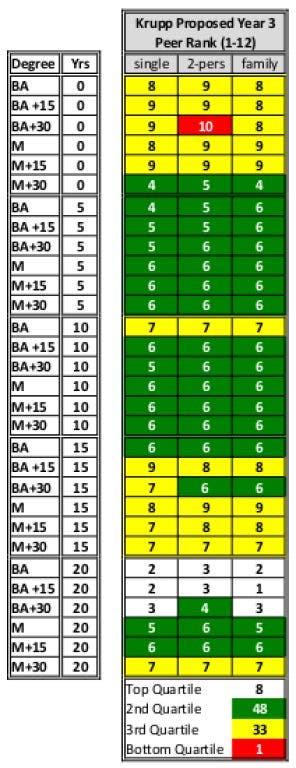
The current peer ranking graphic (click the image for a larger view) shows that Merrimack's pay table, when compared to eleven peer districts, is a mixed bag. In the senior ranks, Merrimack compensation generally ranks in the top half of its peers (highlighted in white or green in the graphic) but ranks near the bottom (shown in yellow or red) for most other pay categories. A key factor is the fact that 48% of the current Merrimack teacher population is within 5 years of the top pay step. Therefore, it stands to reason that the MTA's incentives lie with serving this large portion of its membership and they do so by distributing raises to the upper portion of the chart.
There are many reasons for balancing the pay table but chief among them is that the current pay chart proves that Merrimack has become dangerously uncompetitive in the lower pay categories. A more balanced workforce serves the taxpayer by lowering overall labor costs. Furthermore, bringing on young staff keeps the district vibrant and current with the latest research and training in teaching methods. Don't misunderstand me. I am not advocating we dump our experienced teachers in favor of younger teachers because it will save us a few dollars but I am saying that we are not balanced and that that imbalance is costly in both the short- and long-term. Our senior teaching workforce will one day retire and our current pay structure limits our ability to bring in the next generation of Merrimack teachers to take their place. Our pay table sends two messages loud and clear (1) “if you are a junior teacher, we are not interested unless you are willing to work for a discount” and (2) “if you only have a bachelor's degree and want to retire that way, Merrimack is for you.” I think both messages are not in the long-term interest of the district, parents, or taxpayers.
Thankfully, we have an opportunity in this contract to correct most of that while still offering a modest raises to our senior staff. The School Board negotiated a discontinuance of the performance pay program in order to setup a new pay category that recognizes the value of teachers who complete a Master's degree versus those that amass a number of non-degree credits. Using this School Board goal I believe that I have found a solution that addresses the needs of all parties: taxpayers, parents, teachers, administration, and the school board. I created my own set of pay tables that distribute the pay raises negotiated by the School Board (2.99% in year 1, 2.75% in year 2, and 2.75% in year 3). If you are interested in the details, take a look at my proposed pay tables and the percent pay increase by step here. Under my plan, even senior teachers would receive modest pay increases each year of the contract while the disparities in the current pay table are mostly repaired. The rankings among peer districts are improved dramatically by year 3 of my proposal as shown in the second graphic. Click here to see how the rankings improve over each year of the contract with my proposed pay tables.
In summary, I think the pay raises negotiated by the School Board are badly needed BUT only if they are distributed throughout the pay table to address the problems in our lower pay categories, similar to what I have proposed. I will not vote for the teacher's contract without seeing the pay tables and I don't think you should either.
You have just read "We Need a Raise in Teacher Pay" by Gary G. Krupp – originally posted at Merrimack Education Matters (Home). You can also download a PDF version of the full article along with salary table and peer ranking attachments here.