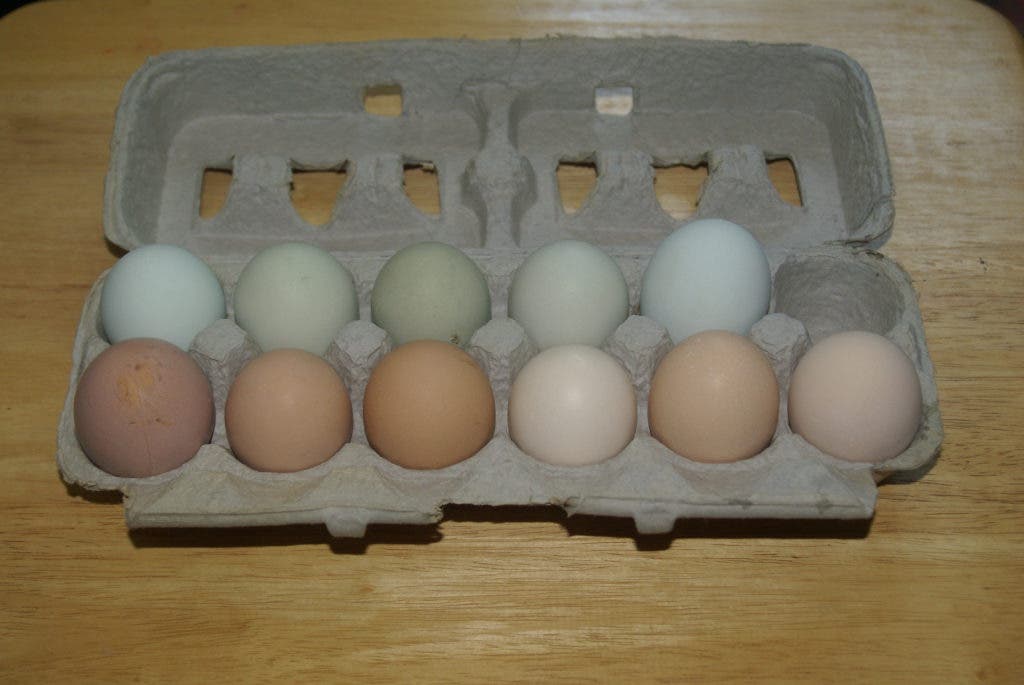
Once you start eggs incubating there is not much to see. We started the clock ticking on the eggs at 2:30 p.m. on Thursday (and when eggs hatch in 21 days, what time you start them is important) and they have been cooking (relatively speaking) since then.
We did candle them before we put them in the incubator so that we could see the:
Yolk – which shows as a darker area inside the egg
Find out what's happening in Merrimackfor free with the latest updates from Patch.
Air Sac – typically found in the large end of the egg and which needs to be identified so that the eggs can be oriented properly in the incubator (air sacs facing outward)
Other than that, we (I) didn't see much of anything, but then that's kind of the point. At Day 1 there is no visible activity.
Find out what's happening in Merrimackfor free with the latest updates from Patch.
My friend who is helping with this adventure often assists local classrooms when they incubate eggs. He sent me the following information regarding hatching eggs that he likes to share with the teachers. It's a nice little summary of what is needed and why.
It takes five things for a baby chick to grow inside an egg and hatch out:
1. First, you need special eggs called fertilized eggs that have the beginnings of a baby chick in them. The eggs we buy at the store for cooking are not fertilized. They do not have baby chicks starting to grow in them. But if you go to a farm that has hens and roosters, you can get fertilized eggs for hatching. At first, the baby chick is very tiny -- just a speck inside the egg, but it will grow until it fills the egg and hatches out.
2. Second, the eggs need to be kept warm. On a farm, a hen will sit on the eggs to keep them warm. In the classroom, we use a machine called an incubator to keep the eggs warm. The incubator has a heating coil around the top to warm the eggs and thermometers that show us the temperature so we can make sure it is just right.
3. Third, there must be some water in the air (called moisture) so that the eggs do not dry out. On a farm, the moisture comes from the hen's body. In the incubator, the moisture comes from water in little compartments in the bottom of the incubator, which are filled by the water bottle on the side. The water evaporates into the air and keeps it moist so the air is not too dry. (For older students, you can use the term "humidity".)
4. Fourth, the eggs must be turned regularly. You know how if you are lying in the same position for a long time, your body gets sore and you need to roll over or change position. Similarly for a baby chick growing in an egg, they don't like to be in the same position all the time, so the eggs need to be turned. On a farm, a hen sitting on her eggs will get up every now and then and put her beak under each egg and roll it a little so that it changes position. In the incubator, there is a black box on the side with a motor that rolls the eggs every hour. I will also check on the eggs and turn them by hand once a day.
5. Fifth, for a baby chick to grow from a tiny speck and fill the egg and hatch out, you need time. It takes three weeks for the chick to get big enough to hatch out. During that time, we can't open the eggs to look inside and see how the chick is getting bigger, but we can shine a bright light on the eggs and see some shadows of what is inside and that way we can see that the chick is growing. I also have a book that shows pictures of what the chick looks like as it grows inside the egg.
So for a baby chick to grow inside an egg and hatch out, you need:
1. Special eggs called fertilized eggs.
2. The eggs need to be kept warm.
3. There must be some moisture in the air so it is not too dry.
4. The eggs must be turned regularly.
5. And you need to wait for three weeks until the chick is big enough to hatch.
For more information on these fertilized eggs and backyard chickens visit my blog Simple Thrift.