Politics & Government
Finance Committee Recommends Studying Winnipesaukee River Basin Program Structure
A legislative commission lent its support to establishing a 6-month commission to look at transferring wastewater treatment to local towns.

CONCORD, NH — The state is looking to get out of the business of operating a wastewater treatment plant in the Lakes Region and hand it over entirely to local control.
And, said a state official, that is increasingly what the nine communities who have it want.
Find out what's happening in Merrimackfor free with the latest updates from Patch.
On Monday, a legislative commission lent its support to establishing a six-month study commission to look at delivering the Winnipesaukee River Basin entirely to community user control.
The House Finance Committee Division 1 voted unanimously to recommend passage of Senate Bill 592 which would, in part, create a commission to look at the issue.
Find out what's happening in Merrimackfor free with the latest updates from Patch.
Before the federal Clean Water Act was passed in the 1970s, communities dumped their sewage directly into the water of the Winnipesaukee Basin.
The communities got together to seek state and federal funds for a piping system throughout the region which would process and clean the water but as it begins to age there may be costly repairs needed which the towns and city of Laconia as users will have to pay for, said Ted Diers, assistant director of the state Department of Environmental Services.
He said the system was set up to treat up to 11 million gallons a day and has 14 pump stations and nine towns tied in but Laconia has 40 percent of the use.
The design flow is larger than its current use at about 5 million gallons a day. It was originally built to take the capacity of the entire region around Lake Winnipesaukee but that has not been feasible.
This was attached to a non germane bill and its language is here https://gc.nh.gov/bill_Status/billinfo.aspx?id=1373.
An overview of the Winnipesaukee River Basin Program is here https://www.des.nh.gov/waste/wastewater/winnipesaukee-river-basin-program
Because changes to the format will require legislation, Diers said the bill sets up a short study with a report due by Nov. 1.
Diers said five years ago, there was not as much unanimity on changing the state's role but it has become more and more urgent as the processing plant in Franklin, which empties treated water into the Merrimack River, and its pipelines get older and there is pressure on property taxes.
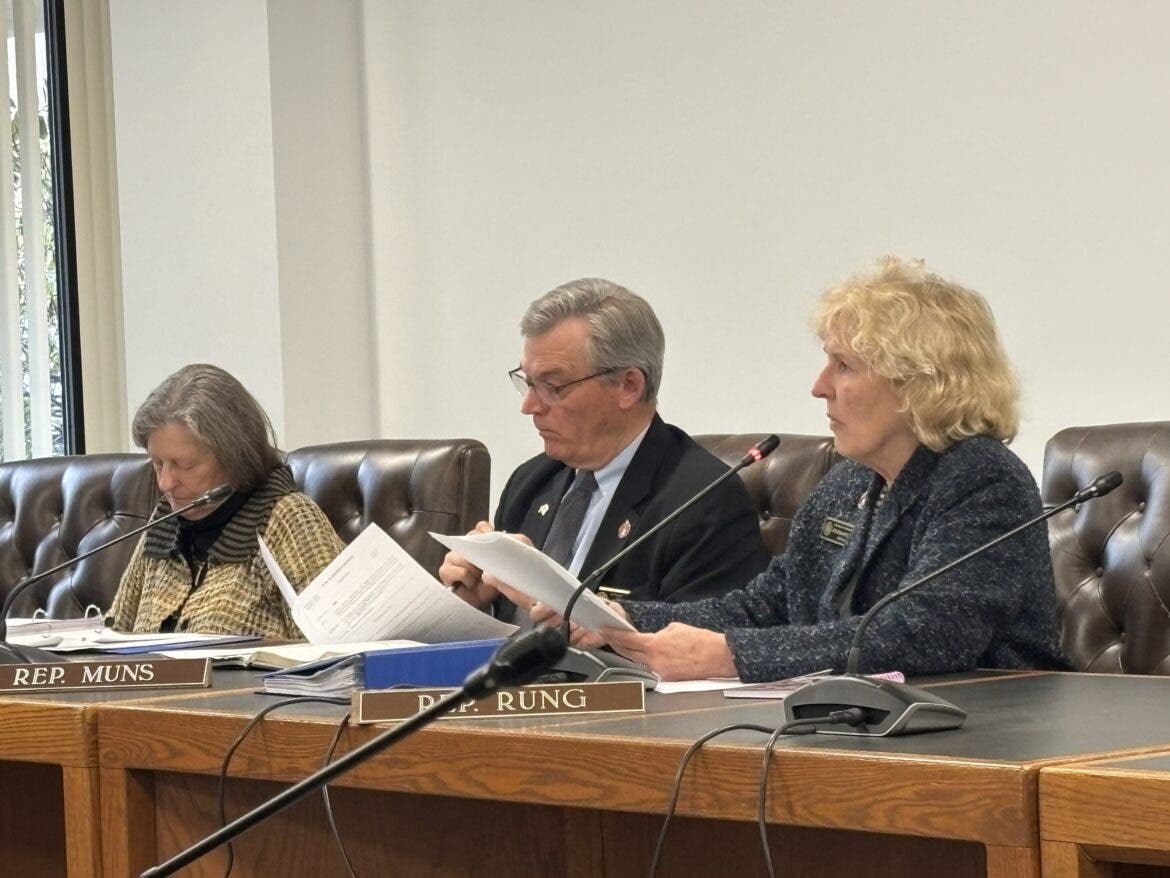
State Rep. Rosemarie Rung, D-Merrimack, asked if there could be expansion to other communities in the future noting Center Harbor is not tied in but the pipe goes through that community.
Diers said any change would have to be done by statute. "The real tricky part will be the change," he said.
It would likely require an engineer "who can really help us through the process of making the choices of what to upgrade and when."
He said that person would be key to creating a pathway if it were to transfer from the Department of Environmental Services to another entity.
Rep. Karen Ebel, D-New London, said she always thought it peculiar that the state owned a wastewater treatment plant. Diers explained the state got involved to help facilitate federal grant funds and noted it came at a time when "Winnipesaukee was not in great shape."
Not one of those individual communities could ever have the wherewithal to do it themself, he noted, and the state was able to step in with the federal government to administer those grants. "I think doing so piecemeal would have been impractical," he said.
Diers said the tricky part is the transition noting that there are state employees involved.
Rep. Carol McGuire, R-Epsom, moved that the bill ought to pass and while Rung offered an amendment that would designate two of the seats to be town designees; the majority of the committee opposed it.
Rung was told there would be no savings to the state to get out of oversight. The bills are entirely paid by the member communities.
Diers said it would be a better fit for the communities to operate it given that the state takes time and is not as nimble. "When we bond, it is hard to predict when that is going to hit your (tax) bill," he said. He said the communities want this autonomy suggesting there would be more control.
Ebel said wastewater treatment is a "complex world" and "it seems to me if the communities want more control over their lives this would make sense," she said of the short study committee.
McGuire worried it was not enough time, but Diers said he thought it was enough time to produce a decent report with next steps, many of which might likely be bills for the next legislative session.
The bill will go to the full House for consideration and will need to return to the Senate because of changes made, despite state Rep. Kenneth Wyler, R-Kingston, warning that the Senate always messes things up. He was told the bill was previously amended by another House committee and must return to the Senate for concurrence.
This article first appeared on InDepthNH.org and is republished here under a Creative Commons license.