Schools
FIRST is About the Journey, Not Just Competition
Six weeks of madness puts the team in shape to compete multiple times during six weeks of competitions.




Editor's note: This is the second in a three-part series about the FIRST Robotics team at Merrimack High School and the ongoing build and upcoming competition seasons.
They are smack dab in the middle of build season and Ben Rogers, co-captain of Merrimack High School's FIRST Robotics team, Chop Shop 166, is excited by what he sees.
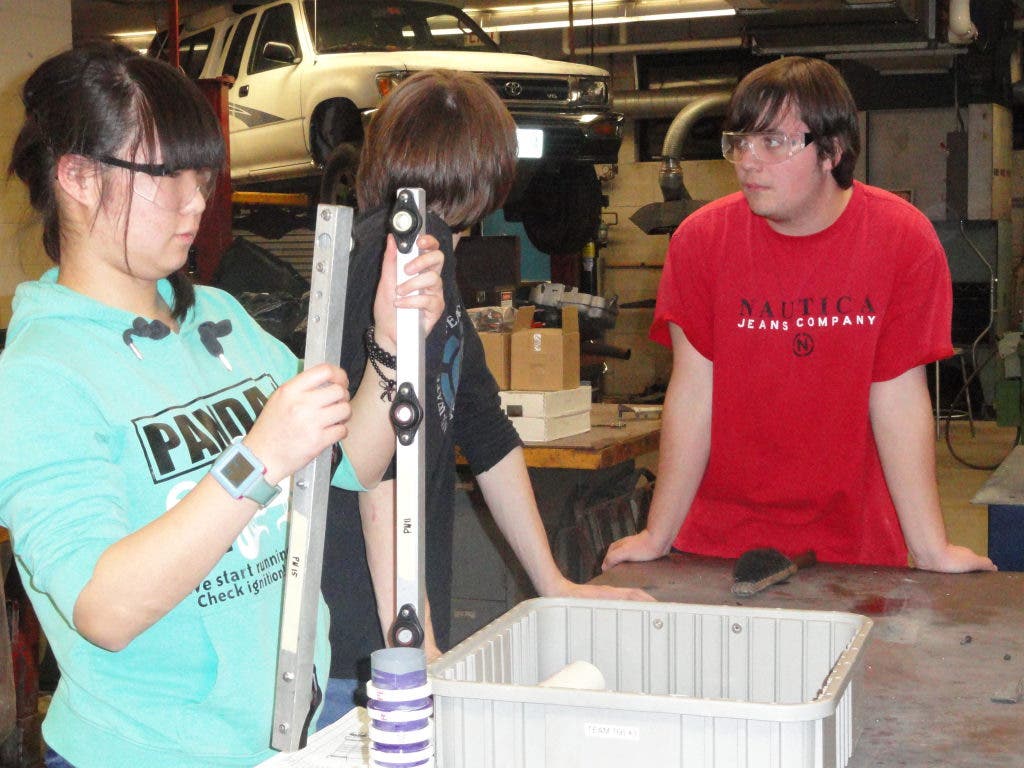
Walking from room to room in the high school, where the team has a workshop and computer rooms filled with students working on various aspects of this year's robot, Rogers is all smiles. They have a test bot sitting on one table in the workshop and at the next table over, a group of six teenagers and one mentor are clustered around their actual robot. Rogers points out a shaft where the tower that will feed balls into the shooting mechanism is going to be placed.
Find out what's happening in Merrimackfor free with the latest updates from Patch.
In the school's auto shop another group of students is working on putting that feeder together.
While all of this is going on, boys and girls are in front of computers working on programming for the robot.
Find out what's happening in Merrimackfor free with the latest updates from Patch.
They have three more weeks of build season to get the robot together in advance of this year's FIRST Robotics challenge: Rebound Rumble.
This year's is a competition that requires members of three teams to form an alliance to compete against an alliance of another three teams. Robots from each team take the playing field and must shoot compact, foam basketballs at three levels of basketball hoops, each worth different points.
In addition to scoring baskets to score points, there is a final element of “coopertition” at the end of the match that earns additional point for all of the teams in the two alliances if robots from the opposing alliances are balanced on a bridge between each side of the playing field as the match ends.
Two weeks ago, Perry Franklin, Rogers' co-captain explained that each year's build season and competition throws them different challenges.
“This year we have to build a shooter, no one on the team has done that before,” Franklin said.
Though there are several team members who've been a part of FIRST for two or three years already, this sort of challenge has never been presented.
But they have help to work through it all. Throughout the build season, the students work very closely with mentors in professional fields similar to what they are doing. They also work with members of the community for presentation and design reviews or to work with them on skills they need to improve.
“The design reviews are so important,” Rogers said. “They (the community members they present to) have a lot more experience so they can catch details we may have missed."
Each year, student teams participating in the FIRST competitions have six weeks to design, build and program their robot to complete a challenge as set by FIRST Robotics. The game is unveiled in January, and students must use critical thinking, teamwork, and mechanical, programming and other skills to put together a robot that completes the task at hand.
It's a hectic time of year for the team which meets year-round.
In those six weeks, students dedicate themselves to hours of extra time spent inside the school building the robot and working on their presentation they will give to the Chairman's Committee at the competition. The team meets Monday-Friday from 6-9 p.m., Saturday from 9 a.m.-6 p.m. and Sunday from noon-6 p.m. Though, as crunch time nears, some students practically take up residence at the school, Rogers said.
The six weeks fly by, are utterly crazy, and by the end everyone is a little punchy, but it's worth it, Rogers said.
“The competition is the reward, but the journey is definitely a big part of it,” he said, commenting on how well the team of nearly 60 students works together.
In addition to the actual construction of the robot, there is a lot of robot-related outreach, including fundraisers and community events throughout the year to help the team afford to build their robot and travel to the competitions.
With a steep $5,000 entry fee, expensive parts to create the robot, and travel costs on top of it all, those fundraisers are a much-needed source of assistance.
Most of the parts aren't reusable from year to year, Rogers said, though all of the control elements are.
Rogers said the team's annual budget from year-to-year is between $20,000 and $30,000. Luckily, despite how costly the industry is, they get a lot of very expensive software donated to them and a number of the parts needed to complete the robot are included in the kit from FIRST or donated to the team.
This year, Merrimack's team will compete at two regional competitions, in Manchester at the Granite State Regional and in Raleigh, N.C., at the North Carolina Regional. Each year they compete in their home regional and try to travel to another. Last year they went to Las Vegas, they've been to Wisconsin before, and to Atlanta four times, among other locations.
Last year, winning the Chairman's Award earned them a trip to St. Louis to the FIRST Championship. While you don't have to win your way into the championship, and can simply sign up to go, there is typically a lengthy waiting list to get in Chairman's Committee leader Isabelle Beauregard said.
The team tries to get there once every four years so students who want to experience it have the opportunity.
A part of getting into the competitions and paying for the travel comes from fundraisers. The team sells LED light bulbs at competitive prices with local stores – they earn half of the price of the bulb, most of which goes to the student who sells it – and this year they are selling items called Smencils, which are gourmet-scented pencils.
Additionally, they hold a FIRST Lego League competition, which is the branch of FIRST dedicated to elementary and primary school aged students. There is a fee to get into the FLL competition, which helps fund the robotics team's activities. Teams from around the regional are invited to the competition annually.
Without the help of the community and the support of the school district and BAE Systems, this team would not be as successful as it is today, Rogers, Franklin and Beauregard said.
BAE for years has done a lot to help fund the program and before they had space and access in Merrimack High School, the Canal Street BAE office was where the team called home during build season. Then the school was able to offer them use of space in the school, which now includes three classroom spaces, a large storage closet and gives them access to the school's auto shop at night to work on the robot.
Team adviser Chris Petrovic shared the teens' sentiments.
“I don't think you'll come across a more supportive administration as you do here at this school and in this school district,” Petrovic said. “The support the school gives us is more valuable to me than any money.”
Read yesterday's story:
Friday: Hear from team advisor Chris Petrovic and his perspective on the FIRST program and the team of students he works with.
Get more local news delivered straight to your inbox. Sign up for free Patch newsletters and alerts.