Politics & Government
Is Polling 'Broken?' Emerson's Kimball Defends Industry As GOP Doubts Grow
Podcast: Emerson College director of polling Spencer Kimball says the data "has never been stronger. Our analysis has never been stronger."

When Emerson College director of polling Spencer Kimball looks at the data coming across his desk from around the country, what he sees is 2006: a huge Democratic wave with an unpopular GOP president in the White House.
Many Republicans shrug off predictions like these. Why? Because they’re based on polling and, as conservative radio host Hugh Hewitt often says, “Polling is broken.” Some GOP activists believe the media generate bad polls for Republicans intentionally to drive down turnout.
Find out what's happening in Merrimackfor free with the latest updates from Patch.
Who’s right?
The question will be answered on Nov. 3, but both polling defenders and detractors already have some data to back up their views.
Find out what's happening in Merrimackfor free with the latest updates from Patch.
On the NHJournal podcast, Kimball makes the case that the polling industry “has never been stronger. Our analysis has never been stronger. And the industry makes more money than it’s ever made.”
Listen to the podcast here.
One reason is improved technology.
“Back in 1936, we were sending postcards and going face to face to collect data. Look what we’re doing today. I can send out a text message, and in about two hours, I can tell you people’s opinions within a poll’s margin of error.”
What causes confusion, Kimball argued, is the mistake of using polls as a crystal ball to predict the Election Day outcome. That’s not what they’re for.
“A poll is not an exact score. It’s a range of scores,” Kimball said. “People want to see the predictive accuracy of the poll. Polls can’t really do that. They fall within that range. Sometimes they’ll fall on the right side, and sometimes they come up a little light on that side. But generally speaking, they fall within that range about 90 percent of the time.”
But not always.
In 2024, the final Des Moines Register Iowa Poll, conducted by J. Ann Selzer and released three days before the election, put Kamala Harris ahead of Donald Trump, 47% to 44%. Trump won Iowa by roughly 13 percentage points, producing an error of about 16 points in the projected margin.
“Sure, you get a poll crash once in a while. We’re all going to talk about it, but think about the hundreds of polls that come out and project the right winners,” Kimball said.
The American Association for Public Opinion Research’s review of 2024 supports that argument — but also Republican complaints.
Across 611 polls of presidential and congressional races and contests for governor and Senate in the campaign’s final two weeks, the average absolute error in the two-party margin was 3.3 percentage points. That’s an improvement over the 5.3-point error in 2020 and the 5.2 points in 2016.
At the same time, the polling error skewed in the same direction—against Republicans. Those polls overstated Democratic margins by an average of 2.7 points across those offices, underestimating GOP support for the third consecutive presidential election.
Polling guru Nate Silver found a similar result when he reviewed polling numbers vs. actual results from 2008 to 2024. Only one election cycle had a pro-GOP bias. Four years had no partisan skew, while the other four tilted (erroneously) toward Democrats. That includes all three elections when Donald Trump was on the ballot.
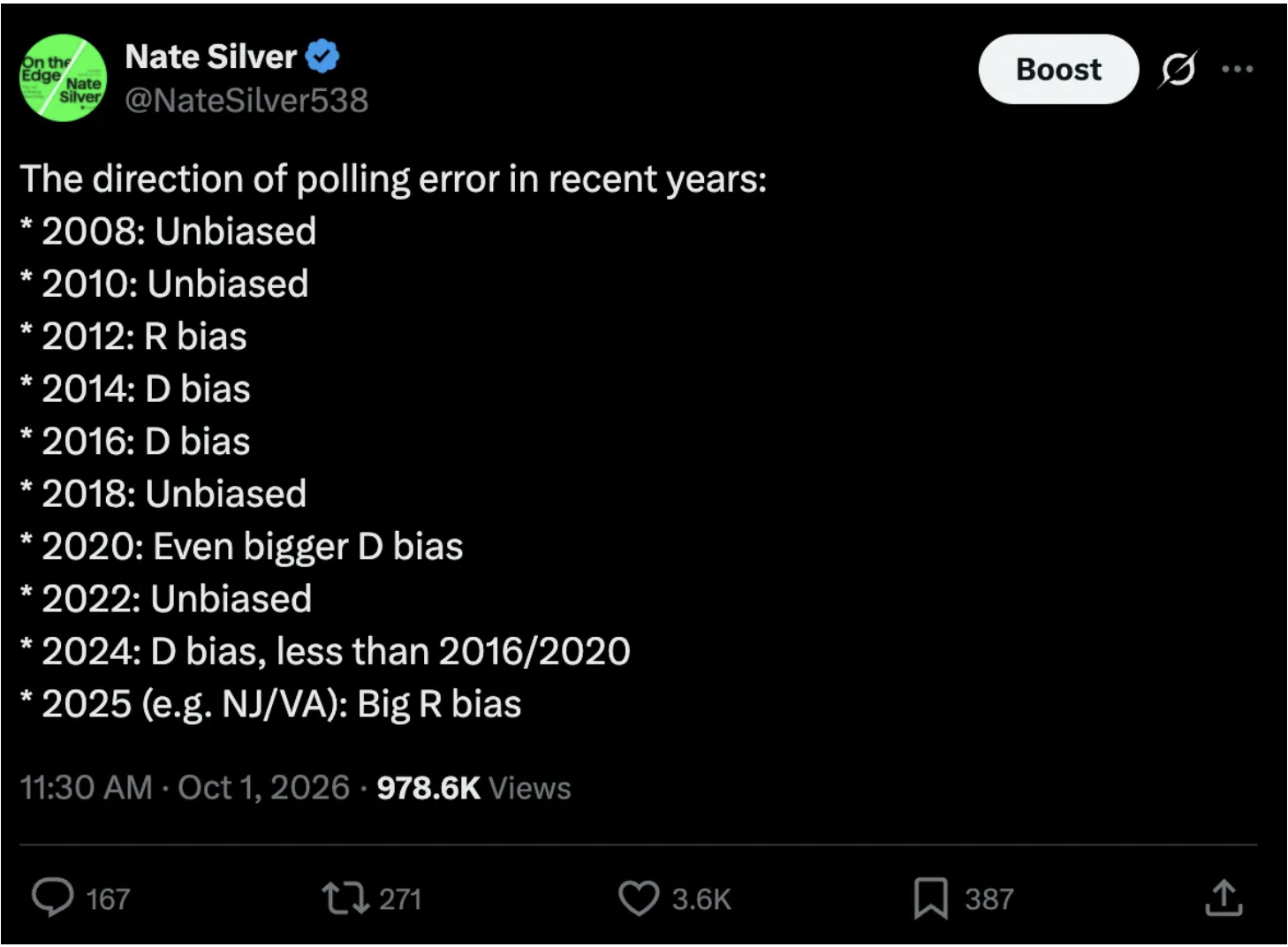
“Polls considerably underestimated Donald Trump and other Republicans on the ticket with him in 2016, 2020, and, to a slightly lesser extent, in 2024,” Silver wrote, noting with irony that “2020 was actually the worst polling error of this trio, but the one election that Democrats won.”
That may explain why Republicans are less likely than Democrats to trust polls. In a June 2024 NPR/PBS News/Marist survey, 61% of Americans reported not very much or no confidence at all in public opinion polls. Just 38% expressed a great deal or a good amount of trust.
But while 47% of Democrats said they trusted the polls, just 34% of Republicans (and 30% of independents) felt the same.
The University of New Hampshire Survey Center gets national attention when it releases its results, as it did two weeks ago. Interestingly, UNH doesn’t actually do “polling” in the sense most people use the word. It has a preselected panel of New Hampshire residents that UNH recruited to participate in future surveys. That means the same respondents can participate repeatedly over time.
Comparing the results of UNH’s final surveys, taken within days of the elections, with the actual outcomes yields mixed results.
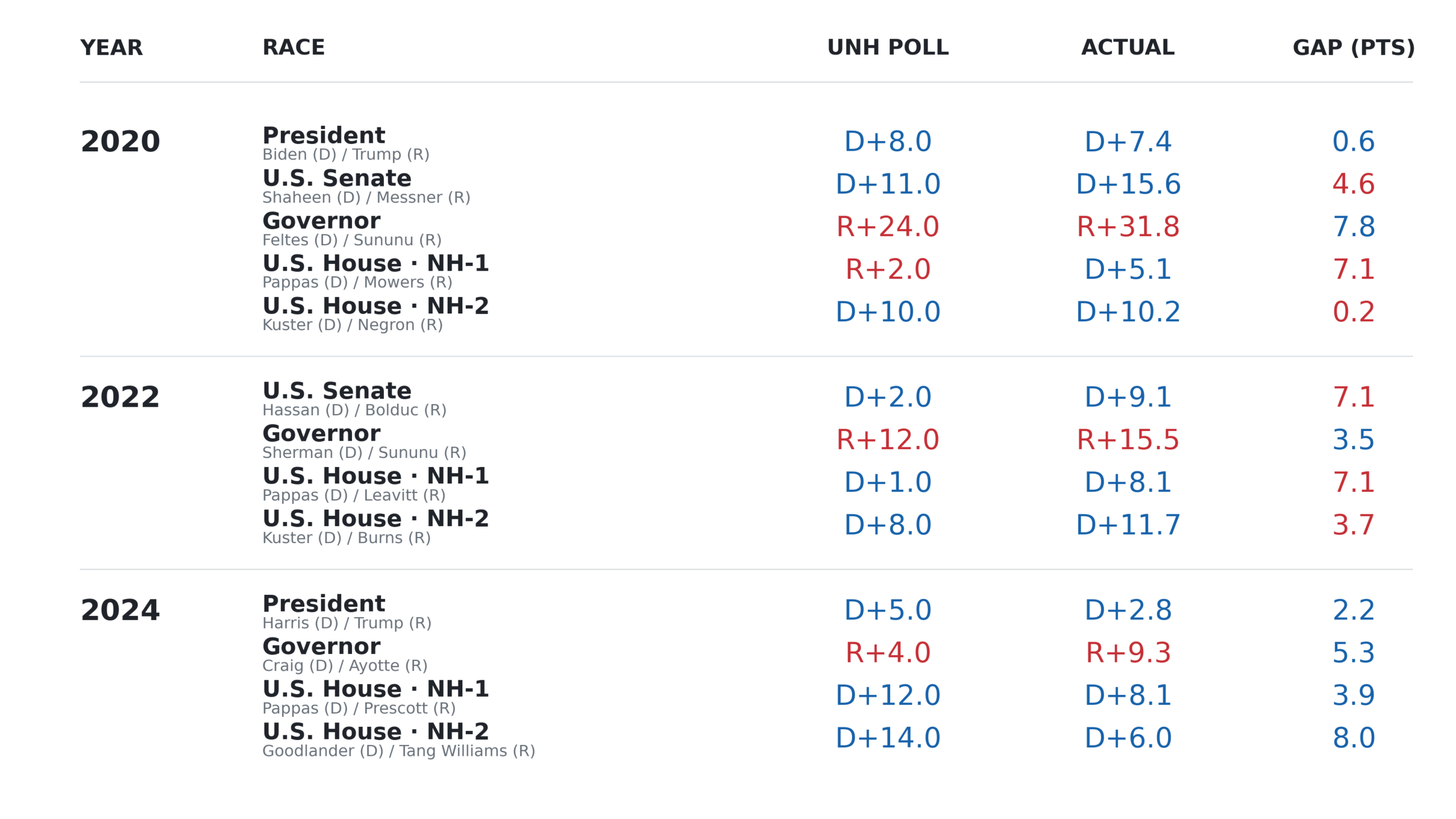
Note that in 2024, UNH’s results were skewed against Republicans in all four races.
Former New Hampshire GOP state party chair Fergus Cullen believes polling is fundamentally flawed. His focus is on the challenge of reaching the right people in an era when landlines have faded, cellphones screen unfamiliar callers, and surveys increasingly arrive by text or online.
“I started working in survey research before cell phones and before the internet, and then watched in real time as cell phone adoption and the internet changed everything,” he said. “I just don’t have any confidence anyone can get a representative sample.”
Cullen also questions whether averaging polls improves the picture.
“I think the adoption of averaging polls has ended up polluting the better polls with the bad ones,” he said. “I think there is real pressure in the industry to not publish outliers or results too far distant from what other people are reporting.”
For veteran New Hampshire Republican strategist Tom Rath, the answer is to put each poll in context.
“The best way to read the polls is with a sense of history and geography and skepticism,” Rath said.
“If you pick up a trend that defies this analysis, pay attention. And if there is a shift in one race from the norm, watch the rest of the ticket as well.”
This story was originally published by the NH Journal, an online news publication dedicated to providing fair, unbiased reporting on, and analysis of, political news of interest to New Hampshire. For more stories from the NH Journal, visit NHJournal.com.