Politics & Government
Smith Talks Cutting Taxes, Deregulating Small Businesses
Gubernatorial Candidate says he wants to model New Hampshire after New York City of the late 90s.


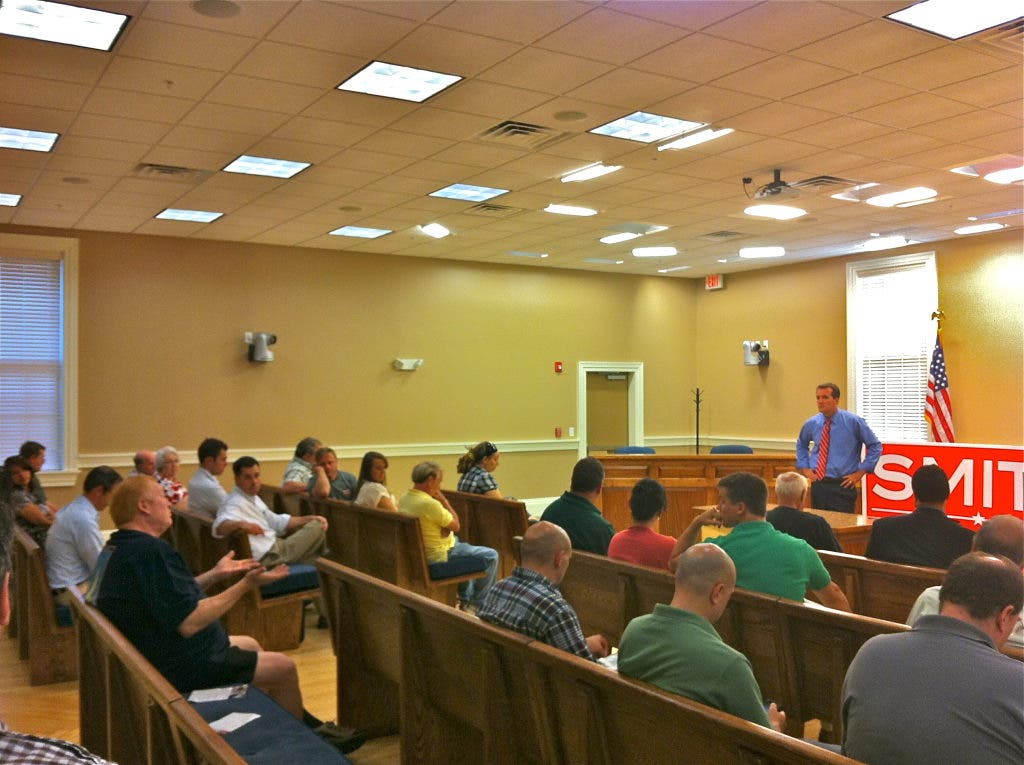


Gubernatorial candidate Kevin Smith is building a campaign on building the business economy in New Hampshire.
Meeting with Merrimack and area residents Thursday night at his 10th town hall meeting since his campaign started, Smith told residents that he hopes to make New Hampshire one of the most desirable states to do business in, but it's going to take work and it's going to take time, he said.
“I think the reason we are gaining this momentum and getting a lot of support in this state is because we're the only campaign out there that's really putting forth a bold vision for New Hampshire. Someone who's thinking 10 years down the road and asking ourselves, 'what do we want New Hampshire to look like by the year 2020. And how will we get to be one of the most economically competitive states in the country come that time?”
Find out what's happening in Merrimackfor free with the latest updates from Patch.
During his 25-minute speech, Smith touted his New Hampshire's Future is Now plan, which can be found on his website, and hit on some of the key components of his plan to diversify the state economy, reduce business taxes, deregulate small businesses, retain younger residents of the state and pull jobs back into New Hampshire from Massachusetts. He told the small group of about 20 attendees that his plan for New Hampshire mirrors that of what former New York City Mayor Rudy Giuliani did for business in the city while he was in office. Giuliani endorsed Smith just two days ago.
Watch: Kevin Smith anecdotally speaks about the importance of deregulating small businesses.
Find out what's happening in Merrimackfor free with the latest updates from Patch.
Smith said New Hampshire is the 5th highest corporate tax rate in the country and his plan calls for reducing the business profits tax and the business enterprise tax, which taxes small businesses that aren't even making a profit.
He would reduce the business profits tax from 8.5 percent to 5 percent by the year 2020, Smith said and the business enterprise tax from .75 percent back to .25 percent where it was when it started out. If a business is making less than a half a million a year, Smith said they would pay a business enterprise tax.
“We want to incentivize entrepreneurs to start businesses in the state of New Hampshire,” Smith said.
Smith conceded that in the first three years, there would be a loss in revenue if these taxes were reduced but there are inefficiencies in state government, he said, where some reform could allow the state to recoup those losses.
By year three, he said, the state would start to see a return on those lowered business taxes, just as New York City did. When Guiliani stepped into office, New York City had a very high corporate tax rate, Smith said, but by slashing the tax rate and making the city more business-friendly.
“Guess what happened over eight years?” Smith asked. “He slashed the business tax rate there but revenue from business taxes increased over those eight years because there was a broader economic base.”
Smith said he had no doubt this would happen in New Hampshire, too.
Smith also spoke about the need to retain younger residents in the state.
“We are losing young people in the state at an alarming rate,” Smith said, pointing out that the state's median age is now older than Florida.
He spoke of the need to get businesses and colleges and even high schools talking about ways to educate and prepare students for positions within the state. He spoke anecdotally about Hypertherm, a plasma and laser cutting company in Hanover that has a relationship with a two-year degree school in the Upper Valley and trains students to enter their field, then hires them. They haven't laid off an employee in 40 years, Smith said.
“We really should be honing the talents of every student that's going through our schools finding out where their talents are, where their passions are and also letting them know where the jobs are of the 21st Century.”
During the question and answer period following Smith's spech, Tony Cortese, of Bedford, inquired about high property taxes, high rooms and meals taxes and about retaining businesses feeling the pinch that could leave for more business-friendly states. He spoke about a rumor that Fidelity Investments was considering moving to the mid-west where business and property taxes are lower.
“Well that would be devastating. That would be completely devastating if that's the case.”
Those are the type of things where New Hampshire should have a proactive governor and proactive state agencies reaching out to current businesses to see how they are doing.
“Often times we don't find out before it's too late,” Smith said.
A spokesperson from Fidelity said that the rumors about the company leaving Merrimack are false.
Smith said the state, all the way down to the planning commissions in the communities need to be working with businesses to cut back on the red tape and show them they are wanted in the state.
Dennis King, a Merrimack resident, pressed Smith on several issues including the toll situation in Merrimack.
Smith told King despite living next door to Merrimack, in Litchfield, he didn't know enough on the subject to give a solid answer, but if elected, he'd be in touch with the highway commissioner to see what could be done for some potential toll relief.
Following the meeting, King said he'd come down to the meeting because he wanted to hear Smith talk, and that he liked what he heard.
“I need to hear more, I need to check him out online,” King said. “I haven't been won over one way or another.”
Cortese, on the other hand, is behind Smith 100 percent, he said.
“I thought he was excellent,” Cortese said. "...He's about putting more money in people's pockets."
Learn more about Kevin Smith on his website and Facebook page.
Get more local news delivered straight to your inbox. Sign up for free Patch newsletters and alerts.