Community Corner
DES Declares Air Quality Action Day
Unhealthy Air Pollution Levels Predicted from tonight through Thursday, Jan. 15, in southwestern New Hampshire.


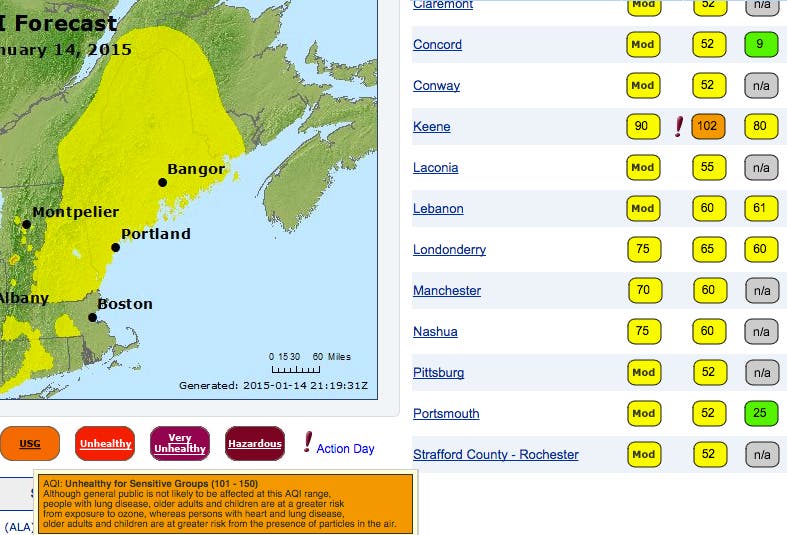
The New Hampshire Department of Environmental Services (DES) is expecting air pollution concentrations to reach unhealthy levels for sensitive individuals in populated valley areas in southwestern New Hampshire from Wednesday evening Jan. 14 through Thursday, Jan. 15. DES officials are calling for an Air Quality Action Day and advise sensitive individuals in these areas to take precautions to protect their health by limiting prolonged exertion. Sensitive individuals include children, older adults, and anyone with heart or lung disease such as asthma, emphysema, and bronchitis. Even healthy individuals may experience mild health effects and should consider limiting strenuous or prolonged activities.
DES forecasts fine particle pollution to be unhealthy for sensitive individuals in the above-mentioned region. The expected unhealthy particle pollution levels are largely the result of locally emitted pollution stagnating under calm winds and temperature inversion conditions. Temperature inversions occur during calm, cold nights when warm air above traps cold air below. Such events prevent pollution near the ground from mixing with cleaner air aloft. As a result, ground level pollution concentrations can increase. Conditions are expected to improve by early Friday morning as wind speeds increase, resulting in better mixing and cleaner air.
Communities located in valleys or other low-lying areas where temperature inversions are common are more strongly affected. Much of the locally emitted pollution comes from heating devices, especially residential wood-burning fireplaces, stoves and boilers. On the infrequent days when fine particle levels are forecasted to be high and the winds are calm, residents may want to avoid burning wood until such time as the winds increase (if an alternative heating source is available). This will help reduce fine particle pollution levels.
Find out what's happening in Milfordfor free with the latest updates from Patch.
The severity of the health effects increases as fine particle concentrations increase. People with asthma and other existing lung diseases may not be able to breathe as deeply or vigorously as normal and may experience symptoms such as coughing and shortness of breath. Symptoms of particle pollution exposure for people with heart disease may include chest pain, palpitations, shortness of breath, and fatigue. In addition to harmful health effects, fine particle pollution may create hazy conditions that reduce visibility.
For further information, contact DES at (603) 271-1370. For air quality forecasts and current air pollution levels in New Hampshire, call 1-800-935-SMOG or visit the DES website at airquality.nh.gov.
Find out what's happening in Milfordfor free with the latest updates from Patch.
Get more local news delivered straight to your inbox. Sign up for free Patch newsletters and alerts.