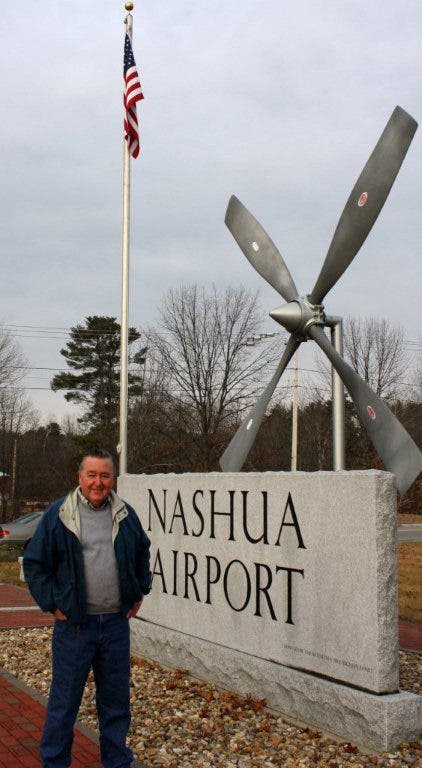
From Chester, N.H., to Libya and places in between details the military career of Chester native and now Nashua resident Dave Stapleford who enlisted in the Air Force on Nov. 12, 1956 in Manchester at the Air Force recruiting station which is now the Parthenon Restaurant.
Stapleford remembers, as do many, having his physical at the Armed Forces Enlisted Examination center on Silver Street. That was an experience that many a draftee during the Vietnam War years tried to get disqualified as 4-F.
Some even tried putting bars of soap under their armpits prior to the physical as word had spread it did something to disqualify people for military service.
It didn't.
Find out what's happening in Nashuafor free with the latest updates from Patch.
But back to Stapleford, he was eventually sent to Lackland, AFB for basic training and then on to advanced training to be a member of the Air Police. Then it was back to New England, this time to Ethan Allen AFB in Winooski, Vt., an old cavalry base where the barracks were like barns and cold like a barn would be too. This was in March of 1957 and when he arrived he was given two blankets and told to go upstairs. He did, and what greeted him were men in their bunks with "about 18 blankets each," he said.
"The building was heated by a coal furnace in the cellar and since it was cold, men had 'pots' under their bunks as it was too cold to go down to the bathrooms in the cellar." As he tells it, he shivered throughout the night with his two blanket quota while the others were comfy buried in their collection of blankets.
Find out what's happening in Nashuafor free with the latest updates from Patch.
In doing some research on an Air Force site, Fort Ethan Allen was first
established on Aug. 5, 1892 and first occupied on Sept. 28,1894. One of the largest cavalry and field artillery training posts in the United States, it was deactivated in 1943 and used for military storage. Acquired by the United States Air Force in 1952 and renamed Ethan Allen Air Force Base the base closed down in 1960 and declared surplus in 1962. Now it currently is the University of Vermont’s Fort Ethan Allen Camp, which is a portion of the Fort Ethan Allen Historic District with about 35 historic buildings used mainly for student housing.
In October of 1957 Stapleford left the cold of Vermont and headed for the "warmth" of Libya and Turkey. He flew in a "prop job" to Bermuda to the Azores to Libya. To prove it is a small world, the first person Stapleford met getting off the plane was Raymond High classmate "Tritty" Brousseau in the Azores. "He was working in finance, and I was surprised to see him. I lived on the Raymond side of Chester so I went to Raymond High while others in Chester could also decide to go to Pinkerton Academy in Derry," he related.
Stapleford recalled he had an uncle who served in the Canadian Army, "who was part of a peacekeeping force in Egypt and in later years was in Tripoli where I ended up. So I was like following his military path," said Dave.
Stapleford tells of one experience in which there was a plane crash, the afterburners weren't bolted down, "and the plane blew up near Tripoli," This kind of goes to show you their way of thinking back then. A camel caught fire and also a young girl was hurt. People rushed to put the fire out on the camel. "We went to help the girl and take her to a hospital and this started a riot. Here we were trying to help the girl and the crowd was coming after us. Libyan Police came in their gray buses and used night sticks like axes to keep the rioters away from us. This made us appreciate our country and its freedom even more," he said.
As a member of the 7272 Air Base Group the time spent in Libya was not very much fun.
"Think of 19 months without women, that's along time. The base they protected was used by pilots to train for 90 days temporary duty as with no rain they could train every day for eventual duty over Europe."
After his time there the Air Force increased the duty time to two years in Tripoli. Stapleford cited the Royal Air Force for having the edge over the U.S., in dealing with the Libyans as they spoke better Arabic than some Arabs. Their groups spent four to five years in the area.
Stapleford then asked me if I had ever heard of the Ghost Plane of the Desert. A plane on a bombing mission in 1943, the Lady Be Good, had navigation problems and they couldn't tell where they were in Libya. Some BP guys found the plane and campsite years later and even fired one of the plane's machine guns. With no rain, nothing rusted," he said. The history of the Ghost Plane is one of the highlights during his time in Libya. And having the plane found while he was stationed in the area gives him the wherewithal to pursue information on the plane whenever he can. He let me borrow a VCR recording of "The History Channel " program on the Lady Be good entitled, "History's Mysteries: The Ghost Plane of the Desert-Lady Be Good."
He has done research on the Lady Be Good and having firsthand knowledge agrees with information on websites.
One such site states "The B-24D Liberator named 'Lady be Good' disappeared on the way of Air Base of Benina Airfield in Solch, Libya, after 1st Bombing, of Naples, Italy on 4, April, 1943. On the way back home navigational problems happened. On 27, Feb, 1957, The BP oil surveyor airplane spotted the Wreckage in the Libyan Desert. In 1960, by another British Oil Exploration airplane crew found eight skeletons of crews with parachutes remaining." Stapleford has a copy of a National Geographic special on the missing plane.
From Libya and his addiction to the Ghost Plane of the Desert, Stapleford was sent to Williams AFB near Phoenix. In December of 1960 he came home ... in the middle of winter ... "so I hunkered down in the middle of a room with a heater going full blast in Chester." Then he and his family moved to Nashua where today he shares his experiences with Air Force friends and others... still keeping an eye on that Ghost Plane of the Desert.
Switching to a review, one book that deserves some press is "When We Walked Above The Clouds, A Memoir of Vietnam," by H. Lee Barnes, a professor of English at the College of Southern Nevada. Barnes pulls no punches in his gritty account of those he served with and those he lost. He brings you to experience digging a trench in 110 degree heat and ripping leeches off your body. Barnes writes hard and tells it like it was, not the Hollywood version of what the Vietnam War was all about. You should own this book. It's available from the University of Nebraska Press, Lincoln Neb. or at the web site www.nebraskapress.unl.edu.