Community Corner
Mill Tour de Force [VIDEO]
When 180 people show up on a Saturday to tour a dusty old mill, it means something.


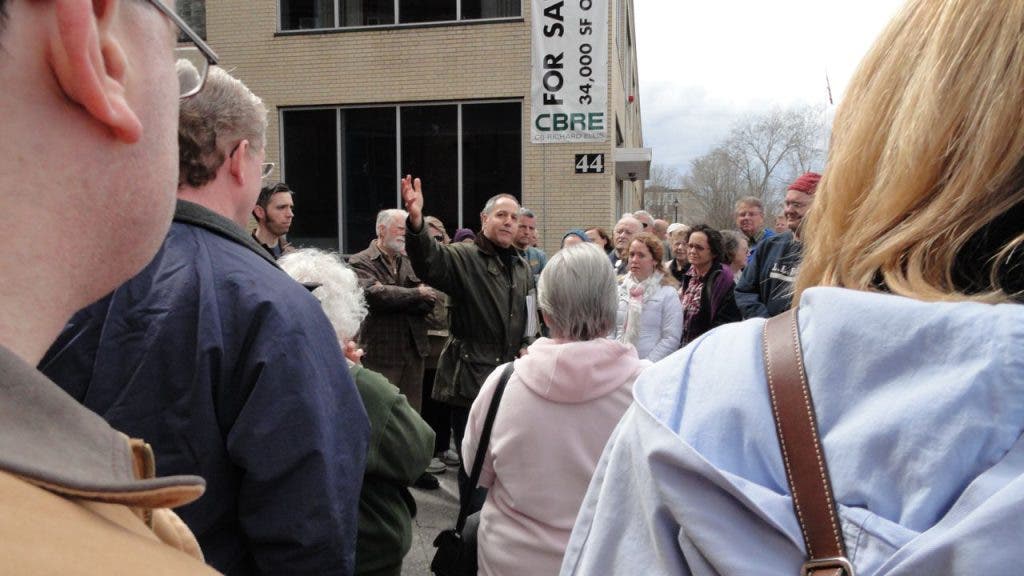


If he talks like a historian and walks like a historian, then he must be a historian – although Alan Manoian will tell you he's just an urban planner who knows his history.
Semantics aside, Saturday's tour of the Franklin Street Mill was a resounding success – for building owner Fulcrum Properties and for Manoian, the city's former Assistant Economic Development Director, who for years conducted informal neighborhood walks, discussing history.
The focus of Saturday's tour was not only on the rich history of the massive mill building, but its potential as a pivotal part of Nashua's future.
Find out what's happening in Nashuafor free with the latest updates from Patch.
Jack Heaney of Fulcrum Properties is working with James Vayo of Renaissance Downtowns to see if together they can create a vision for this space that will add value to the city, enhance the neighborhood and perhaps even become a draw, especially with the planned .
"We like to work on difficult problems; we like to fix broken buildings," said Heaney, addressing the crowd. "This really is your building – you own this. It's our job to figure out where the money will come from."
Find out what's happening in Nashuafor free with the latest updates from Patch.
Inviting the public to take a look-see and then offer ideas was a key component of the development plan. Following the tour, Vayo invited tourists to talk about their impressions of the space and write down their ideas for possible uses on large sheets of paper he hung on the wall.
Among the many ideas offered up: research labs, a history museum with people in costume, a charter school, a microbrewery, a waterfront restaurant, art studios, a year-round farm market, greenhouses and a community garden.
Early in the tour, Manoian charmed the crowd with delectable bites of mill history, like how its 1.2 million bricks from Bow and chunks of granite from Nashua helped create a one-of-a-kind structure, with attention to aesthetics and durability.
"This building is built of New Hampshire perfect stone. You'll never see such a thing again," Manoian said.
There were plenty of other stories, about the "castle-like" architectural features preferred by the building's original owners, who feared industrial espionage over their "top-secret" machinery, and of the world's first transatlantic telephone order, made from England to this plant in Nashua, for an order of ladies garters.
But the highlight for many came about halfway through the three-hour tour, the front door was unlocked and everyone climbed the stairs for a chance to roam around the spacious 310,000 square-foot former card and paper factory.
"These are people with a combination of family connections – whose mothers and fathers worked here, or who worked here themselves as teenagers – and those who just love learning more about Nashua," said Manoian, sizing up the crowd before the tour began. "The truth is, most of us don't know the real human story behind these buildings."
Norm Lavalle never worked inside the factory, but as an employee of the gas company, he had to come inside a few times to do work on the gas lines.
"They had a big melting pot where they melted lead, and I remember an elevator shaft – probably that one, right there," said Lavalle, spotting a large elevator in the center of the wide-open third-floor space.
"The tour was fantastic. I could definitely see beautiful apartments, especially on the river side, and maybe a restaurant on the ground floor – it will all come together. It's just a matter of time," Lavalle said.
Joanne Hall, a lifelong Nashua resident, said if apartments were part of the plan they should be affordable, but not low-income.
The city also needs other attractions – a movie theater within walking distance would be ideal.
Her friend, Geraldine Longenberger, agreed.
"It has to be mixed use, like in Lowell and Cambridge. And it can't be highbrow. I've looked at some of the condos they have here, like Jackson Falls – they were asking $400,000. We need to reclaim these old buildings, but it has to make sense," Longenberger said.
Sid Ceaser, a Nashua resident who rents studio space across the river in the millyard Picker Building, was also impressed with the space.
He can envision affordable studio spaces for art students or working professionals, like himself. He said he has been in the Picker Building for eight years, not because it's ideal, but simply because it's the only place in the city he can afford.
"I love the idea of studio space here. If that could happen, and I could pay about what I'm paying now for 1,100-square-feet, I'd do it in a heart beat," Ceaser said. "What worries me, though, is that once the Broad Street Parkway comes through and someone decides there's a goldmine in retail space here, I'll get priced out."
As the last few people made their way out of the building, Heaney called the tour a huge success.
"We were really impressed with the people who came out and we're reinspired to make this work. Clearly the community is interested in seeing something happen here," Heaney said.
Vayo encourages anyone interested in getting in on the conversation to become part of the Visualize Nashua group, by signing up at visualizenashua.com.
For inquiries about the property, Jack Heaney can be reached at jack@fulcrumprop.com.
Get more local news delivered straight to your inbox. Sign up for free Patch newsletters and alerts.