Community Corner
Veneer of Safety: Tragedy at Nashua Children's Home
Chapter 2: The initial healing begins, and the first trial ends in conviction for Daniel Ayer.
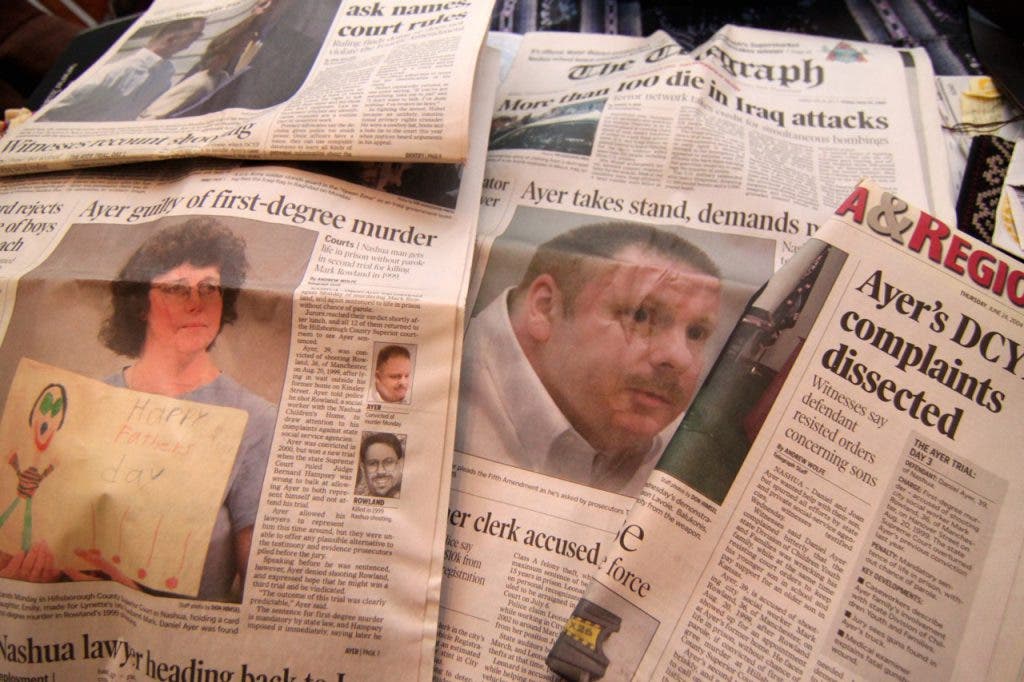
About this three-part series: On August 20, 1999, Mark Rowland, a therapist for Nashua Children’s Home, was shot to death by a client family member while conducting a home visit. This article presents the chronology of events through the lens of David Villiotti, who continues to serve as Director of the Children's Home.
Villiotti takes us through the initial chaos in the agency and community, the bizarre court proceedings that followed spanning five years, and the efforts of the agency to honor their fallen comrade, and to continue the pursuit of its century-long mission in the face of fear and self-doubt.
Editor's Note: This was written in 2008. We're grateful to Dave Villiotti for sharing it with us here at Nashua Patch, and with our readers.
Find out what's happening in Nashuafor free with the latest updates from Patch.
___________
Chapter 2
The Healing
Find out what's happening in Nashuafor free with the latest updates from Patch.
Mark Rowland was an avid basketball fan, particularly when it came to his hometown and the Syracuse Orange team. He was the staffer who most enjoyed the gymnasium, built on the grounds of Nashua Children’s Home in 1987. It was the only building at Nashua Children’s Home that was appropriate to be named after an individual, but remarkably, for 12 years, it remained simply, “The Gym.”
On the afternoon of October 23, 1999, “The Gym” was dedicated as the Mark S. Rowland Memorial Gymnasium. In attendance were Lynette, Emily, all of Mark’s family members from the Syracuse area, and his fellow parishioners from the Manchester Church of Christ. The plaque affixed to the Rowland Gym’s entrance now read: “Mark S. Rowland, 1963-1999, Counselor, Colleague, Advocate, Friend.” Bearing its new name in black lettering both at the outside entrance and on its interior walls, the Rowland Gym would later have blue and orange boldly added to the white interior, the colors of Syracuse University.
On May 14, 2000, the City of Nashua ball field abutting Nashua Children’s Home was dedicated as Mark S. Rowland Park, largely through the efforts of Alderman Jim Tollner, supported by Mayor Bernie Streeter. Lynette Rowland quoted from the gospel: “In this world you will have trouble but take heart …The best thing we can do when we have storms is to be prepared.”
Mark Rowland’s memory was honored several other times posthumously. He received the Dr. Roger Fossum Award for service to New Hampshire children at the annual attorney general’s conference on child abuse at Waterville Valley, NH in October 1999. In February 2000, he received the Outstanding Alumni Citation from Abilene Christian University, and in the following month was recognized as Outstanding Child Welfare Worker of the year for New England by the Child Welfare League of America. Addressing a crowd of 2,000 people at the League’s Annual Meeting in Washington, D.C., Lynette Rowland said, “It means affirmation that Mark was doing the right thing… It also means healing for me and my daughter. She’s only 2. She was robbed of the chance to know her daddy. I think it will help her as she grows older… to know her daddy was a great person.”
Every year since the tragic morning of August 20, 1999, the annual meeting of Nashua Children’s Home has featured the awarding of the Mark S. Rowland Exemplary Service Certificate, based on voting by Nashua Children’s Home staff for “the extraordinary efforts by a staff member in advancing the mission of Nashua Children’s Home.” The initial certificate, quite appropriately, was awarded to Assistant Residential Director Shalini Joshi, who along with her colleague Martha Read, was the first Nashua Children’s Home staffer to learn of the shooting as she responded to the scene. On the evening of May 7, 2000, balloons were released into the warm night air, and the assembled crowd sang “Happy Birthday,” as two days hence would have been Mark Rowland’s 37th birthday.
Until her move back to her native Colorado, and a few years since, this award was accompanied by the inspirational words of Lynette Rowland. “You don’t have to stop loving someone because they die,” Lynette said on this evening, previous to the keynote address by New Hampshire Attorney General Philip McLaughlin, who had also visited Nashua Children’s Home in the weeks following the tragedy.
“You fill their void,” he told Nashua Children’s Home staff, speaking of the children on whose behalf the organization exists. “You do it every day. You do it silently. You do it very well. It’s an admirable thing you do.” The Second Annual Mark S. Rowland Exemplary Service Certificate was awarded to Assistant Residential Director Laura Benevides in 2001, the supervisor so instrumental in providing an aura of calm and support to the boys and girls on the evening of August 20, 1999.
Grief counseling for the employees of Nashua Children’s Home directly followed Mark’s death. Staff struggled with the loss of their colleague, with their consuming grief, and also with fresh concerns about their own well-being. Staff at Nashua Children’s Home, and throughout the child welfare/juvenile justice delivery system, have always known that our work involved an amount of volatility, that our services are often provided to individuals who are labeled as “resistant” or “explosive.” Yet there had always been this belief, this veneer of safety, a belief that nothing that bad could ever happen. This veneer was now shattered. Something that bad, and far worse, had taken place.
Staff routines once commonplace were now viewed with trepidation: answering the front door on weekends when no receptionist was on duty, walking to one’s car when leaving a shift late at night, the sheer openness of our setting to visitors. We took reasonable precautions. A “panic button” was installed under the receptionist’s desk wherein Nashua police could respond to our site within seconds (it has only been used once in the nine years since). More security was added to our entrances, as well as a requirement that visitors be clearly identified with passes. Brighter and more ample lighting was added in our parking areas.
Most importantly, we needed to find a way to continue the pursuit of our mission in the face of such tragedy. I’ve often been asked how “long” it took us to “get over” the senseless acts of August 20, 1999. My answer is that we’re not “over it,” will never be “over it.” The murder of Mark Rowland is woven into the fabric of Nashua Children’s Home. It’s part of our history, part of who we are. Our challenge is to continue to honor the memory of Mark Rowland and to ensure that we do not forget the circumstances of his death, while also celebrating the energy and positive efforts he brought to his work with children and families.
The Case
The original charge of second-degree murder was changed to first-degree the following week. The pre-meditation standard was reached via statements that Daniel Ayer made to his wife Joan, as well as to a teenaged niece, of his intent. Ayer himself told police that he had considered making a “demonstration” since December 1998, telling NPD officers, “I had to kill someone so someone would listen.” Joan Ayer told police that Ayer said, approximately a week in advance of August 20, that he was going to shoot someone, and on that morning he left the house stating, “I’m going to do what I said I was going to do.” At the scene of the crime, Joan Ayer was described as being “hysterical,” stating to a Nashua police officer, “Oh my God he shot him … He said this morning that he was going to shoot him … He was sitting across the street waiting for him all morning.” The admissibility of a statement made by one spouse to another, and the ability to hear testimony on the comments of a person not called as a witness, would be contested months later.
From the time of his indictment, Ayer proved to be a petulant client. His attorneys, public defenders, pursued his competency to stand trial, maintaining that he was “suffering from a mental deficiency.” He rejected his lawyers’ attempts to challenge his competency, declaring himself mentally fit. Attempts to change the venue of the trial were unsuccessful. On three occasions, Ayer filed motions seeking to fire his court-appointed attorneys, accusing them of “taking part in a state cover-up” and also dismissed their questioning his mental competency as “slanderous.” Other complaints included the lack of promptness with which his lawyers responded to his requests for sufficient civilian clothes for court appearances. Copies of these complaints were filed with the Professional Conduct Committee, which oversees New Hampshire lawyers. All of these motions were rejected. The relationship of Ayer with his attorneys, Julia Nye and Richard Guerriero from the Public Defender’s Office, continued to be a prominent matter, through trial and beyond.
Pre-trial motions to suppress the recorded statements that Daniel Ayer had made to Nashua police officers following his arrest resulted in much of this material being ruled inadmissible. Motions seeking to suppress Ayer’s earlier statements to police, due to his claim of being too upset to understand the reading of his Miranda rights, were not upheld, however, and guns and other evidence taken from his truck were allowed as well. The Miranda question was ruled moot by presiding justice Bernard Hampsey, as Ayer’s statements to police were spontaneous and Miranda rights only apply when police initiate questioning. The portion of Ayer’s videotaped statement subsequent to his mentioning a desire to speak to an attorney was ruled inadmissible by Judge Hampsey.
The defense was unsuccessful on several other pre-trial motions as well. Ayer wanted to argue that the shooting was justified, as it was his belief that his son was going to be kidnapped. He also wanted the eventual jury to consider a lesser charge of manslaughter as he stated that he acted under “extreme provocation.” In addition to denying these motions, Judge Hampsey ruled that the jury could hear testimony about Joan Ayer’s remarks as they fell within the provisions of “excited utterance,” which are considered truthful, rather than hearsay.
Joan Ayer’s note to Mark Rowland asking to re-schedule their meeting and Mark’s written reply were not allowed, nor was Ayer’s statement to police about driving to the courthouse following the shooting for the purpose of “further demonstrations.” Both were considered to be overly prejudicial, potentially having the effect of unfairly inciting the jury. Ayer’s response to Judge Hampsey’s rulings, less than two weeks before trial, was to indicate an intent to boycott his own trial. His lawyers asked the New Hampshire Supreme Court to halt the upcoming trial for the purpose of reviewing Judge Hampsey’s rulings. They declined to do so, and also declined to force movement of the trial to another venue.
Trial #1
On July 18, 2000, the day prior to the first-degree murder trial of Daniel Ayer, the defendant made a request to represent himself. Judge Hampsey asked if he still planned to absent himself from the trial. When Ayer answered in the affirmative, Judge Hampsey stated, “Obviously I feel it’s a tremendous mistake he’s making, but it’s his mistake to make,” and approved Ayer’s plan. With Assistant Attorneys General Kelly Ayotte and Simon Brown prosecuting the case, Ayer’s public defenders were to attend the trial and serve only as “stand-by” counsel.
On the day of trial, however, Judge Hampsey reversed himself, and ordered Ayer’s lawyers, over their vehement protestations, to defend him. Ayer, absent but commenting on this reversal of the pre-trial, called Judge Hampsey’s ruling a “matter of treason.” Attorneys Nye and Guerriero asked Judge Hampsey to defer starting the trial until they could appeal his ruling to the New Hampshire Supreme Court and await a ruling. Judge Hampsey refused to do so. They did file an emergency appeal with the Supreme Court, asking for a stoppage of the trial, but as instructed, delivered the opening statement on the trial’s first day, and questioned witnesses.
On the trial’s second day, the New Hampshire Supreme Court halted the trial, ordering prosecutors to give reasons why Judge Hampsey’s order “should not be summarily reversed.” Both the defense and prosecution were ordered to argue whether the trial should resume with Ayer representing himself, or whether a mistrial should be declared. The Supreme Court’s ruling was unusual in that it rarely accepts pre-trial or mid-trial appeals because their involvement is moot if the defendant is acquitted. Ayer’s right to self-representation, no matter how ill-advised, was too important to defer until later.
Ayer’s first act as his own counsel was to ask for a “mistrial with prejudice,” essentially asking that the murder charge against him be dropped on double jeopardy grounds.
Mark Rowland’s family had arrived from New York and Colorado, but the trial was interrupted on Thursday and remained recessed until the following Tuesday. After questioning each juror on Tuesday afternoon, Judge Hampsey found no reason to declare a mistrial. The trial resumed with Ayer representing himself in absentia. The prosecution had recommended a mistrial, as they were fearful that the Supreme Court would overturn a guilty verdict on appeal, as. Ayer’s right to self-representation had been compromised. When the trial resumed on Wednesday morning, the defense called no witnesses, cross-examined no one, and offered no closing statement. The case went to the jury on Thursday afternoon. On Friday morning, July 29th, they rendered a verdict: Daniel Ayer was found guilty of first-degree murder. Judge Hampsey, stating that he “wasn’t going to sentence an empty chair,” required Ayer to be present for sentencing.
Lynette Rowland delivered the Victim’s Impact Statement. The podium faced the front of the courtroom, aimed at the judge and witness box. She turned it to face the defendant. The widow juxtaposed her blissful life with Mark with the misplaced angst of Daniel Ayer.
She recounted the wretched timeline of August 20, 1999, Mark leaving their home, kissing her goodbye, the phone call that she received from me – the one that no one ever wants to receive, her arrival at the hospital, her realization that her husband was dying. She referenced Daniel Ayer’s claim of unfair treatment.
“Do you want to know what’s unfair? It’s unfair that we should be even having a trial in the first place. It’s unfair that one man’s choice to use a gun has destroyed one innocent life and has affected and is continuing to affect so many others. It’s unfair that the silenced voice of Mark Rowland cannot be heard at this trial. So I, speaking for him and for the many of us who have lost Mark, want you to hearken to the silent voice. The voice that speaks the loudest is that of my 2-year-old daughter: ‘My daddy didn’t want to die. When can we go see him? Saturday? The bad man killed my daddy. He made a bad choice.’ ‘You’re right, Emily. He will have to sit in time-out for a very long time.’ And to Ayer she said: “…do you realize you killed the very person who would have listened to you better than anyone?
Then: “I hope that someday you will feel remorse for what you did. If you do, and if you confess and express that remorse to God, He will forgive you. I suppose I could even find it in my heart to forgive you, to, although I don’t pretend to be as loving as God. But if you don’t…if you continue through the rest of your life with a hard heart and a victim’s mindset, then you will suffer right along Satan for eternity for this act that you committed at his prompting.”
Daniel Ayer was sentenced to life in prison without the possibility of parole.
Coming Saturday: Chapter 3 - The retrial, final outcome, and reflections.
About the author: David Villiotti has worked in residential treatment facilities for 36 years, the past 27 years as Executive Director of Nashua Children’s Home. Click the video to hear in his own words his process of putting this story into words.