Politics & Government
Geno Marconi Pushes For State-Funded Defense In Lobster Roll Lawsuit
Geno Marconi was forced to retire from his position as the Director of Ports and Harbors last year when he pleaded guilty to a misdemeanor.

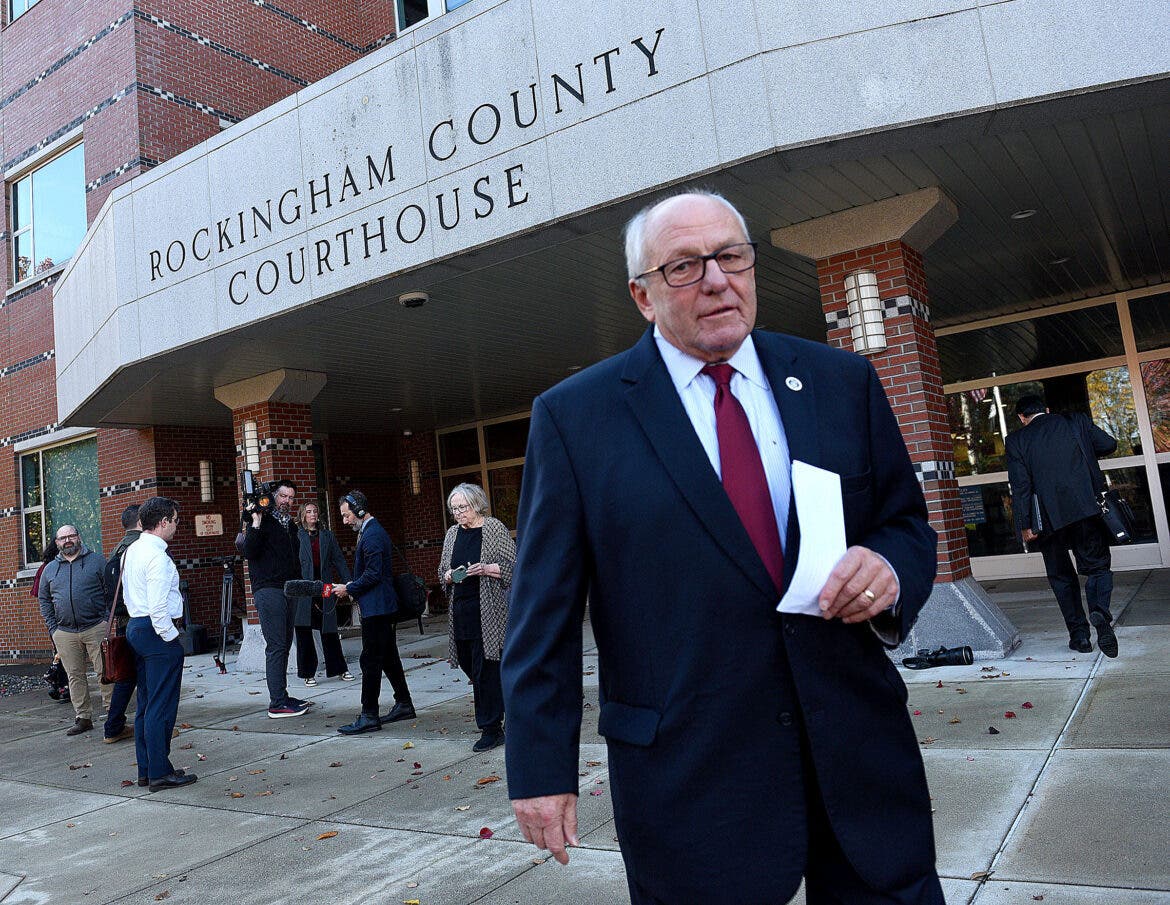
Geno Marconi says his right to a legal defense in the Rye Harbor Lobster Pound lawsuit is being thwarted by the Attorney General’s Office and Gov. Kelly Ayotte.
Marconi was forced to retire from his position as the Director of Ports and Harbors last year when he pleaded guilty to a misdemeanor charge of violating the state’s driver privacy act. It was the final chapter in the odd scandal that engulfed the Pease Development Authority, the New Hampshire Supreme Court, then-Gov. Chris Sununu, and Attorney General John Formella.
Find out what's happening in Portsmouthfor free with the latest updates from Patch.
But the civil lawsuit alleging corruption at the harbor is providing, if not a full sequel, at least an epilogue to the tale of Geno Marconi.
Marconi’s lawyer, Arnold Rosenblatt, filed a Writ of Mandamus last week in Merrimack Superior Court in Concord, demanding a hearing in front of the Executive Council. The issue Marconi wants heard is the fact Formella and Ayotte are denying him a defense in the civil lawsuit.
Find out what's happening in Portsmouthfor free with the latest updates from Patch.
Marconi is a named defendant in the civil lawsuit brought by Rye Harbor Lobster Pound owners Sylvia Cheever and Nathan Hansom. Cheever and Hansom claim Marconi, as the director of the New Hampshire Division of Ports and Harbors, targeted them for unfair treatment between 2020 and 2023 in order to help friends and family.
But Cheever and Hansom also name several others as defendants in the lawsuit, including the Pease Development Authority Board, and Executive Director Paul Brean. Under state law, Marconi ought to be indemnified and defended by the state in the civil lawsuit, according to Rosenblatt. The lawsuit concerns actions he took as a state employee on behalf of the PDA.
“The allegations against Mr. Marconi in the Civil Action arise exclusively from his actions in his official capacity as Director of the DPH. The Civil Action concerns the PDA and DPH’s regulation of a commercial establishment located at the Rye Harbor State Marine Facility, which is a matter squarely within the scope of the Director’s statutory responsibilities,” Rosenblatt wrote.
But Formella and Ayotte have so far denied Marconi’s request for a state-funded defense against Cheever and Hansom. When he first requested the state defend him last year, Formella’s office told Marconi he didn’t qualify for defense under the law. According to Rosenblatt, allegations from Cheever and Hansom against Marconi were part of the evidence presented to the grand jury, but which did not result in any charges.
Marconi appealed the denial to Ayotte’s office last year, and she responded this year. Her legal counsel, Myles Matteson, told Rosenblatt that Ayotte was not going to consider his appeal, and had no intention of letting Marconi make his case to the Executive Council.
“As I have indicated to you previously, the Governor controls the agenda of items considered by the Executive Council. That means that petitions such as those under [state law] 99-D:7 are put on the agenda to appear before the Council only with the exercise of the Governor’s discretion. In this case, given her denial of the appeal, there is no further consideration of this petition by Governor and Council,” Matteson wrote in April.
Marconi has the right to appeal to both the Governor and the Council, Rosenblatt wrote, and he now wants a superior court judge to force Ayotte to put the appeal on the Council agenda.
“Mr. Marconi has a clear legal right to have his petition presented to and acted upon by the Governor and the Executive Council, and the Respondents have a corresponding non-discretionary legal duty to do so,” Rosenblatt wrote.
Marconi was placed on leave from his job in the spring of 2024 when the Attorney General’s Office kicked off a prolonged criminal investigation. Court records previously released indicate Marconi was investigated for allegedly taking kickbacks and engaging in COVID relief fraud as well as the alleged harassment of the Rye Harbor Lobster Pound business.
However, Marconi was never charged for any crimes related to any of those allegations. Instead, the charges that were finally filed in October of 2024 were all connected to Marconi sharing PDA Board Vice Chair Neil Levesque’s vehicle registrations, which are considered private records under the law.
In between the start of the 2024 investigation and the indictments, the whole controversy snared his wife, then-New Hampshire Supreme Court Justice Anna Barbara Hantz Marconi.
Hantz Marconi recused herself from all cases involving the New Hampshire Department of Justice when the investigation started in April of 2024, but became frustrated as it dragged on into June of that year. She was given a meeting with Sununu in June where she reportedly expressed her frustration with the way the investigation hindered her ability to work. Before the meeting, Hantz Marconi claims that Chief Justice Gordon MacDonald gave her the “OK” to talk with Sununu about her concerns. MacDonald later disputed that version of events.
When Formella learned during a subsequent phone call with Sununu about the Hantz Marconi meeting, the Attorney General opened his own investigation into the sitting justice, according to court records. Sununu told Formella and investigators he did not think Hantz Marconi crossed any legal lines in the talk. For his part, court records indicate Formella was concerned that Hantz Marconi called him “weak.”
Hantz Marconi was placed on leave and, months later, indicted on felonies for allegedly trying to pressure Sununu to take some sort of action in the matter. She has consistently denied any wrong doing.
Both Hantz Marconi and her husband’s legal cases came to a close last year with plea deals. Hantz Marconi pleaded no contest to a misdemeanor, paid a $1,200 fine, and returned to work on the Supreme Court. Geno Marconi pleaded guilty to a misdemeanor, paid a $2,000 fine, and retired from his state job. Neither spent time in jail. Harbor Advisory Board Chair Brad Cook, the man with whom Geno Marconi shared Levesque’s vehicle registrations, also got a plea deal that kept him out of jail in exchange for a fine.
Levesque and Marconi were adversaries within the PDA universe, and Levesque pushed allegations of corruption against Marconi. Marconi reportedly shared the vehicle registrations that were filed with a pier permit as part of a yet unexplained retaliation scheme.
"I was but one witness who uncovered what I believe to be vast wrongdoing by the defendant. I was subpoenaed to testify before the grand jury to testify to what I knew, and I complied with my duty to provide that testimony,” Levesque said in a prepared statement after Geno Marconi’s guilty plea. “I was subsequently the victim of retaliation as I, and others, worked to disclose what I believe to be a sophisticated, organized criminal enterprise, run by the defendant.”
As Geno Marconi’s defense attorney, Richard Samdperil, noted at the time, there is still no proof of Geno Marconi’s alleged criminal organization.
“After four and a half years of investigation, including going through his personal finances, his family’s finances, his computer and phone, and months of interviews and similar proceedings, the state has never charged him with any criminal conspiracy or enterprise. It’s a baseless accusation,” Samdperil said.
This article first appeared on InDepthNH.org and is republished here under a Creative Commons license.