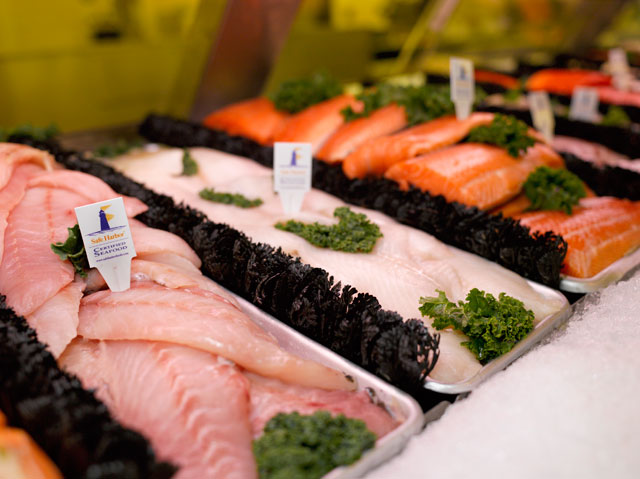
Grocery shopping for fish can be extremely daunting. When approaching the fish counter at your local grocery store, a myriad of questions can arise. Does this fish contain compounds or chemicals will harm me and my family? Where did this fish come from? Is this fish wild-caught or farm-raised and does that actually matter? This article will delve into the surprising answers to these questions.
The Institute for Health and the Environment at the University of Albany published a study in Science attempting look at some of these very questions regarding one of the most popularly consumed fish: salmon. The study analyzed roughly 700 salmon fillets that were wild-caught and farm-raised from major fisheries around the world. The fillets were analyzed by biology and toxicology experts. The study concluded that farm-raised salmon contains much higher concentrations of compounds that are known to cause cancer, specifically PCBs, dioxins, dieldrin, and toxaphene. Additionally, the EPA concluded after the study that consumers should limit their consumption of farm-raised salmon to no more than one meal per month!
The study suggests that the problem stems from what the fish are being fed. Whereas wild-caught salmon typically eat a range of small micro-organisms like krill, farm-raised salmon are fed a mixture of ground up fish and fish oils, known as “salmon chow”. Since chemical contaminants a fish is exposed to during its life are stored in its fat, this higher fat "salmon chow" passes along more of these contaminants to the farmed salmon than a wild-caught salmon would ever be exposed to. The authors of the study add that consumers may be able to mitigate the detrimental effects of consuming farm-raised salmon by removing as much skin as possible before consuming. Since these harmful compounds are stored in the fatty skin of the fish, removing the skin can help to lessen the amounts of chemicals consumed. But if the wild-caught variety of the fish is vastly safer, then why take the risk at all?
Find out what's happening in Portsmouthfor free with the latest updates from Patch.
Another popularly consumed fish is tilapia because of it's mild-flavor and relative inexpensiveness. Ninety percent of available tilapia is farmed in the United States, which makes it readily available for consumers in the United States. Aside from it's modest amount of B-Vitamins, selenium and potassium, the harm of eating farm-raised tilapia far outweighs the benefit. Tilapia contains high levels of arachidonic acid, which can cause high levels of inflammation in humans. If you pair this fact with the high levels of omega-6 acids that tilapia contain, consuming large quantities can put consumers at a higher risk of high cholesterol, high blood pressure, diabetes, cardiovascular diseases, arthritis and other inflammatory diseases. Once again, the problem seems to stem from what the fish are being fed, as their diet consists of soy-meal, corn-meal, and algae that forms in their fisheries.
Wild-caught fish are not completely void of imperfections. Mercury is accumulating in the oceans at an alarming rate due to industrial smoke stacks spewing it as a byproduct from burning coal. Micro-organisms like phytoplankton absorb this harmful element when consuming mercury-laced algae. Small fish will then consume the phytoplankton and then a larger fish will then consume the small fish. Each time a larger fish consumes a smaller one, it absorbs all of the mercury content from the smaller fish and phytoplankton. This means that fish higher on the food chain such as sharks, tuna and swordfish end up having the highest mercury content. Mercury is a neurotoxin that has been linked to conditions like Autism and Aspergers. Over-consumption could put your potential future children at risk for developing these conditions. In this case, it can pay to just avoid tuna, swordfish and shark altogether.
Find out what's happening in Portsmouthfor free with the latest updates from Patch.
When at the fish counter, be sure to ask these questions: Is the fish farm-raised? Where was the fish caught? In the case of salmon, farm-raised fillets generally have more of an opaque-orange hue, whereas wild-caught have more of an reddish hue. Typically fish caught in the Pacific are safer than the Atlantic. In fact, any salmon that says “Caught in the Atlantic” is almost definitely farm-raised because over-fishing has put a ban on most wild Atlantic fisheries. Additionally, just because a fish is labeled as “Fresh” does not mean that it is wild-caught. Many fish counters will not discern if their fish is farm-raised or wild-caught when displaying them, which is why it so important to ask.