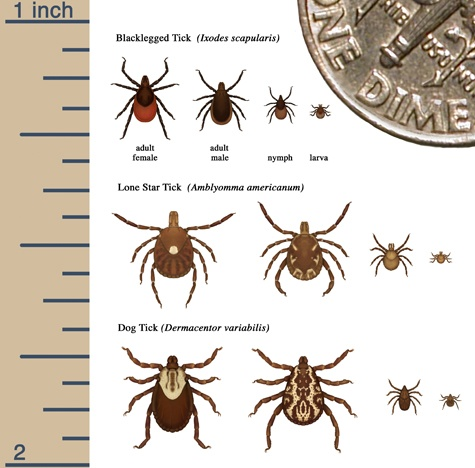
Lyme disease is the most common tick-born disease in the Northern Hemisphere. According the Centers for Disease Control and Prevention, about 30,000 confirmed and probable cases of Lyme disease occur each year in the United States. It is prevalent throughout wooded costal regions of the Northeast, the Great Lakes and the Pacific Northwest and incidents peak between the months May and August.
It is often labeled as “The Great Imposter” disease because it can be misdiagnosed as fibromyalgia, chronic fatigue syndrome, multiple sclerosis, ALS as well as other debilitating diseases. A telltale sign of Lyme disease is the Bull’s Eye rash that appears at the site of the tick bite, but is not always a clear indication of the existence of the disease. In nearly half of all reported adult cases, the Bull’s Eye rash did not appear at the site of the bite and therefore more clinical evaluation is usually necessary to give a diagnosis.
As we enter an era where the prevalence of Lyme disease is becoming more of an immediate threat, various questions arise. How can it be prevented? Is it treatable? What will life be like once it is contracted?
Find out what's happening in Portsmouthfor free with the latest updates from Patch.
Prevention may be easier said than done, but is certainly not impossible. Firstly, in warmer months, people should avoid thickly wooded and bushy areas with high grass and leaf litter, as these are the most common residences for the pathogen-carrying ticks. When walking through the woods, try to walk in the center of trails. Wear bright clothes so ticks are more visible and place pant legs on the inside of socks for better skin protection. Bathe immediately after coming home and do routine full-body tick checks to assure there are none present. Ticks tend to hide under arms, in and around the ears, inside the belly button, behind the knees, between legs, around the waist, and especially in hair. Examine outdoor gear and all pets that go outside. If ticks are suspected of being present on clothes, try tumbling them in a dryer on high heat for an hour so that any present will perish.
Although there is not a known cure for Lyme disease, it is still certainly treatable. Most people that contract Lyme notice extreme fatigue, muscle and bone discomfort as well as cognitive impairment. A rotation of various herbs and botanicals is crucial to the treatment of Lyme disease. Herbs such as cat’s claw, Banderol, garlic, andographis, teasel root, and Japanese knotweed have all shown an ability to decrease the pathogen count of Lyme disease. Plants like Cilantro and Chlorella have toxin-binding properties that help to purify the body of the toxicity that is produced as the bacteria perish. Additionally, Silver hydrosol is a natural antibacterial that can kill the disease causing microbes. All herbs and botanicals should be taken under the supervision of a doctor.