
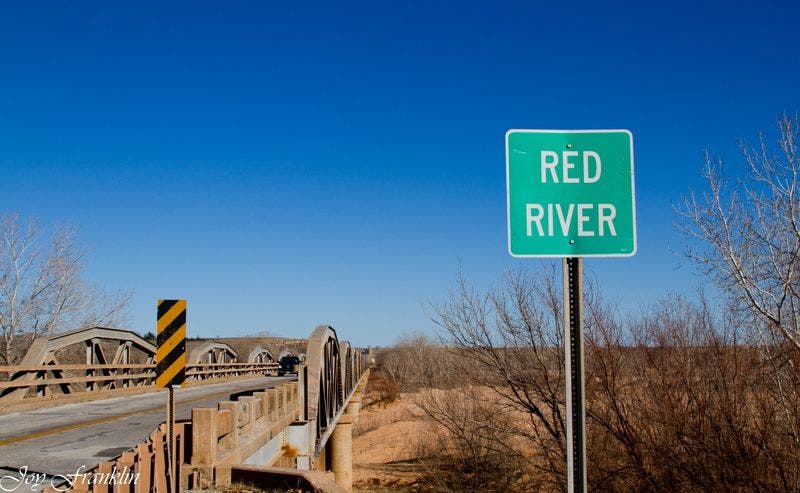
Dad spent the better part of one hot August day getting pretty loaded on Jack Daniels, the Old Number 7. That itself wasn’t anything new, but this time he drove us down Interstate 35 in his crappy ‘74 Dodge Challenger with the mag wheels and side pipes, a considerable source of pride that he called “Old Blue.” We parked just before the Texoma Bridge, which crosses the river where the bank is wide and the water runs slow and dirty. The dirt is red in Oklahoma, and so is the river.
Paul, my oldest brother, had saved all winter and spring for a Ruger 10-22, .22 caliber rifle, and he was really excited about shooting it for the first time. All any of us could think about was shooting that gun.
At first, Mom refused to even buy it for him. “If you can save enough to buy it yourself, then you can get one,” she’d told him – never believing a fourteen-year-old would actually do it, and not believing any of us could do much of anything. Paul worked an extra paper route, slogging through a long and nasty winter (both are rare in Tulsa) and saving every penny, until he had enough.
Find out what's happening in Portsmouthfor free with the latest updates from Patch.
Mom was a mean woman, but there were rare moments when some long-forgotten love of justice clawed its way to the surface and overpowered her more natural tendency to cause hurt. The look on her face was more than angry. Mad could earn you a slap or two; this was defeat. She didn’t speak to Paul for two days, but she bought him the gun.
That didn’t mean she would take him anywhere he could shoot it, and there was no way she’d agree to let Eddie or me go. Working a couple of jobs left her pretty spent, and what energy she had left was used up on the doctors she dated. No way was she going to look for a place where we could shoot.
Find out what's happening in Portsmouthfor free with the latest updates from Patch.
Tulsa died when the oil money pulled out, but it was still a big city in 1981 – largely a suburban one, but where we lived, right smack in the middle, there was nowhere nearby you could shoot a gun without attracting a lot of attention. Just street after street of houses: one-square-mile grids, tick-tack-toe boxes with outlying thoroughfares lined with strip malls, apartment complexes, gas stations, bars and movie theaters. You might find a vacant lot, but the cops were everywhere and they were pricks.
Paul had complained, but Mom didn’t care. “Take it with you when you go see your father,” she’d told him. “Let him deal with it.” Paul did.
Dad lived in Oklahoma City, down Interstate 44 from Tulsa. I’ll always remember him saying, “It’s ninety-nine miles to Oklahoma City, and a-hundred ninety-eight miles to Lawton!” I still don’t know if that’s true, but I remember Mom cussing “that pack of trash he calls friends” who lived all along the way. Dad insisted she was “crazy as a shithouse rat.”
Mom dumped us with him. The plan was for us to stay the whole month of August. The problem was Dad liked to drink, and he was kind of cheap. Jack Daniels was expensive, he always said, so you had to skimp on everything else. When he told us we were going fishing we begged him to get some bullets. “We’ll stop by Otasco!” he said, eyes lighting up, finger poking at the sky – as if this ubiquitous piece of our childhood and the Oklahoma landscape were a revelation.
Predictably, he’d grabbed the cheapest ammunition they had: the last two boxes of Number 12, a pistol cartridge that people called snake shot (“Because it’ll turn that rifle into a shotgun,” he said, in answer to our quizzical stares), and their last box of ball ammunition. The Number 12 was a big mistake; the Old Number 7 was a bigger one.
At the river, I sat in the shade under the bridge and Dad told me to cast a line while he and Paul did some shooting. They found some old tin cans and set them up, Paul running down range to place new targets as Dad reloaded the ten-round magazine. The ball ammo went quick, in 10-shot bursts – one on a water moccasin that Eddie found sunning itself a little ways downriver, and Dad blasted into hamburger. I couldn’t concentrate on the fish because I was too busy thinking about shooting that gun.
Dad dug into a fresh box, the Number 12, reloading the magazine. Dropping the slide, he shot a can, but the next round jammed against the empty casing still lodged in the chamber. “Goddamn cheap ammo!” he exclaimed, voice level, but forceful. Ripping the magazine from the well, he shoved it towards Paul, not looking at him. After six or seven tries at pulling the slide back hard and shoving it forward he gave up, setting the rifle aside and grabbing his bottle.
Taking a long pull, he looked at us sternly. “Don’t touch that gun,” he said, getting up and weaving his way back to the car. Returning, he held a straight-blade screwdriver in his hand. Slumping back down into his camping chair, he jerked the slide of the rifle back and prized the empty casing out of the chamber. “Too long,” he mumbled, swaying in his seat, holding out the tiny brass cylinder; made for a pistol, it simply wouldn’t fit properly in the rifle’s chamber. Squinting disapprovingly, he tossed it aside and reached for another one.
I glanced their way, noticing that Dad was about halfway through his bottle. Looking up, Paul met my stare. We were thinking the same thing. “Dad,” he said, voice rising just a little; still looking at me, I could already see the hurt in his eyes. “Don’t you think you oughta lay off a bit?”
Eddie, the brother wedged right between us in age, was standing off a bit, near the water again, but within earshot. He heard the question, and his body turned involuntarily toward us. It was a thought we’d all had many times; we’d talked about it amongst ourselves when Dad couldn’t hear, and every now and again we’d even hide his bottle. Come morning he’d go looking to spike his coffee and all hell would break loose. Sooner or later, we had to tell him where it was.
“Shut up!” he snapped, lips tightening into a circle and drawing back slightly from his teeth. We knew that expression; Eddie had been the first one of us to notice that it made Dad look just like Clint Eastwood, right before he killed a bad guy. From that day forward we had called him Dirty Dennis – but only if he was in a good mood. As his head snapped up, a strand of black hair fell across his face. He was good and drunk at this point, struggling to focus. Immediately, shame washed over him and his face softened. “I’m fine,” he said, trying to sound apologetic but sounding impatient instead. That was the thing about Dad: he was a terrible father, but at least you got the sense that he felt bad about it.
With the rifle slide still locked to the rear, Dad placed a fresh round directly into the chamber. Something across the river grabbed his attention and he dropped the slide, pulling the rifle up quick and taking aim. A squirrel had wandered down to the water on the Texas side, maybe seventy-five feet away. Dad killed it easily; we thought that was pretty cool. At that distance, we shouldn’t have.
Chuckling, he handed the rifle over to Paul and took another long pull on the bottle. “That snake shot ain’t extractin’,” he slurred. “You’ll have to load ‘em one at a time, and pry out the empties.”
That’s when things really went wrong. Paul grabbed the screwdriver and dug the empty casing out, but in his excitement he set the fresh cartridge kitty-corner in the chamber. When he dropped the slide it jammed, on a live round again. For some reason that we never could figure out, the slide just wouldn’t come back now – no matter how hard Paul yanked on it. Dad watched for a while, eying the struggle impassively as he took another couple of drinks. Once it was clear that Paul was beaten, he set the bottle down and reached out for the gun.
“Lemme have it,” he said. Dad always wanted to be helpful, he just never really knew how to do it right. Taking the gun confidently, he placed his left hand over the end of the barrel, the muzzle resting firmly in the middle of his palm. Right hand on the stock, he started bouncing the rifle on his knee. Changing his grip after a moment, his thumb slipped inside the trigger guard and rested firmly across the trigger.
I hadn’t noticed any of this. Bored, I’d set the fishing pole down and walked over to where Eddie was skipping rocks. It was early evening by now, but the humidity wasn’t letting up one bit. The air under the bridge was cool and damp, and coming out of the shade the heat hit me like a wall. I picked up a rock and let it fly; bouncing across the water, it came to a rest just inches from the opposite bank. Eddie looked at me, his face showing approval. Even though less than two years separated us we’d never been very close, but in that moment, when he looked at me, I felt like I’d pleased him. I liked the feeling. Another thirty seconds of Dad bouncing that rifle on his knee, and the bullet slipped out of the groove in which it had become wedged and slid perfectly into the chamber. The slide followed it all the way down, driving the cartridge firmly into place as Dad’s thumb applied backward pressure on the trigger.
The hammer fell on a primer that functioned exactly as it should have. The Number 12 splintered through Dad’s left hand, spiraling off into the Oklahoma sky. “Ow!” he shouted, jerking his hand back and shaking it violently, like he’d been stung by a bee. Blood splattered the front of Paul’s Van Halen t-shirt. Eddie and I hadn’t seen a thing.
“Boys,” Dad said, dragging that one syllable word out long and serious, “pack up your stuff; we gotta go.” Something in his voice sounded different. Perhaps he sobered up for just that instant. But we were busy having fun, and not interested in a long drive back to the city. “Aaaww,” we complained in unison, looking in his direction. “Do we have to?”
And there stood Dad, swaying from side to side as the blood dripped down his fingers, forming a dark red pool in the pale red dirt by his foot. “Yeah kids,” he said. “We gotta go.” A nervous smile was on his lips, but there was fear in his eyes. “I just shot myself,” he said.
Paul pulled off his shirt, handing it to Dad, who took it with his injured hand. His face grimaced as he closed his fist tightly around the cloth, instantly soaking it with blood. Turning away, he didn’t wait for our compliance, instead reaching down for his bottle and starting for the car. Paul was at his side, carrying the rifle, the muzzle pointed safely at the ground. Eddie grabbed Dad’s chair, and I grabbed Dad’s fishing pole. We left the bag of Number 12 where it sat.
Back at the car Dad fell into the passenger’s seat and upended the fifth, gulping it down. Slouching forward, his feet flat on the ground, he stuck his left arm straight out, through the car’s open window. Blood ran down his palm and wrist, and the outside of the door. Fumbling, he reached back for the CB mic; Paul saw what he wanted and helped him out. Leaning back slightly, Dad keyed the mic. “I’m shot!” he declared.
It sure didn’t take long, just a few minutes of awkward silence before we heard the wail of sirens approaching. Then State Troopers were swarming all around Old Blue. We got to ride with an agent of the Oklahoma Bureau of Investigation, and spent the night at the State Police barracks. Dad got a ride to the hospital. Mom sure gave him hell the next day, when she came to take us away, and it was a long time before we saw him again. Dad never suffered anything more than some minor nerve damage, but to his dying day you could still see fragments of that Number 12 snake shot resting under the skin of his left hand.
This story originally appeared in the Autumn/Winter 2015 issue of River Poets Journal. Print copies can be purchased here. All proceeds go to the publisher.
