Neighbor News
Open Letter to Parents and Facebook
Why every elementary school child should have a Portal, and why Facebook should pay for it.
As if it wasn’t hard enough being a parent.
It’s already difficult being a parent in today’s society. But when the fabric of society seems to be unraveling, it likely leaves you feeling untethered, completely detached from society. All alone.
Now take that feeling and magnify it times the difference between your age and experience and your child’s age and experience. The first job of a parent is security, right? We’re supposed to provide food and shelter, bathing, clothing, socialization… Which all amounts to the primary assurance we provide as parents: the idea that “everything will be alright.”
The focus here is on socialization. How do we get our kids some semblance of the social interaction they need? We’re told that humans are social creatures. If that’s true, it is exponentially more true for our little ones. They need to interact with each other. It’s how they learn. Sure, we can teach them things, make sure they do their remote learning lessons in math and reading and the like, but as any parent who has become both a remote worker and full-time teacher will tell you, it’s just not enough. Kids learn best when they learn together.
Find out what's happening in Portsmouthfor free with the latest updates from Patch.
What our kids are facing, though, is the prospect of being around adults all day, every day, for – let’s face it – what looks to be a very long haul. The deleterious effects of prolonged social isolation on adults is being spoken about widely. Not so for the children. Parents are being expected to manage their own anxiety, feelings of grief over the loss of social interaction, remote work schedules, and then impart modified lesson plans to their children. But helping our kids feel some sense of normalcy is being forgotten.
In pursuit of a solution, I recently took it upon myself to start discussions with my daughter’s kindergarten teacher, and with the parents, through an app called Bloomz. The topic: Whether to create a separate Zoom meeting, purely for the kids to have some unstructured meeting time, and be able to talk to one another. The unanimous reaction was along the lines of “What a wonderful idea… Thank you so much! This is just what we need.”
Find out what's happening in Portsmouthfor free with the latest updates from Patch.
My daughter’s teacher, to her credit, has done an amazing job posting content on Bloomz, and holding online meetings in Zoom. It has been really remarkable… having “story time” and “show and tell” via computers and tablets. But it’s a little bitter-sweet, to be honest. On the one hand, it’s really nice to see the kids have some approximation of a regular class day. On the other hand, there are times I have to choke back tears thinking about how this is the new normal… and it’s not quite enough yet, to be honest, despite the teacher’s herculean efforts. (She really deserves a raise. They all do.)
What would make a real difference, for my daughter’s class, but in a broader sense, for society’s schoolchildren, is for us as parents to reduce the effects of technological divergence, and agree upon some standards. Technological divergence is the problem of people using different technologies to communicate. And it’s a big problem. No matter what solution we choose for enabling online social interaction between our children, there will be a parent who can’t afford it, or who doesn’t know how to use it. This is why the people of Rochester, NH, to their great credit, have offered free WiFi hotspots for disadvantaged or disconnected families, which are broadcast from school buses. It’s ingenious, but also a sad reminder that the tools some of us have at our disposal to cope with isolation are not ubiquitous.
We could fix technological divergence. It is not an intractable problem. To achieve convergence, all we need to do is come together to discuss the criteria for using technologies to socialize our kids (what a common solution needs to be able to do, functionally), and then figure out how to get the agreed upon solution into the hands of the people who need it (i.e., how to fund the program).
As a Web Developer, I have some experience with technology. And I have been observing how various forms of communication have been working, and where they have fallen short, for young children.
Here, then, is one opinion about what a technological solution to providing online social interaction needs to be able to do:
- Children need to be able to sign in. With parent permission of course. And they should be able to place the call. If kids have to rely on their parents to open up the laptop, log in with a password, close out of whatever document they were working on, open the chat application, and then call someone or enter the meeting… it’s not going to work. If we are going to provide an opportunity for truly social interaction, the kids need to be the ones driving things. They need to be the primary users of the technology.
- Children need to see who is available to speak with, and who isn’t. Sometimes classmates are out sick. Or little Johnny or Jane is having an off day and doesn’t feel like playing. The point is, sometimes kids want to talk to each other, and sometimes they don’t. A technological solution to child interaction needs to be able to reflect a child’s “availability.” In order for a social interaction to be “social,” the intended audience needs to be able to say, “I’m not interested in speaking to you right now.”
- The interface needs to be simple. This is perhaps geared more toward young children, but that’s kind of the point. One would suspect that teenagers are already pretty adept at texting, using social media, and so on. They already have their channels of communication established. The biggest gap, it seems, is with enabling younger children to use technology to replace something that they only really know how to do the old-fashioned way… in person.
- “Meeting” duration needs to be open-ended. A lot of childhood social interaction is all about the context. I’ve found that the times my girls are most expressive is when they’re doing something, like a craft project. Something that takes time. When the cadence of a meeting revolves around taking turns speaking, muting and unmuting participants, and using passwords to get into the meeting, it has become far too contrived for a kid to feel engaged. Kids need to be able to speak up, or not, as they see fit… even interrupt, so that they develop opportunities to learn the etiquette of conversation. They do this through trial and error. And so, a technology that allows children to socialize needs to be natural. It needs to flow like a real conversation, not a business meeting.
- User accounts need to be secure. With young kids and technology, security is a valid concern. Parents need to be able to control the information about their kids that is publicly available, or available at all, and that which stays private. If a virtual meeting technology defaults to showing a user’s real name, email address, phone number, age, or location, it would be a bad choice for group adoption, such as for an entire class.
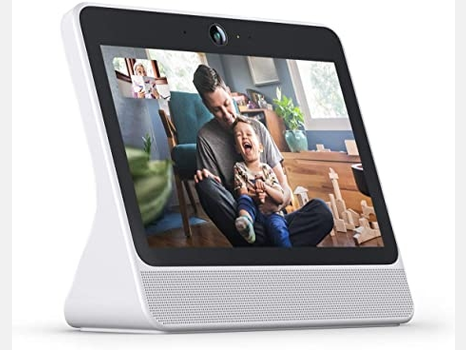
The reason I’m singling out Facebook is because I have firsthand experience with their Portal platform, and despite my preconceptions and biased attitudes relating to Facebook and privacy, I can tell you that their Portal platform is really, really good! It checks all the boxes. My girls can just call up their grandmother in Arizona whenever they want. They don’t need permission, or a password. They have fun. They can put on silly faces, like fire breathing dragons, read along with a book, or just talk. They can wander around, and the Portal will pan the camera and apply a cinematic effect, zooming in and out. It’s pure gold!
But perhaps the best feature is that they don’t have to do anything in particular on the call if they don’t want to. There’s no time limit. They can come and go as they please, and we can just leave the Portal on, when they want to talk to the other person in the meeting, they do so. When they don’t, they can just draw or play and wait for the inspiration to speak, as it suits them. In times past when I’ve been away, I’ve been able to color (in an adult coloring book) along with my daughters, periodically fielding requests to see what my picture looks like now, or hearing that they want to show me how much progress they’ve made. Portal is probably the next best thing to an in-person “play date” that can be achieved through technology.
And that brings us to the central critique. In these times of quarantine and isolation, Facebook has a chance to step up, in a big way. Facebook can, and arguably should, offer Portals for free or at steep discounts to elementary school children. After surveying the field of other technologies, names like Zoom, Amazon and Skype, it is clear that Facebook hit upon the right recipe for helping young kids to socialize remotely. But with the economic disparity between households that has been really put on display lately, and which has only been exacerbated by the country’s (and the world’s) deep economic woes and high unemployment, it is also clear that Facebook’s Portal could be exactly what people need, but can’t afford. If the Portal were a prescription that kids all over the world needed, and it had an introductory price of $129 USD, one would like to think that Facebook would step up and help pay for the “medication” for those who need it. I would argue that the Portal is as much as prescription as an anti-depressant right now. Facebook should step up, the same way big pharma does when people can’t afford their medications.
If Facebook is prepared to answer the call, it doesn’t have to be an act of pure altruism. Their entire business model, the way they monetize users, is premised on the twin growth vectors of high engagement and new user acquisition. If they can keep users engaged, users will consume media, click on ads, pay for level-ups in games, etc. But there still has to be a steady inflow of new users, because there will also be attrition. What better time to have people become acquainted with Facebook than as children?
You can bet that Facebook knows that “getting them young” is smart business. It’s surely the reason why so many of the features of the Portal (like reading “The Three Little Pigs”) are oriented toward children. I’m just asking Facebook to put their actual money where their proverbial mouth is.
Facebook, if you want to acquire users young, help out financially to put a Portal in the hands of every family with a child in elementary school.
If you want to organize getting Portals for your own child’s class, Facebook has dropped their price for the tablet style Portal from $129 to $79 through May 10. Additionally, if you already have a Portal, you can send a 20% discount to others by inviting them at: https://portal.facebook.com/account/?referral (max 3 referrals in a 30 day period).
Note: A previous version of this article mistakenly referred to the effects that can be superimposed on a participant's face as a "Snapchat" integration. Facebook's Portal has its own effects platform.
Chris Buck, JD/MBA is a father first, NH Web Developer, a recovering attorney and occasional blogger. You can follow him at @ChrisBuck.

