Politics & Government
Portsmouth's Langley Boardman House Earns National Historic Register Listing
The 1803-1806 Federal-style house was recognized for its architectural significance and its association with a prominent cabinetmaker.


CONCORD, NH — The Langley Boardman House in Portsmouth has been added to the National Register of Historic Places.
The New Hampshire Division of Historical Resources announced that the U.S. Secretary of the Interior listed the property for its architectural significance and its connection to cabinetmaker Langley Boardman.
Langley Boardman, who lived from 1774 to 1833, was a dominant figure in the Portsmouth furniture market for 35 years. He established the city's largest cabinetmaking shop after his apprenticeship in Salem, Massachusetts. Boardman produced fashionable Federal-style furniture for Portsmouth's merchant class, with sales extending across the Piscataqua River region and as far as Buenos Aires.
Find out what's happening in Portsmouthfor free with the latest updates from Patch.
Built between 1803 and 1806, the house is one of 13 Federal-style homes constructed on Middle Street in Portsmouth. Its front façade features flushboard siding designed to resemble granite. The building includes a semi-circular Ionic front portico and an inset Palladian window on the second floor.
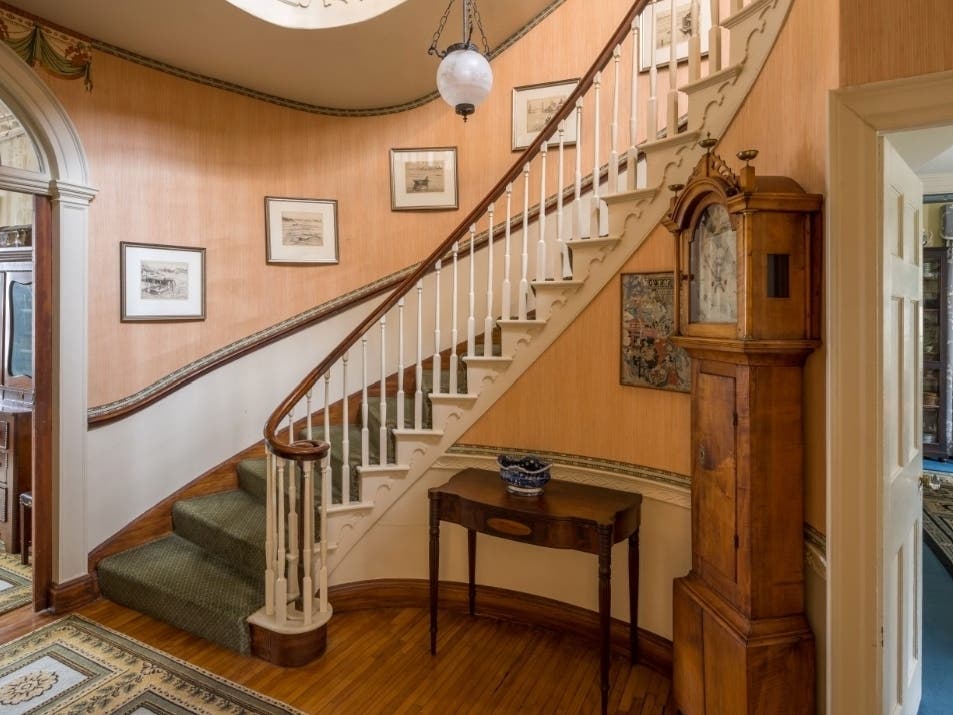
Former N.H. State Architectural Historian James L. Garvin described the house as "one of the most sophisticated in Portsmouth during the early Federal period" due to its moldings. Many rooms retain original Federal-style mantelpieces, cornices, and wainscotting. An elliptical staircase is located at the back of the corridor, creating a full-depth center hallway.
Find out what's happening in Portsmouthfor free with the latest updates from Patch.
The house also features a carved ornament mantelpiece in the parlor, incorporating urns, flowers, and a pineapple-detailed cornice. The hierarchy of finishes throughout the house distinguishes public from private spaces and indicates each room's importance. Langley Boardman's son, John Howe Boardman, made several updates in the mid-19th century, including enlarging a room for use as a dining room.
Listing on the National Register makes property owners eligible for grants such as the Land and Community Heritage Investment Program (LCHIP) and the Conservation License Plate Program. The New Hampshire Division of Historical Resources, part of the N.H. Department of Natural and Cultural Resources, oversees the National Register program in New Hampshire.
Get more local news delivered straight to your inbox. Sign up for free Patch newsletters and alerts.