Politics & Government
Data Center Panic Meets Pushback At AFP-NH Roundtable
State Rep. Tanya Donnelly (R-Salem): "Some of the largest data centers that we have are in the desert, where there's no water."

News of the mere possibility that a data center might come to Nottingham inspired hundreds of local residents to pack a Planning Board meeting to express their opposition.
Democratic candidate for governor Cinde Warmington also showed up to reiterate her opposition.
Find out what's happening in Salemfor free with the latest updates from Patch.
“We need to make sure that we have looked carefully at all of the impacts of these data centers before we make any decisions, and that is why I am calling for a statewide moratorium while this issue is studied and so that all of you can be protected.”
The opposition was so heated that the proposal, which had never reached the formal application stage, was withdrawn before the meeting took place.
Find out what's happening in Salemfor free with the latest updates from Patch.
For opponents of data centers, that was a positive sign. But for people who believe data centers and the AI economy they power are vital to New Hampshire’s future and don’t want the Granite State left behind, events in Nottingham were an omen.
And not a good one.
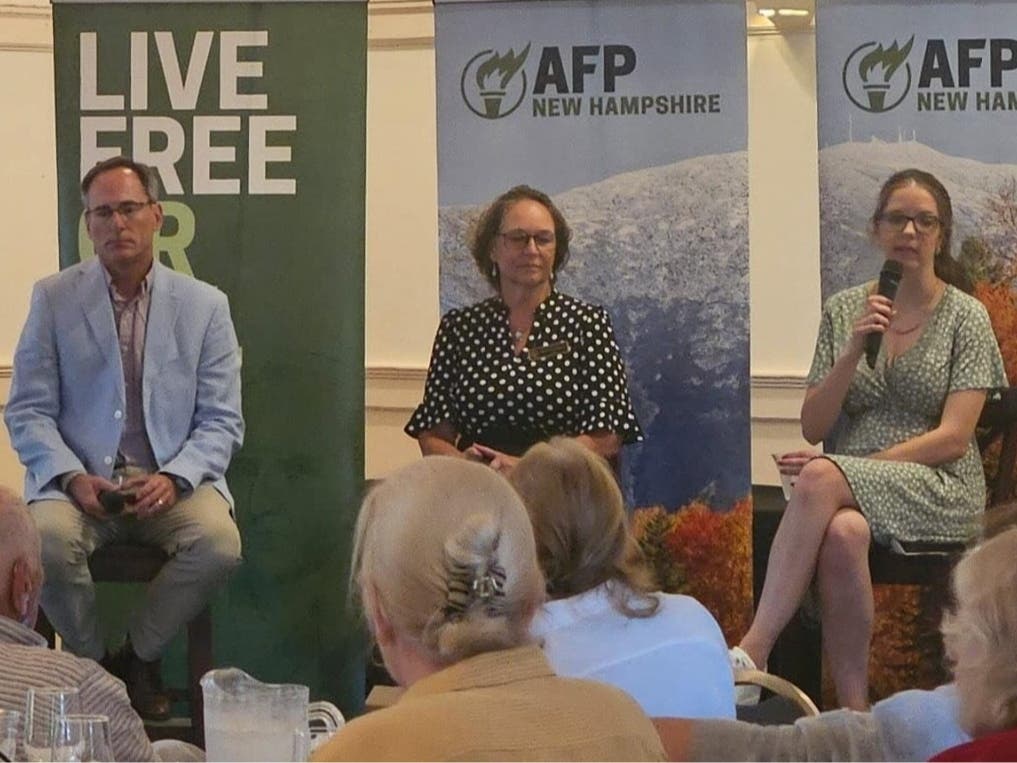
Last month, Americans for Prosperity-New Hampshire hosted a forum to counter some misconceptions — and intentional misinformation — about data centers and focus a spotlight on the economic benefits they can create.
The roundtable discussion featured state Rep. Tanya Donnelly (R-Salem) and Drew Cline, president of the Josiah Bartlett Center for Public Policy. Sarah Scott, AFP-NH’s deputy state director, who moderated the panel, said interest in data centers has grown as rapidly as the AI technology driving much of that growth.
“It’s just a term that people hear and start to panic and wonder if this is going to be some massive project in my backyard,” Scott said.
Among the greatest misconceptions about data centers in New Hampshire, Cline said, is that they are a new phenomenon. There are currently 10 data centers in New Hampshire, including a 7,000-square-foot facility in Bedford that expanded its real estate footprint in March.
The state’s largest facility, FirstLight Manchester, spans 14,000 square feet, about the size of a grocery store.
Beyond acknowledging their existence, AFP argues that opponents of data centers often mischaracterize the water usage rates of potential projects to stoke fear among local residents.
Cline noted that data centers’ water use is insignificant compared with other common uses, such as golf courses and agriculture.
“Besides, if you rank what uses the most water, data centers are at the bottom,” Cline said. “Golf courses are above them, and agriculture accounts for roughly 70 percent of water use in the country. There are five golf courses on the Seacoast, and I don’t see protests there.”
Donnelly, who has more than 20 years of experience in the technology sector, including AI transformation, said such views ignore the enormous amount of progress in the sector.
“Technology has changed dramatically with closed-loop water systems and glycolic chemicals that are not using any water,” Donnelly said. “Some of the largest data centers that we have are in the desert, where there’s no water. They can actually create large-scale and small-scale data centers that use no water to cool them.”
Data centers that use large amounts of water would nonetheless be subject to state Department of Environmental Services guidelines. Any water withdrawal greater than 57,600 gallons per day, or roughly 40 gallons per minute, requires a Large Groundwater Withdrawal Permit from the department.
As for concerns about power usage, Cline argued that the best path forward is through the legislative process rather than outright bans on data centers.
The roundtable participants acknowledged that New Hampshire will never be a data center superstar — electricity costs are too high, and the supply of accessible land is far greater in Southern and Western states — but said staying out of the sector entirely would be a loss to the local economy.
Across the country, data center construction is booming. In May 2026, private data center construction was running at a seasonally adjusted annual rate of $59.3 billion, up 23 percent from May 2025. That figure covers construction, not the servers, chips, electrical equipment, or new power generation associated with the facilities.
That spending supports construction workers, electricians, engineers, equipment manufacturers and suppliers.
One strategy to address concerns about electricity rates is to allow data centers to have their own sources of power off the shared grid. Last year, Republican Gov. Kelly Ayotte signed HB 672, known as the “Bring Your Own Power Law,” allowing for arrangements to do just that.
New Hampshire became the first state in the country to codify off-grid energy production and attracted the attention of numerous companies, according to Michael Vose, who chairs the House Science, Technology and Energy Committee.
Warmington denounced the move, accusing Ayotte of “opening the floodgates to data centers and cryptominers.”
A moratorium on large-scale data centers is front and center in Warmington’s agenda, the former executive councilor wrote in an op-ed last month.
“On Day 1, I will issue an executive order placing a temporary moratorium on large-scale data centers while we evaluate whether and where these facilities should be built,” Warmington wrote. “During this pause, we will develop a real regulatory framework built around a Community Bill of Rights that protects Granite Staters.”
That may be good political rhetoric, but Donnelly says it’s bad policy — particularly for property taxpayers.
“Data centers generate a lot of property tax,” Donnelly said. “It doesn’t use municipal services, such as fire and police, except to do the inspections. They’re not going to schools, so these are just revenue makers for a lot of communities if they’re done right.”
In Loudoun County, Va., for example, data centers generate 38 percent of general fund revenue and nearly half of all property tax collections.
At the AFP roundtable, Cline emphasized that political activism surrounding data centers was part of an orchestrated progressive campaign by legacy and new environmental groups aimed at stopping data centers.
350.org, a group co-founded by left-wing journalist Bill McKibben, boasts a New Hampshire chapter with a $500,000 annual budget, Cline said.
“It is all a scheme to raise money, and to scare you, and to give them the ability to control your behavior, and control your money, and control the economy,” Cline added. “They started all this to score a win, so they can go back to their donors and tell their donors, ‘ We killed a data center; give us another million dollars.”
This story was originally published by the NH Journal, an online news publication dedicated to providing fair, unbiased reporting on, and analysis of, political news of interest to New Hampshire. For more stories from the NH Journal, visit NHJournal.com.