Health & Fitness
Funding Advocate Travels to D.C. as Part of #OneDegree Effort
Nanci Carney working to urge Congress to boost federal funding for cancer research.


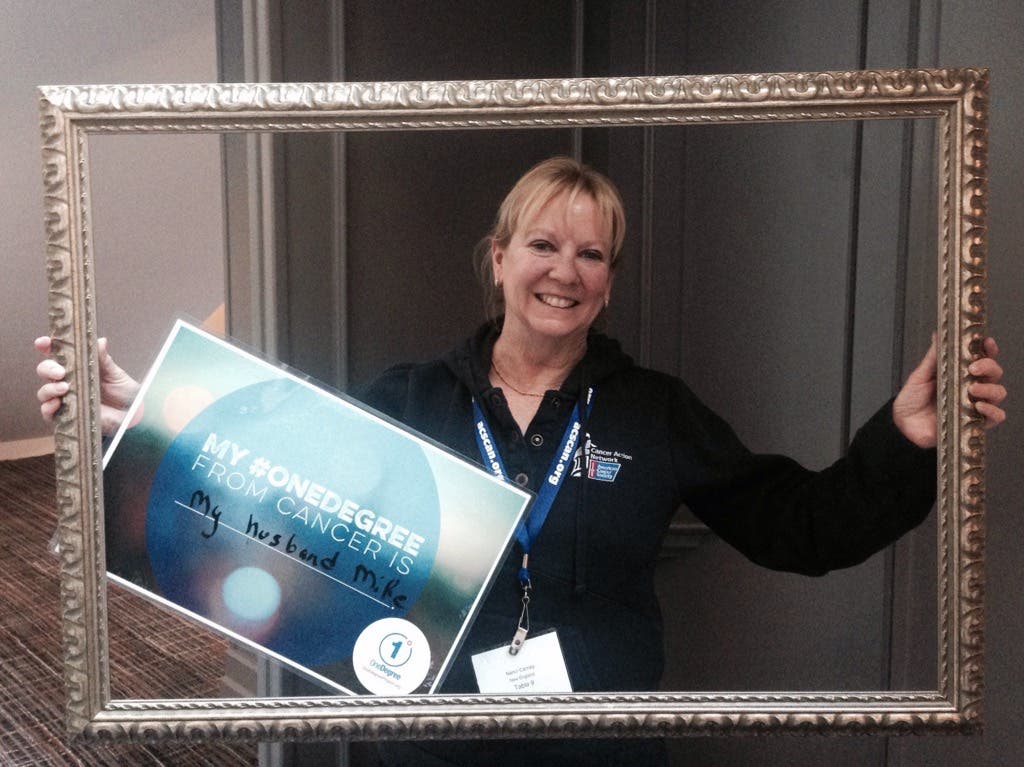
Local cancer-fighting advocate Nanci Carney is headed to Washington, D.C. to help kick off an unprecedented joint effort to save more lives from cancer by boosting the nation’s investment in lifesaving cancer research, according to a press statement.
The American Cancer Society Cancer Action Network (ACS CAN) and Stand Up To Cancer (SU2C) have combined forces to launch the One Degree campaign to ask Congress to increase medical research funding at the National Institutes of Health by $6 billion over two years, including $1 billion for cancer research at the National Cancer Institute.
Carney, from Salem, has the opportunity to represent New Hampshire for a March 17 Lobby Day on Capitol Hill that brings together Hollywood celebrities and grassroots advocates from across the country in a nationwide movement to make federal research funding a priority.
Find out what's happening in Salemfor free with the latest updates from Patch.
“We’re all just One Degree from someone with cancer -- each of us has a relative, friend or co-worker who has battled the disease, and many of us have fought cancer ourselves or given care to a loved one with the disease,” said Carney. “Lifesaving cancer treatments have one thing in common – they begin with basic research often led by the National Institutes of Health and the National Cancer Institute. We must ask Congress to make federal funding for research a priority.”
Carney’s One Degree to cancer is her late husband, Mike, who passed away from the disease when he was 38 years old, leaving her and her three young children without a husband and a father. Since her husband’s passing, Carney has dedicated herself to fighting back against cancer, attending both state and federal summits as an ACS CAN advocate.
Find out what's happening in Salemfor free with the latest updates from Patch.
While in D.C., Carney will join with others from across the country to ask Congress to make research funding a national priority. She is attending events on Capitol Hill and will also have an individual meeting with Senator Kelly Ayotte and the office of Senator Jean Shaheen.
“Cancer strikes one in two men and one in three women in their lifetimes. It kills one person for every minute of every day in this country. But thanks to innovative cancer treatments and therapies, nearly 15 million cancer survivors are living – and thriving – in America today,” said Carney. “We are asking everyone to join us to increase cancer research funding and save more lives. Cancer hits hard – together we are fighting back.”
ACS CAN and Stand Up To Cancer have launched a website, OneDegreeProject.org, that invites members of the public to share their One Degree by entering the name of a loved one with cancer in an electronic petition that will be sent to Congress. The website also provides videos featuring actors Bill Hader and Rob Riggle that viewers can share via social media with the hashtag #OneDegree.
Federal funding for cancer research and prevention programs has had a role in every major advance against this disease, resulting in 350 more lives saved from the disease per day than in 1991. Past federal investments have also put the scientific community on the verge of making groundbreaking new discoveries that could accelerate our progress and bring us closer to ending death and suffering from cancer.
More than 80 percent of federal funding for the NIH and NCI is spent on biomedical research projects at local research facilities across the country. According to NIH, nearly $30 billion funded almost 50,000 research grants to more than 300,000 researchers at over 2,500 universities, medical schools, and other research institutions in every state. In New Hampshire, NIH awarded $93.3 million in grants and contracts during FY2013 that directly supported 1,440 jobs in the state.[i]
Today, NIH funding is still well below where it was prior to sequestration in 2013. When accounting for inflation, NCI’s budget is more than 26 percent ($1.2 billion) below its 2003 funding level and the NIH budget is more than 24 percent ($6.5 billion) below where its budget was in 2003.
Photo captions: Nanci Carney, holding a sign in honor of her #OneDegree to cancer, her late husband, Mike.
Get more local news delivered straight to your inbox. Sign up for free Patch newsletters and alerts.