Politics & Government
Natural Gas May Actually be Worse than Coal for Climate: Report
Study says methane leaks may have a yearly warming impact equivalent of up to 250 coal-fired power plants; activists rally in Pelham.


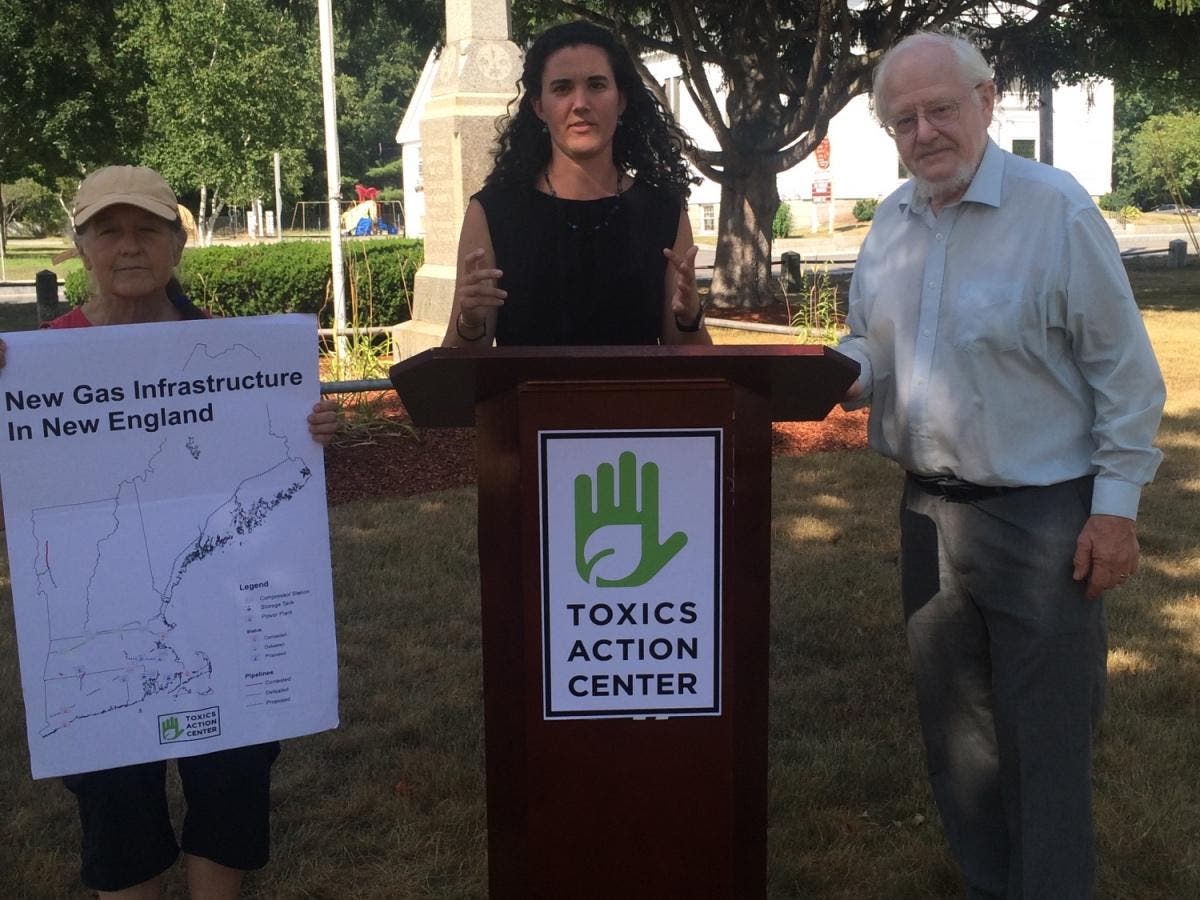
PELHAM, NH — A new report released by Toxics Action Center, Frontier Group, Environment America, and more than a dozen community groups across New England finds that burning gas for electricity is as bad for the climate as coal — or worse, according to a press release.
The report, titled “Natural Gas and Global Warming: A Review of Evidence Finds that Methane Leaks Undercut the Climate Benefits of Gas,” shows that older claims that gas has a modest impact on the climate are wrong, as they fail to account for the greenhouse gas effect of methane and high rates of methane leaks from gas infrastructure.
“For years, communities on the frontlines of proposed pipelines, power plants, compressor stations, and LNG terminals have been told by the fossil fuel lobby and politicians that gas is a low-carbon bridge to a clean energy future,” said Shaina Kasper of Toxics Action Center. “Today, it’s clearer than ever that this is not the case. New fracked gas infrastructure proposed across the region threatens our climate future, our health, and our neighborhoods. It’s time to double down on clean local renewable energy sources right here in New England.”
Find out what's happening in Salemfor free with the latest updates from Patch.
Released simultaneously in seven New England cities and towns today, the report emphasizes that methane is a much more powerful greenhouse gas than carbon dioxide, trapping 86 to 105 times as much heat as CO2 over a 20-year period. Making these findings even more concerning, the report authors found flaws in studies that reported very low rates of methane leakage, finding evidence instead of high rates of methane leaks from gas infrastructure.
Download the report at http://goo.gl/eJcJ8N
Find out what's happening in Salemfor free with the latest updates from Patch.
"Methane can leak during every stage of natural gas production – during drilling, processing, and even from the pipeline," said Elizabeth Ridlington of Frontier Group, report author. “Our review of the evidence suggests that these leaks may have an annual global warming impact equivalent of up to 250 coal-fired power plants, enough to nearly or completely offset any other climate benefits of natural gas.”
Cathy Corkery Chapter Director and Senior Regional Organizer for New Hampshire Sierra Club, added, "We know the smart investment dollar is investing in our homes, municipal buildings, local businesses and people - Not expanding utility pipelines whose costs will be passed on to the ratepayers but the profits never get socialized as well. This is real money with real benefits that will address climate solutions, employ local workers, keep our money in our state economy, and save money for the consumers. This is our moment to get this right and leave something better for our kids.”
These thoughts were echoed by community leaders in New Hampshire: “I’m an educator: a+b=c,” said Julia Steed Mawson of Pelham Pipeline Awareness Outreach Subcommittee. “This report shows that a) Methane leaks are substantial, b) Methane is just as potent a pollutant as coal, so that means c) Natural gas is not a bridge fuel; it’s a gangplank.”
Yesterday's seven-city release also made clear the connection between the increasingly evident urgency of a regional transition to clean, renewable energy sources and localized opposition to a surge of proposals for new gas infrastructure across all six New England states.
“My daughter and I spend as much time outside in this beautiful summer weather as possible. A gas pipeline would have devastated everything we love about living in New Hampshire,” said Kaela Law of Pelham Pipeline Awareness. “I'm very glad to be standing here today having worked hard and successfully driven off the Northeast Energy Direct, an export pipeline project proposed by Kinder Morgan. In stopping this project, I helped to protect my daughter, my community, our resources and beautiful New Hampshire.”
Submitted by Toxics Action Center.
Get more local news delivered straight to your inbox. Sign up for free Patch newsletters and alerts.