Community Corner
Small Town With Long History Celebrates America's 250th
John Adams' family connections run through the house that the all-volunteer Atkinson Historical Society now calls home.

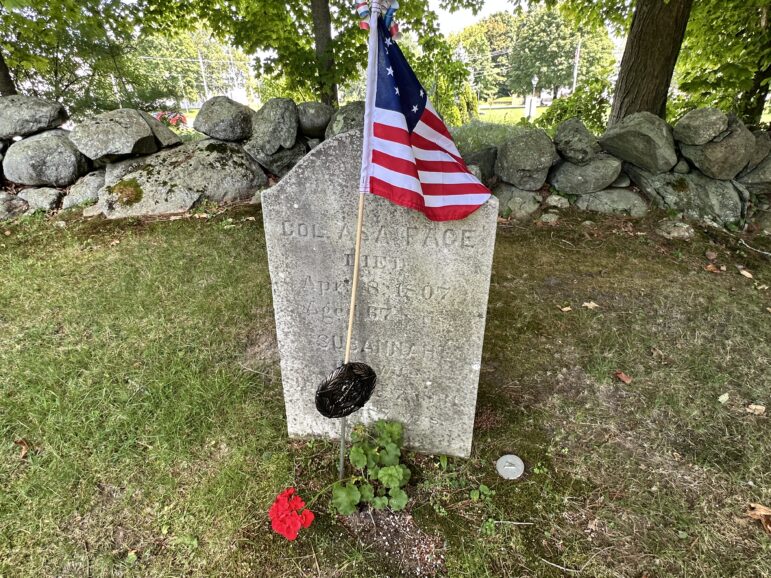
Above: A 13-star “Betsy Ross flag,” a Revolutionary War veteran’s medallion and a geranium mark the grave of Col. Asa Page in the Atkinson town cemetery. KATHARINE WEBSTER photo
Find out what's happening in Salemfor free with the latest updates from Patch.
ATKINSON, NH — A small town with a long history is marking the 250th anniversary of the Declaration of Independence by celebrating its contributions to the American Revolution, its 1700s buildings and sites — and its ties to President John Adams and his wife, Abigail.
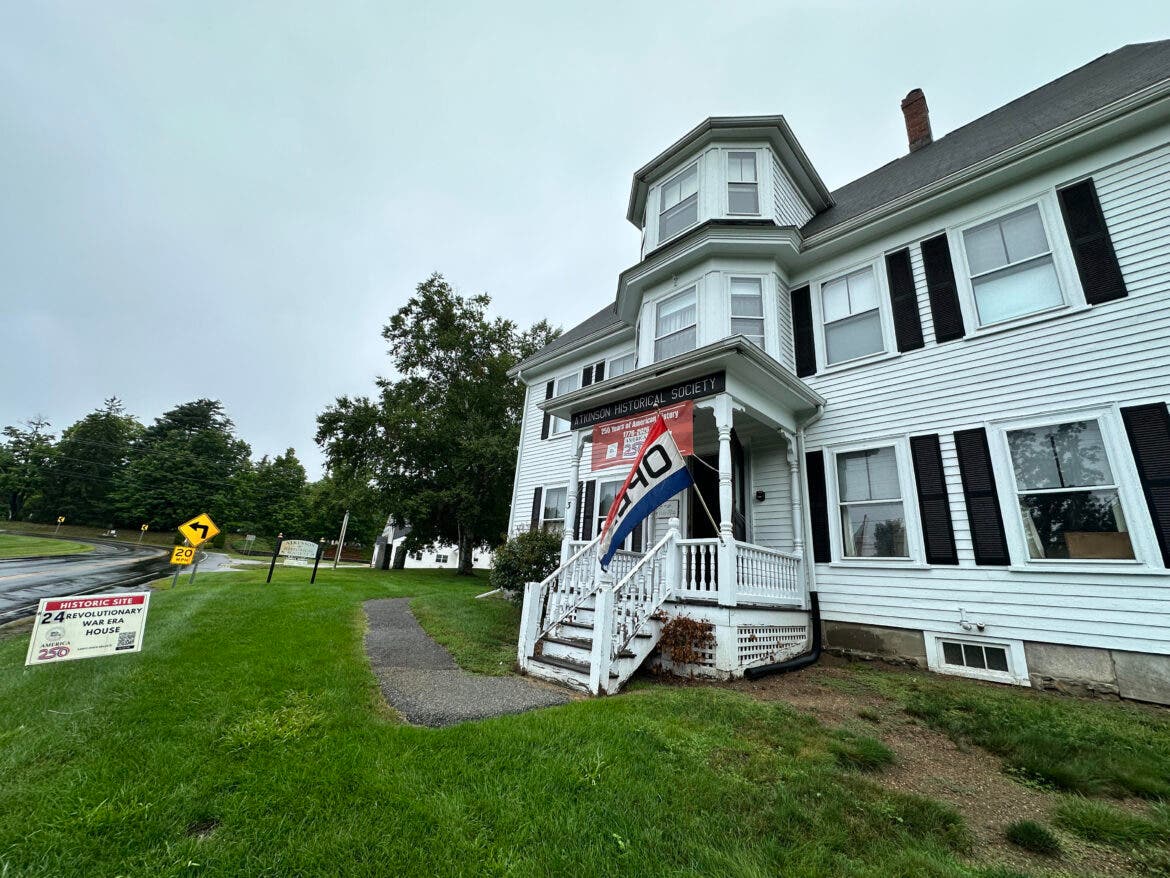
The Adams family connections run through the house that the all-volunteer Atkinson Historical Society now calls home, says Lucia Cusimano, the society’s curator.
Find out what's happening in Salemfor free with the latest updates from Patch.
The Rev. Stephen Peabody, Atkinson’s first Congregational minister, began building the house in 1772, only five years after Atkinson was incorporated, with his first wife, Mary Haseltine Peabody, Cusimano says. Three years later, Peabody enlisted as a chaplain during the opening year of the Revolutionary War, serving under Col. Enoch Poor in New Hampshire’s 2nd Regiment.
“He was chaplain at Winter Hill during (Gen. George) Washington’s siege of Boston,” she says.
Over the next eight years, 130 Atkinson men served in the Continental Army, in the militia, or as patriotic non-combatants – men who contributed goods to the war effort, signed an oath of allegiance, or both. That’s an astonishing number, given that the town’s population in 1790 was 479, according to the first official U.S. census.
To mark their service on Memorial Day, the Atkinson Historical Society provided the names of Atkinson’s Revolutionary War soldiers, town cemetery coordinator Margery Watkins identified their gravesites, and Jim Garrity, the town moderator and an active member of the Atkinson Veterans Club, read the soldiers’ names.
One of those who served was Capt. Jesse Page, who trained the Atkinson militia in a field in front of his home, the Page Homestead. The home still stands, and the field across the street is marked with a sign, but no battles were fought here, says historical society President Kate Rochford.
“The war never took place here in New Hampshire,” Rochford says. “We all went to Boston.”
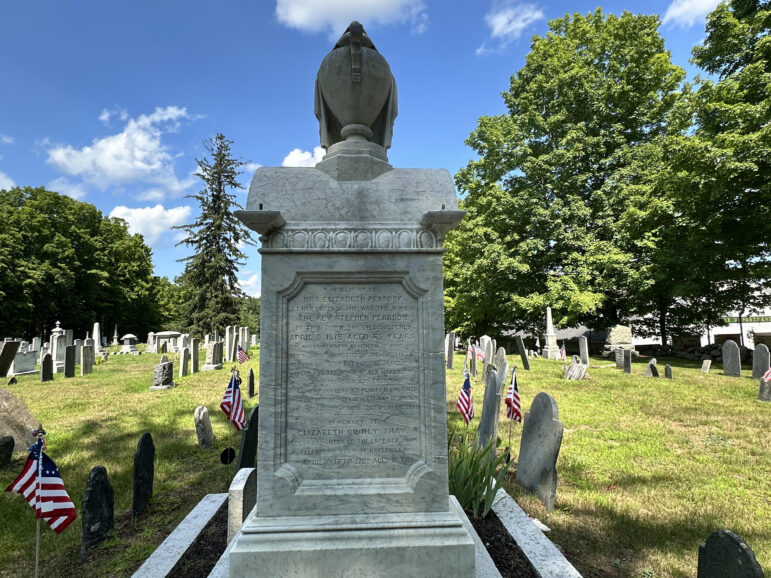
One side of the Peabody family memorial in Atkinson’s cemetery commemorates Elizabeth Peabody, sister of first lady Abigail Adams and second wife of the Rev. Stephen Peabody, the new town’s first permanent Congregational minister. KATHARINE WEBSTER photo
Family Ties to John and Abigail Adams
In 1793, the Rev. Peabody’s first wife died. Two years later, in 1795, he married Elizabeth Smith Shaw, sister to Abigail Smith Adams – and the following year, Abigail’s husband, John, was elected president.
The family ties persisted for decades, with six of the Adams’ grandchildren going to Atkinson Academy, then a private school, while boarding with the Peabodys. Abigail Adams visited her sister’s family in Atkinson several times, and her husband also visited once.
Peabody and both of his wives were champions of education. Peabody and Mary Haseltine Peabody hosted a “dame school” in one room of their home. Peabody co-founded Atkinson Academy in 1787 as a private preparatory school for boys, and four years later, Stephen and Mary’s daughter, Polly, and three of her friends petitioned the school to admit girls. The girls entered the academy in 1791, making it the second co-educational school in the country at the time – 45 years before the founding of the first U.S. college for women.
The original Atkinson Academy burned down in 1802, and a new building was erected nearby in 1803. Peabody assumed 87 percent of the unpaid debt, a burden he carried for the rest of his life.
There’s one other Atkinson connection to the Adamses. Cheese made in the cheese room at Samuel Little’s house on present-day Maple Avenue was sent to President John Adams while he was in office. President John Quincy Adams also visited the house, which was known in its time as “the Little mansion.”

Above: Special medallions and geraniums mark the graves of Atkinson’s Revolutionary War veterans. KATHARINE WEBSTER photo
Massachusetts or New Hampshire?
Before 1740, the towns today known as Plaistow and Atkinson, N.H., were part of North Haverhill, which was in an area disputed by the Massachusetts Bay Colony and the New Hampshire Province – a dispute that went all the way to King George II of England. In 1741, the New Hampshire Province won its case, claiming all the territory 3 miles north of the center channel of the Merrimack River.
That split North Haverhill, including putting the North Haverhill Meetinghouse in New Hampshire, but much of the church’s land remained in Massachusetts – and the boundary ran right through the North Parish cemetery. Amid ongoing tensions, the Massachusetts and New Hampshire General Courts allowed the North Parish to continue as a whole as “the Haverhill District,” according to “Atkinson, Then and Now,” a book by the historical society.
In 1747, residents of the eastern half of the Haverhill District petitioned to become their own town in New Hampshire, and the west siders asked to join them because they were financially unable to support the church parish on their own. In 1749, the New Hampshire General Court designated the whole district as Plaistow. But in 1766, because of disputes within the parish, the west siders petitioned to become a separate town.
In 1767, Atkinson was born, and five years later, Peabody became the first permanent minister of the town’s Congregational church. He continued to farm for the rest of his life because the town could not afford him much of a living.
European settlers had acquired the area known as Pentucket from the Penacook people, according to a transaction document dated 1642. Indigenous people continued to travel through the area on a trail system that ran from Rhode Island to present-day Canada, according to “Atkinson Then and Now.”
Part of one trail became the Boston-Haverhill-Concord, N.H., stagecoach route in the 1700s. In 2014, the New Hampshire portion of what is now state Route 121 was designated the Robert Frost – Old Stagecoach Scenic Byway, and a decade ago, Atkinson erected scenic highway signs. The original 5-mile marker stone along the stagecoach route, placed exactly 5 miles north of the Merrimack River, still stands.

Above: The town pound is one of 42 surviving Revolutionary War-era homes and sites that the Atkinson Historical Society is highlighting for the 250 the anniversary of U.S. independence. KATHARINE WEBSTER photo
Atkinson Then and Now
Many of the town’s oldest homes are located along the stagecoach route – now also called Main Street in town – including the Page homestead, and along Academy Avenue, which intersects with Main Street at the town center.
By the 1790s, the town also had a couple of taverns, two grist mills, a sawmill, a meetinghouse and a town pound, where stray animals that had damaged other people’s property were kept until their owners paid a fine. The pound is preserved as a historic site.
At one time, Atkinson also had five, one-room schoolhouses, spread throughout the sprawling farm town.
“Kids had to be able to walk to school back then,” Rochford says.
Over several decades, two of the schoolhouses burned down and two others became private homes. Eventually, all of the town’s schoolchildren attended the Center School, a one-room schoolhouse built in 1879 across the street from Atkinson Academy. As the number of children in town grew, the Center School leased classroom space from the academy.
The academy closed its doors as a private school in 1949, and the Center School closed at the same time. The town renovated a former Universalist Church as its elementary school: the Rockwell School, named for brothers Leslie H. Rockwell Jr. and Richard K. Rockwell, who died while serving in the U.S. Army Air Forces during World War II.
In 1956, at the height of the post-war baby boom, the academy reopened to provide additional classroom space for the town’s elementary school students. By the early 1990s, the public school had fully transitioned to Atkinson Academy, where it remains today.
Atkinson’s population remained remarkably steady – between 400 and 500 souls – until the baby boom, Rochford says. Today, it has some 7,000 residents and two state representatives, and Atkinson Academy has been expanded several times. But the 1803 building still stands, while the Rockwell building now houses the Atkinson Police Department.
Currently, the historical society is overseeing the restoration of the Center School as a one-room schoolhouse museum and learning space, using grants, private donations and fundraising.

The Page family homestead, seen across the field where Capt. Jesse Page trained the Atkinson militia. KATHARINE WEBSTER photo
Happy Birthday!
The Atkinson Historical Society began its 250th anniversary celebrations on Washington’s birthday in February by opening an ongoing exhibition, “The Revolutionary War Era: Life in Atkinson,” co-curated by Cusimano and Sally Holmes, a historical society director and researcher, at the former Peabody house.
The building is now known as the Kimball House Museum after the Rev. Joseph Kimball, who bought the house and later donated it to the town to be used as a library and a museum or art space, with the land in back to be used for a cemetery, “if needed.” (It was, and is now part of the town cemetery.)
On Flag Day, working with the historical society, the Atkinson Veterans Club and the cemetery coordinator placed “Betsy Ross flags” with 13 stars and special medallions on the known graves of the town’s Revolutionary War veterans. The veterans will be honored again in a formal ceremony on Veterans Day.
In between, the historical society is continuing its research into the town’s oldest buildings, which can be viewed on an interactive map on its website. Many of them are also marked with roadside signs. The historical society has already sold out three trolley tours of historic sites scheduled for Oct. 3.
The Kimball House Museum is open to visitors every Wednesday from 2 to 4 p.m. and the first Saturday of each month from 10 a.m. to noon. The historical society welcomes donations and volunteers.
This story was originally published by InDepth NH.