Politics & Government
What Drives Young Granite Staters And Gen Z To Get Involved In New Hampshire Politics?
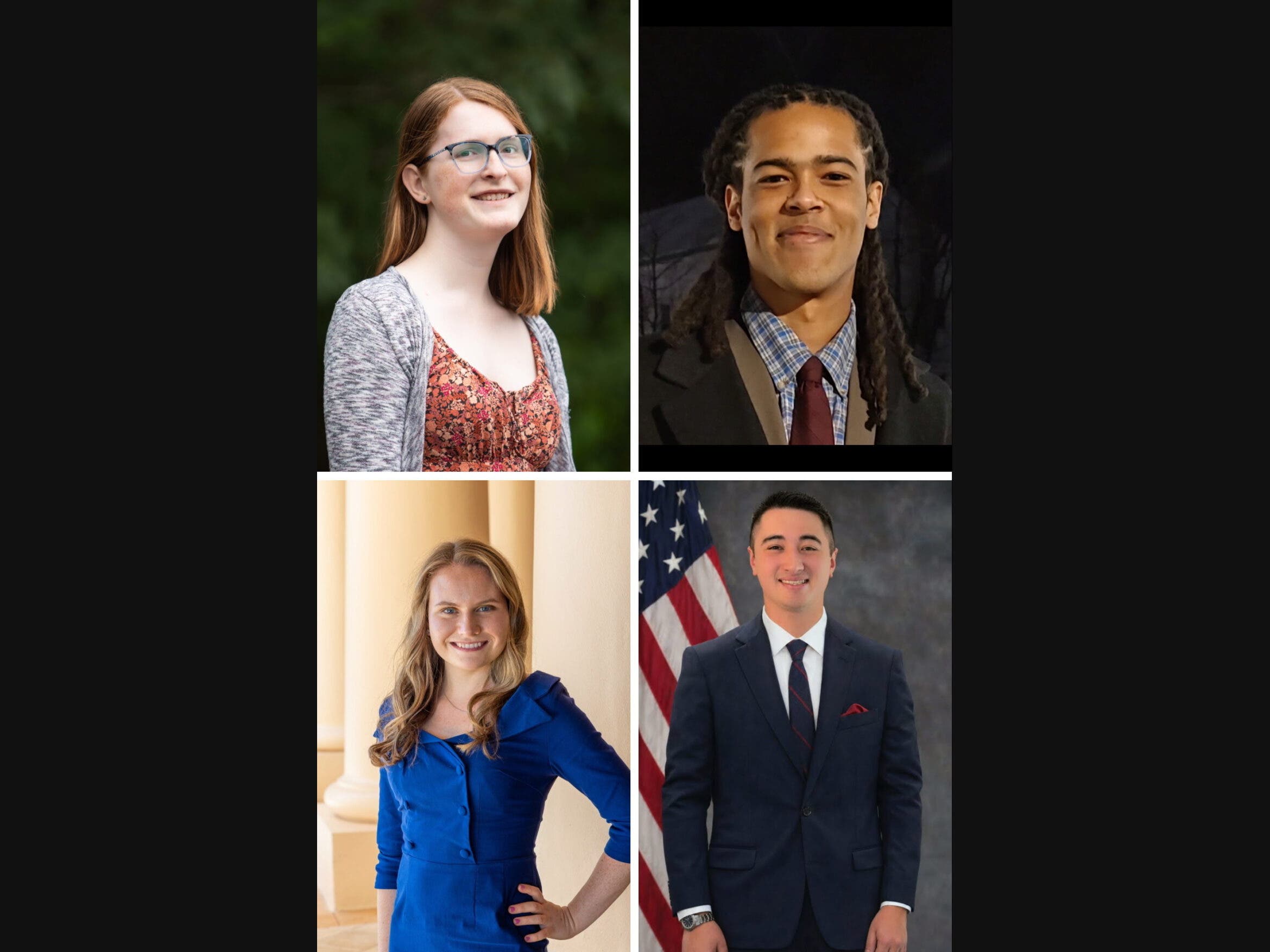
Reps. Alice Wade, D-Dover; Valerie McDonnell, R-Salem; Jonah Orion Wheeler, D-Peterborough; and Matthew Brooks, R-Sandown; explain why.

If you ask members of Gen-Z why they ran for office, you’re likely to hear that they wanted to breathe new life into the political scene here in New Hampshire, and provide more representation of their generation.
“I had this realization that even if I can’t change the outcome of a lot of these national issues, I can still make a difference at the local level,” said Rep. Alice Wade, D-Dover, 25.
Find out what's happening in Salemfor free with the latest updates from Patch.
Born between 1997 and the 2010s, Gen-Z showed up at the polls Tuesday, and on the ballots. InDepthNH.org spoke to Wade, Rep. Valerie McDonnell, R-Salem, 22, Rep. Jonah Orion Wheeler, D-Peterborough, 23, and Rep. Matthew Brooks, (R-Sandown), 22.
Wade — who just finished her first term representing Strafford County District 15, and was reelected to serve District 21 — has a background as an aerospace engineer and never saw herself getting involved in politics. But after she graduated college she began looking for ways to be in her community, which led to politics.
Find out what's happening in Salemfor free with the latest updates from Patch.
“From there, I just started looking into state government, local advocacy work, and got involved with my local Democrats, got involved with a local nonprofit a few years back. When the opportunity opened to run for office, I was encouraged to run, and I saw it as the next step to take that involvement in advocacy further into the State House, and to make a more direct impact on these issues and for my constituents,” Wade explained.
One of the highlights of her first term was helping pass legislation that supported gold-star families whose children died while serving in the military, Wade said. She also took a leading role in fighting anti-trans legislation in the House, as part of a push back on other medical restrictions.
“We managed to flip more Republicans than we lost Democrats on every single one of those bills this past term,” Wade said.
The State House, and the state, needs younger lawmakers being part of the conversation, Wade said.
“My general perspective is that we need to have a wider-range of perspectives on any number of issues, both because it gives more diverse viewpoints, but fundamentally because Gen-Z lawmakers grew up in a very different world than the Baby-Boomers did. Both of those perspectives are valuable; it is very valuable to have the perspectives of folks who are retired, and also having the perspective from folks who are renters, or who are struggling with work, and pay for childcare (and) housing,” Wade said. “Those are the people our legislation is impacting, and if we fundamentally don’t have the experiences to personally understand what those struggles are like, we’re not going to be very effective at addressing the solutions for it,” Wade said.
When asked what message Wade has for other members of Gen-Z who are unsure about how to take the first leap into the realm of politics, she said their impact at the local level — compared to at a national level — is like a drop in a bucket versus a drop in the ocean.
“If you’re frustrated by the way things have been going, and you’re looking for something to do (and) a way to make a difference, doing it locally is the absolute best use of your time per the output for the positive change you can make as an individual,” Wade said.
McDonnell was reelected on Tuesday for her third term as a State Representative for Rockingham County District 25. When she was first elected back in 2022, she was 18 years-old, which she said was an anomaly because the general age of a state representative in the state — and around the country — is typically older.
She first got involved in politics while she was in high school, where she saw a lack of both patriotism among her classmates and education in civics. A number of her friends had zero interest in registering to vote, or in the democratic process in general, which she said was the result of a lack of focus on civics.
McDonnell serves on the Education Policy and Administration committee, where she was able to help address the lack of civics education. In 2023, she helped pass legislation called the “More Time on Civics” initiative, so that it was taught more in schools around the state, and encouraged students to register to vote, or perhaps even run for office themselves.
“Education has really been my focus, and being a sponsor for Senate Bill 295 — and the House version of the bill is House Bill 115, where I was the prime sponsor — that is the bill that expanded the EFA (Education Freedom Account Program) universally. So, any student Kindergarten through 12th-grade in New Hampshire would be eligible to apply to the program. That was something a lot of us fought very hard for, myself especially, and was a big win for us,” McDonnell said.
McDonnell thinks one of the key differences between members of Gen-Z and older generations of politicians boils down to the use of social media. She’s seen candidates both in New Hampshire and around the country use Instagram-styled videos to promote a cause. On the other hand, she recalled how sometimes older politicians won’t even have a campaign website, where younger people end up designing one for them. The inclusion of an online presence definitely sets Gen-Z candidates apart from their older opponents, she said.
McDonnell stressed that it’s easier to get involved in local issues than people sometimes think. People are oftentimes nicer than they appear, and are more open to younger people running for office. When she first ran for office, she thought her age was a disadvantage, but she learned the people she talked to were excited to see someone young running.
“Overall, age really isn’t a disadvantage, it’s just a different perspective. If younger people aren’t in state government, then younger people aren’t going to be represented (and) they aren’t going to vote, which leads back my goal from the beginning, to encourage voting regardless of age, but specifically among adults ages 18-25, which are statistically less likely to vote,” she said.
Wheeler — who won reelection for his third term representing Hillsborough County District 33 — first began his involvement in politics as a volunteer, knocking on doors, canvassing different issues at events, and going to the State House to testify on various bills. He found very quickly that the legislature is a place where everyone can participate.
When people realize anyone can take part in the process, the allure of the State House being this untouchable building begins to fade away.
“When you see that, you realize, ‘Oh, I can run and participate in this building even if I’m not a super-wealthy person with a lot of connections and social capital,’” Wheeler said.
His biggest achievement is being part of a collaborative, deliberative government of 400 people who create and pass laws, he said. Wheeler’s most proud of being a legislator who is willing to collaborate with everyone and get things done. He’s also proud of being in a legislature where that is still possible.
While Gen-Z is no monolith, it is one that grew up with access to the internet, Wheeler said. The online spaces can be full of vitriol and siloed political conversations, he said.
“Where we can’t really seem to have conversations with each other unless we agree on the fundamental perspective of the world, which is just not how life has worked for a long time,” he said. “But it’s also where our generation has had access to more information quicker than ever before seen on this planet Earth, and I think that we are still in the beginning stages of what that looks like for our generation… As we adapt into this new technological world, our generation is a little bit more equipped to have a more holistic perspective on how technology will affect this world.”
In New Hampshire, every bill gets a hearing on the House floor and nobody’s testimony will be denied by a committee chair; every person’s testimony is heard, Wheeler said. That’s part of the important and unique modes of government here in the state, according to Wheeler. Young people in the Granite State have a unique ability to get involved in how the state they reside in is governed, he said.
Young residents don’t just have an opportunity to get involved locally, but also have a constitutional say as to what happens in the State House, Wheeler said.
Brooks has been interested in politics since he was 14 and closely watched President Donald Trump’s 2016 campaign. Prior to becoming a state representative, Brooks served as the executive secretary for the University of New Hampshire College Republicans, where he earned a degree in Political Science with minors in Justice Studies and Forensic Science.
“When I found the opportunity to run for office, I jumped on it and ended up winning this Tuesday, which was great,” Brooks said.
He originally wanted to change the education curriculum by helping out with financial literacy, teaching kids how to better budget their money, and about taxes.
“Unfortunately, that is changed due to the massive majority switch in the House,” Brooks said of his legislative agenda. “So, currently, what I wish to do is up for discussion with the remainder of the Republican party in the state of New Hampshire. I had plans, those plans are probably no longer going to happen due to the vast majority of the opposition that is on the other side.”
It’s time for more young people to be in power, according to Brooks. The older generations of people in politics haven’t made any changes with their time in office, he said.
“If anything, things get worse the more old people we put in,” Brooks said.
Brooks thinks young people know what they need, know how the economy works and how bad the housing market is, and know how to make changes so that people from his generation can afford to live more comfortably.
When asked what he would say to people from Gen-Z who are on the fence about getting involved politically, Brooks emphasized the importance of voting in every election. If Gen-Z wants to get involved more locally, they should reach out to committees in their towns or cities to find a way to volunteer their time.
This story was originally published by InDepth NH.