Health & Fitness
Child Hospitalizations Rise Again, But NJ Shows 'Tripledemic' Progress
New Jersey offered signs that the winter peaks of COVID-19, influenza and RSV could be in the rearview. But that doesn't mean it's over.


NEW JERSEY — Pediatric hospital beds around the state continued filling up this week, but New Jersey may have passed the peak of the "tripledemic." COVID-19 levels and influenza activity both declined, offering hope as the state continues to weather the winter surge of respiratory diseases.
The "tripledemic" — the simultaneous threat of COVID, flu and respiratory syncytial virus (RSV) — continues to strain hospitals around the nation. While New Jersey has made progress in recent weeks, that doesn't mean the wave of viruses has ended.
The CDC still recommends masking for indoor, public spaces in much of South Jersey — Burlington, Camden, Gloucester, Salem, Cumberland, Cape May and Atlantic Counties. But the federal agency removed several New Jersey counties Thursday from the "high" category for COVID community levels, which triggers mask recommendations.
Find out what's happening in Across New Jerseyfor free with the latest updates from Patch.
.png)
The CDC adopted the community-level metric — based on hospitalizations and case rates — in late February. The agency updates its color-coded COVID maps each Thursday, recommending masks in counties with high community levels. All New Jersey counties, except Warren and Hunterdon, were in the high category the prior week.
The mask recommendations don't trigger any mandates in New Jersey, and people may also choose to continue masking in any setting. But the World Health Organization "continues to recommend the use of masks by the public in specific situations, and this update recommends their use irrespective of the local epidemiological situation, given the current spread of the COVID-19 globally," according to the agency's updated guidelines, released Jan. 13.
Find out what's happening in Across New Jerseyfor free with the latest updates from Patch.
Additionally, only 15.4 percent of New Jersey has received the bivalent COVID booster, which health officials consider a key component in helping to prevent severe illness and death.
Here's how the tripledemic continues to impact New Jersey.
State Of NJ Hospitals
As of Thursday, 512 of New Jersey's 784 pediatric beds (65 percent) were occupied — up from 432 (60 percent) a week prior, according to NBC News analysis of federal data.
Additionally, the CDC reported 62 COVID deaths in the state over the past week. The estimated national death toll from the virus totaled 3,350 people during that span.
But New Jersey showed signs of progress, as COVID hospitalizations continued falling. State officials reported 1,473 people with confirmed or suspected COVID in New Jersey hospitals as of Wednesday — down from this season's peak of 1,776 reported Jan. 6.
New Jersey's intensive-care units continue to fare better than the nation's as a whole, with 47.6 percent of the state's ICU beds in use as of Friday, according to federal data. Meanwhile, 77.2 percent of ICU beds in the U.S. are occupied.
Additionally, 72.9 percent of New Jersey's in-patient beds are occupied, with 6.5 percent in use for COVID.
'Tripledemic' Virus Levels Declining
The main culprits of the tripledemic showed signs of waning this week.
New Jersey faced one of its harshest flu seasons in recent memory, with high influenza activity throughout the state for several months. Over the last several weeks, every New Jersey county showed "high" influenza activity, according to the New Jersey Department of Health. But in this week's state influenza report, health officials downgraded several counties to the "moderate" category.
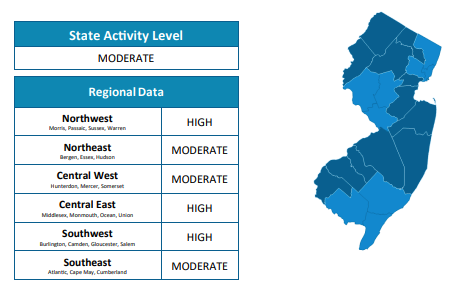
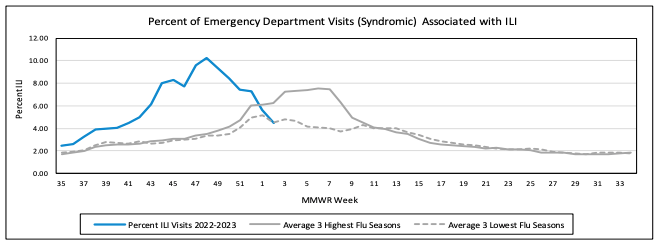
Influenza and RSV surged earlier than usual throughout the state this year. But two key metrics continue to decline: the rate of hospitalizations for influenza-like illness and the positivity rate of RSV tests.
From late November to early December, more than 10 percent of visits to New Jersey ERs stemmed from influenza-like illness — double the rate of the state's three strongest flu seasons in the past decade. The rate has since declined to just below 5 percent, which is in line with the state's tamest flu seasons of the past decade at this time of year, according to health officials.
More than 15 percent of RSV tests in New Jersey turned up positive in early November. The positivity rate has been lower than 5 percent during the new year.
See the data below:
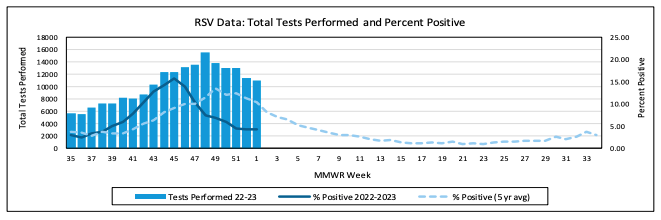
RSV is a common respiratory virus that usually causes mild, cold-like symptoms. But the virus can cause serious illness, especially in infants and older adults, the CDC says.
Additionally, COVID levels in the region's wastewater declined for the third straight week, according to Biobot Analytics, which monitors sewage as it relates to public health. Virus levels in the wastewater can often indicate COVID's prevalence in communities before lagging indicators, such as hospitalizations or deaths.
Wastewater samples in the Northeast averaged 999 COVID copies per milliliter of sewage (copies/mL) this week, according to Biobot Analytics. That's nearly half of the season's peak (1,775 copies/mL the week of Dec. 28) and the region's lowest mark since late November.
For more coronavirus numbers, visit the New Jersey Department of Health's COVID-19 dashboard, The New York Times data page for New Jersey, the CDC's data tracker and Biobot's wastewater webpage. Statistics on the flu and RSV come from the state health department's weekly surveillance reports on influenza and respiratory illness.
Get more local news delivered straight to your inbox. Sign up for free Patch newsletters and alerts.