Health & Fitness
Child Hospitalizations Rise In NJ; Masks Recommended Nearly Everywhere
New Jersey, however, made some progress amid the 'tripledemic,' with declines in hospital patients requiring COVID treatment.


NEW JERSEY — Almost all of New Jersey should continue masking up as the state continues to weather winter surges of COVID-19 and other respiratory illnesses.
The "tripledemic" — the simultaneous threat of COVID, flu and respiratory syncytial virus (RSV) — continues to strain emergency rooms and pediatric departments around the nation. New Jersey made some progress in recent days, with COVID hospitalizations declining. But in the past week, 82 people in the state died from the virus, and pediatric hospitalizations surged amid a spike in severe influenza cases among children.
In terms of capacity, New Jersey's hospitals continue to fare better than the nation's as a whole. However, millions of residents haven't received the updated COVID booster, which health officials consider a key component in helping to prevent severe illness and death.
Find out what's happening in Across New Jerseyfor free with the latest updates from Patch.
Only 16 percent of eligible New Jerseyans have received the bivalent COVID booster, with 1.34 million getting the dose. Roughly 5.6 million state residents — more than half the state's overall population — completed the initial COVID-vaccination series but haven't received the updated shot, according to CDC data. Read more: New Variant 'Most Transmissible' Yet: What To Know About XBB.1.5 In NJ
As of Thursday, the CDC recommends masking up for indoor, public spaces in all of New Jersey, excluding Warren and Hunterdon Counties. A week prior, the agency recommended masking in all counties.
Find out what's happening in Across New Jerseyfor free with the latest updates from Patch.
.png)
The CDC adopted the community-level metric — based on hospitalizations and case rates — in late February. The agency updates its color-coded COVID maps each Thursday, recommending masks in counties with high community levels. The mask recommendations don't trigger any mandates in New Jersey, and people may also choose to continue masking in any setting.
Here's how the tripledemic continues to impact New Jersey.
State Of NJ Hospitals
New Jersey made some progress in terms of COVID hospitalizations — a week after the state logged its highest total of hospital patients with the virus in nearly a year.
Hospitals around the state had 1,660 patients with confirmed or suspected COVID as of Thursday, showing gradual declines since Jan. 6's tally of 1,776 patients, according to the New Jersey Department of Health. The Jan. 6 total was the state's highest since Feb. 8, when last winter's omicron wave waned.
The CDC reported 82 COVID deaths in New Jersey over the past week. The estimated national death toll from the virus totaled 3,780 people during that span.
New Jersey's intensive-care units continue to fare better than the nation's as a whole, with 48.8 percent of the state's ICU beds in use as of Friday, according to federal data. Meanwhile, 78.3 percent of ICU beds in the U.S. are occupied.
Additionally, 72.7 percent New Jersey's in-patient beds are occupied, with 7.5 percent in use for COVID. The ratio becomes concerning when COVID patients exceed 10 percent of inpatient beds, representing "extreme stress" at 20 percent, according to a framework developed by the University of Washington's Institute for Health Metrics and Evaluation.
Sixty percent of New Jersey's pediatric beds — 432 out of 1,151 beds — were occupied as of Thursday, according to NBC News analysis of federal data. New Jersey has the nation's 13th-lowest rate of pediatric hospital beds in use, with Rhode Island topping the list at 96 percent of beds occupied. But New Jersey's pediatric hospitalizations increased overall since Jan. 5, when 52 percent of beds were in use.
Severe flu cases among children continue to rise, with the state reporting 25 in the first week of January. New Jersey hit 69 severe cases of influenza-associated pediatric illness for the flu season — the state's highest total since at least the 2013-14 season.
Three New Jersey children — all younger than 2 years old — have died from influenza-related illness during the flu season, which began Oct. 1.
Signs Of Progress
New Jersey began 2023 with improvements in several metrics of virus mitigation, offering signs of hope during one of its strongest flu seasons in recent memory.
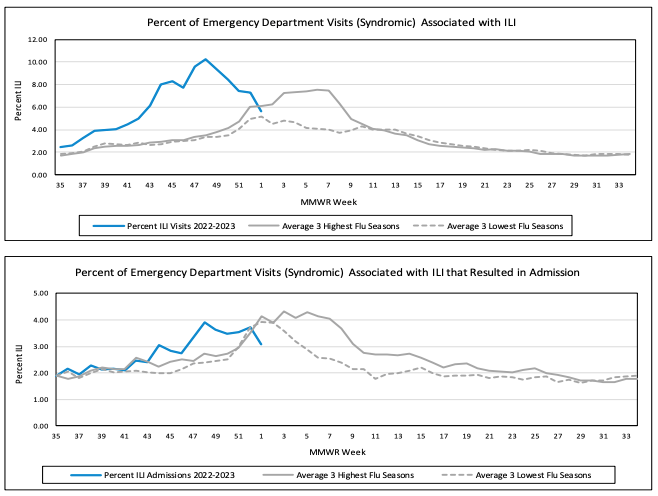
Influenza levels remained high in every region of the state last week. But the rate of emergency-room visits associated with influenza-like illness continued to decline, dipping lower than 6 percent for the first time since October. The rate of those visits that required admission also fell to about 3 percent — nearly a full percentage point lower than late 2020's peak.
The following graphs compare New Jersey's current flu season to the state's three most-and-least-severe flu seasons in the past decade.
Additionally, COVID levels in the region's wastewater declined for the second straight week, according to Biobot Analytics, which monitors sewage as it relates to public health. Virus levels in the wastewater can often indicate COVID's prevalence in communities before lagging indicators, such as hospitalizations or deaths.
New Jersey is in the Northeast region, which averaged 1,284 COVID copies per milliliter of sewage (copies/mL) this week, according to Biobot Analytics. The region's seasonal peak came the week of Dec. 28, with an average of 1,781 copies/mL in the wastewater samples — the region's highest mark since January 2021, when the omicron wave raged.
For more coronavirus numbers, visit the New Jersey Department of Health's COVID-19 dashboard, The New York Times data page for New Jersey, the CDC's data tracker and Biobot's wastewater webpage. Statistics on the flu and RSV come from the state health department's weekly surveillance reports on influenza and respiratory illness.
Get more local news delivered straight to your inbox. Sign up for free Patch newsletters and alerts.