Health & Fitness
New Mask Guidance For NJ As New COVID Subvariants Emerge
BA.4 and BA.5 appear to spread quicker and evade antibody responses better than prior strains, but vaccines remain effective, research says.


NEW JERSEY — With New Jersey's COVID-19 cases and hospitalizations continuing to decline, the Centers for Disease Control and Prevention continued mask recommendations for indoor, public spaces in only four counties. But the emergence of two omicron subvariants could create new challenges for the Garden State.
The CDC recommends masking in counties with "high" COVID-19 community levels — a metric based on hospitalizations and case rates that the agency adopted in late February. The agency updates its color-coded COVID-19 maps each Thursday.
This week, the CDC recommended masking in Morris, Monmouth, Atlantic and Cape May counties. Four counties — Warren, Hunterdon, Union and Cumberland — are in the low category, while the rest have medium community transmission levels, according to the agency.
Find out what's happening in Across New Jerseyfor free with the latest updates from Patch.
.png)
The CDC's mask recommendations do not trigger any mandates in New Jersey. People may also choose to continue masking in any setting.
The federal agency reported 70 COVID-19 deaths in New Jersey in the past week. The Garden State continues to move past the peak of its springtime COVID-19 wave, but researchers have presented concerns about omicron subvariants BA.4 and BA.5, which both have growing presences within the region.
Find out what's happening in Across New Jerseyfor free with the latest updates from Patch.
The subvariants appear to escape antibody responses both among people who have had COVID-19 and those who are fully vaccinated and boosted, according to studies from the Beth Israel Deaconess Medical Center of Harvard Medical School, and a separate study from scientists at Columbia University. BA.4 and BA.5 are the fastest-spreading strains reported to date and are expected to dominate COVID-19 transmission in the U.S. and Europe within the next few weeks, according to the European Centre for Disease Prevention and Control.
But the COVID-19 vaccines still appear to provide substantial protection against severe disease, according to the research.
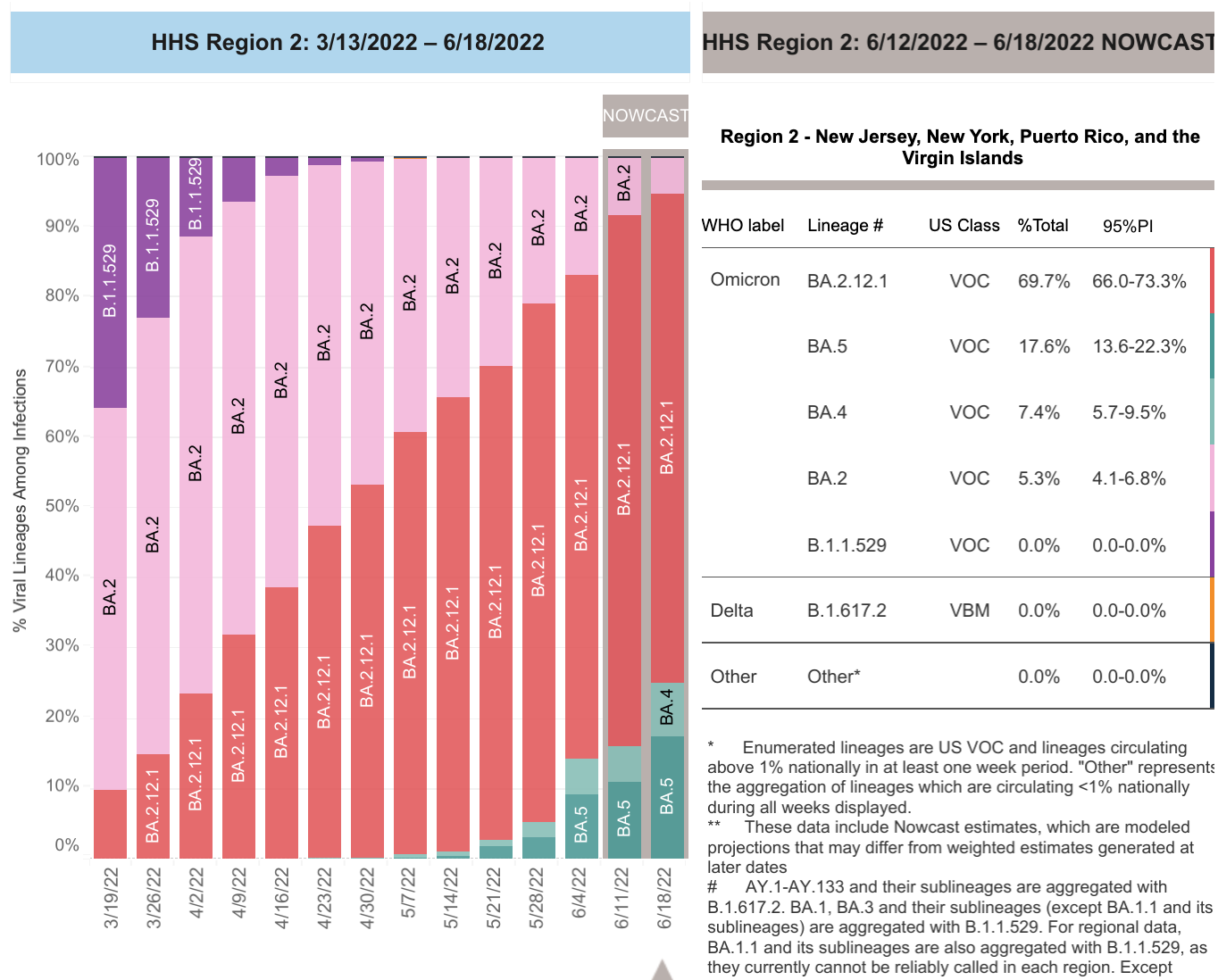
BA.2.12.1 remains the region's most common variant, comprising 69.7 percent of cases for the week ending June 18 — the CDC's most recent week of available variant data. (The CDC separates variant-proportion data into regions. New Jersey's region also includes New York, Puerto Rico and the Virgin Islands.)
But BA.4 and BA.5 continue to spread more quickly than the rest of the COVID-19 subvariants circulating, going from a minimal presence a month ago to 25 percent of cases in New Jersey's region, according to CDC data.
However, the state's total of hospital patients with confirmed or suspected COVID-19 continues to decline. The New Jersey Department of Health tallied 736 hospitalizations for the virus as of Thursday — down from the total of 791 a week prior and the springtime wave's peak of 928 on June 1.
State health officials reported a transmission rate of 0.83 on Wednesday. A transmission rate lower than 1.0 indicates that each existing infection causes less than one new infection, indicating the spread of the virus is slowing down.
New Jersey averaged 2,790 new cases per day in the past week — well down from last month's peak of 5,073 daily infections for the week ending May 24, according to federal data.
This week marked the first time COVID-19 vaccines became available for American children ages 6 months to 4 years. See New Jersey's COVID-19 vaccine appointment finder for availability.
While it is less common for young children to get hospitalized or die from COVID-19 than it is for older age groups, about 1 in 3 children younger than 18 hospitalized with the virus have no underlying conditions, according to the CDC.
"Since January 2020, we’ve lost 215 children — each 6 months to 4 years — to COVID-19," CDC Director Dr. Rochelle Walensky said Thursday at a White House news briefing. "To put that in perspective, during March 2020 through April 2022, COVID-19 was among the top five leading causes of death in every age group of children under the age of 19 and the No. 1 infectious cause of death in children."
For more coronavirus numbers, visit the state health department's COVID-19 dashboard, The New York Times data page for New Jersey and the CDC's data tracker.
Get more local news delivered straight to your inbox. Sign up for free Patch newsletters and alerts.