Health & Fitness
NJ Mask Guidance Shifts Amid Uptick In COVID Hospitalizations, Cases
Short-term fluctuations in hospitalizations and cases may not represent a larger trend, but they came after NJ made weeks of progress.



NEW JERSEY — As COVID-19 hospitalizations and cases increased in New Jersey, federal health officials shifted their recommendations on which counties should wear masks in indoor, public spaces. The uptick in key COVID metrics may represent a short-term fluctuation instead of a larger trend, but it comes after the Garden State made progress against the virus for several weeks.
The CDC recommends masking in counties with "high" COVID-19 community levels — a metric based on hospitalizations and case rates that the agency adopted in late February. The agency updates its color-coded COVID-19 maps each Thursday.
This week, the CDC recommended masking in Monmouth, Burlington, Atlantic and Cape May County. The guidance differs from the prior week in that the agency removed Morris County from the high category but elevated Burlington County from the medium classification.
Find out what's happening in Across New Jerseyfor free with the latest updates from Patch.
.png)
The CDC's mask recommendations do not trigger any mandates in New Jersey. People may also choose to continue masking in any setting.
A Recent Backslide
Find out what's happening in Across New Jerseyfor free with the latest updates from Patch.
The state had 815 hospital patients with confirmed or suspected COVID as of Thursday — down from the figure of 836 reported Thursday but up from June 22's total of 696 patients, according to the New Jersey Department of Health.
Throughout the pandemic, New Jersey has seen several short-term fluctuations in its COVID hospitalization totals that don't amount to sustained trends. But the recent uptick snapped weeks of momentum for the Garden State that saw hospitalizations steadily dwindle after reaching 928 on June 1.
New Jersey's transmission rate totaled 0.99 as of Thursday — about a week after the state's rate was 0.83. A transmission rate lower than 1.0 indicates that each existing infection causes less than one new infection. But the Garden State risks exceeding the pivotal 1.0 threshold, which would indicate that the virus is spreading more quickly.
The state averaged 2,948 new cases per day in the past week, according to federal data. New Jersey's infection totals have steadily increased since June 18, when the state averaged 2,688 new daily cases in the prior week. (In terms of infections, New Jersey's springtime COVID wave peaked the week ending May 24, when the state averaged 5,073 new daily cases, according to federal data.)
Seventy people in New Jersey died from COVID in the past week, according to the CDC.
New Jersey's backslide in key COVID metrics comes amid mounting concerns about omicron subvariants BA.4 and BA.5, which both continue to grow within the region. The subvariants represent the fastest-spreading strains reported to data and appear to escape antibody responses both among people who have had COVID-19 and those who are fully vaccinated and boosted, according to separate studies from Beth Israel Deaconess Medical Center of Harvard Medical School and scientists at Columbia University.
The COVID-19 vaccines still appear to provide substantial protection against severe disease, according to the research. But vaccine makers continue to work on updated shots that might elicit stronger immune responses against emerging variants.
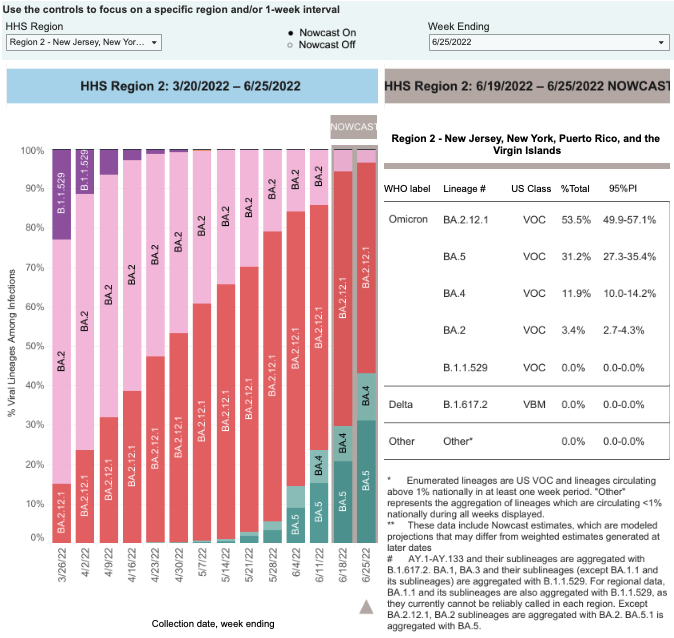
In the New Jersey region, omicron subvariant BA.2.12.1 remained the most dominant strain for the week ending June 25 — the CDC's most recent week of variant-surveillance data. But while BA.2.12.1 represented 53.5 percent of cases in the region, BA.5 grew to 31.2 percent of cases, while BA.4 reached 11.9 percent of infections.
The CDC separates its most up-to-date variant-proportion data into regions. New Jersey's region also includes New York, Puerto Rico and the Virgin Islands. See the CDC's regional data below:
For more coronavirus numbers, visit the state health department's COVID-19 dashboard, The New York Times data page for New Jersey and the CDC's data tracker.
Get more local news delivered straight to your inbox. Sign up for free Patch newsletters and alerts.