Politics & Government
Gov. Budget Vetoes: Can 274 NJ School Districts Still Disappear?
Here's what NJ Gov. Phil Murphy REALLY did when he signed the 2020 fiscal year budget – and vetoed a bunch of things he didn't like.


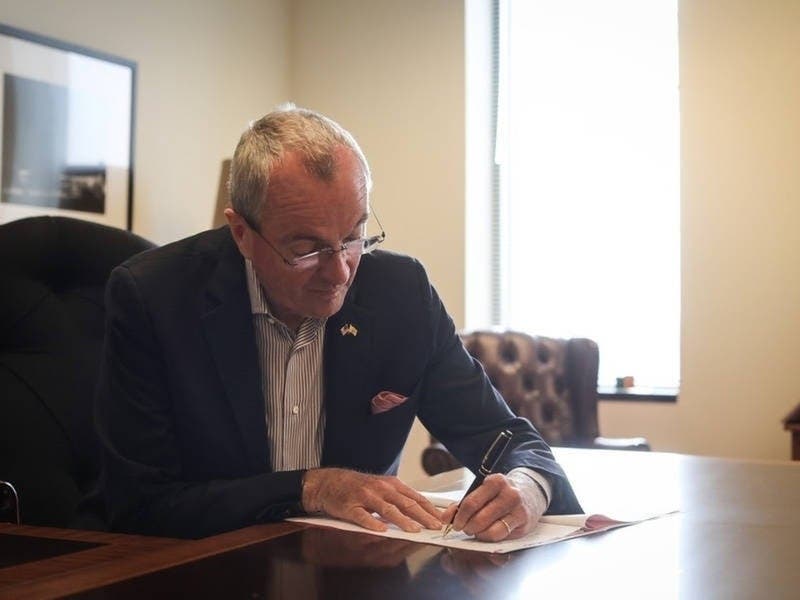
New Jersey Gov. Phil Murphy signed a 2020 budget on Sunday that he says restores core investments in education, NJ Transit and many other middle-class priorities.
But he also took a big step toward gutting what was becoming a very unpopular plan that could lead to the elimination of nearly 300 New Jersey school districts.
Gutting the beginnings of the school consolidation plan was just one of Murphy's big line-item vetoes that came after the governor failed to convince the legislature to approve millionaire's tax.
Find out what's happening in Asbury Parkfor free with the latest updates from Patch.
Here are the school districts that would be cut: 27 Proposed Laws Pushed: Nearly 300 NJ School Districts May Go
Indeed, the governor said he used his line-item veto power to eliminate $48.5 million in what he called "pork." But that pork largely involved budget items championed by Senate President Steve Sweeney, a fellow Democrat who refused to accept Murphy's plan to raise taxes on those making $1 million or more.
Find out what's happening in Asbury Parkfor free with the latest updates from Patch.
Here were a few of those plans, including consolidation, and what Murphy cut:
- Nearly 80 percent – $38 million – was cut from $48 million designated for a study into school consolidation
Sweeney has been pushing for requiring county superintendents of schools to establish consolidation plans that would combine all school districts, other than preschool or kindergarten through grade 12 districts, into all-purpose regional schools districts.
The study should take into account the feasibility of consolidation and any consequences of consolidation. Districts would then have 2 years to consolidate if approved by the state commissioner of education, or 3 years if the commissioner does not and creates their own plan.
Read more: Eliminating 274 School Districts? Tolls? Look At What NJ Could Do
- $5 million dedicated to Cooper University Hospital was eliminated entirely
This cut could also be a shot at Sweeney, since his childhood friend, George Norcross, the South Jersey political boss who may just be the most powerful man in the state, serves as chairman of the Board of Trustees of Cooper Health System and Cooper University Hospital.
The Murphy administration has been probing Norcross's connection to allegedly questionable tax breaks awarded over the years – a move that has angered the political boss and compelled him to sue the governor. Sweeney has largely taken Norcross's side in the matter.
Read more: Troubles Surrounding NJ's 'Most Powerful Unelected' Man?
Murphy said he was merely taking decisive action "to promote the fiscal responsibility that was lacking in the Legislature’s spending plan and setting up New Jersey to better weather a possible future economic downturn."
“The budget enacted today is a victory for working families in New Jersey in many different ways—it supports middle-class priorities, invests in education, makes a record investment in NJ Transit, provides property tax relief and so much more,” said Murphy.
“However, we must be honest about its shortfalls: This is a budget that does not include tax fairness, does not ask opioid manufacturers to help fund addiction services, and does not raise gun fees that have been untouched since 1966. These common-sense revenues would have allowed us to save for a rainy day and sustainably fund necessary investments for New Jersey’s nine million residents. Make no mistake, I will continue fighting for tax fairness and fiscal responsibility well beyond today’s budget actions.”
Careful examination of the Legislature’s budget, he said, revealed that the lawmakers' estimated surplus to be roughly half a billion dollars short due to the use of "unrealistic" revenue projections, unachievable savings assumptions, underfunded programs and services and supplemental spending legislation passed outside the budget.
When coupled with a lack of new sustainable revenues, Murphy utilized his constitutional authority to line item veto $48.5 million in spending added by the Legislature.
Here's what Murphy and lawmakers also did:
- The governor signed Executive Order No. 73 directing the Treasury’s Office of Management and Budget to place up to $235 million in discretionary spending into reserve, which will be monitored by treasury and released if, during the course of the fiscal year, sufficient revenues and assumed savings materialize. The executive order, he said, was deemed necessary since the budget passed by the Legislature did not include much-needed reliable and recurring revenue sources – such as the millionaire’s tax – and instead included additional spending, while relying heavily upon "questionable" revenue and savings projections.
- The final $38.712 billion spending plan maintains a total of $1.276 billion in surplus revenues comprised of $875 million in undesignated surplus revenue, and a $401 million deposit into the state’s Surplus Revenue Fund (SRF) – the “lock box” commonly known as the Rainy Day Fund – the first such deposit in more than a decade.
- The budget signed by the governor includes an additional $150 million in General Fund support for NJ Transit, for a total subsidy of $457.5 million, the largest general fund subsidy to NJ Transit in state history.
- Nearly $200 million was included to continue the ramp-up to full K-to-12 formula funding, and more than $60 million was also included to not only maintain, but to further expand pre-K.
- A total of $30 million in funding for the Community College Opportunity Grant (CCOG) program was included, allowing thousands of qualified students to attend community college tuition-free in the 2019-2020 academic year.
- About $283 million in funding was included for the Homestead Benefit program, which will be used to lower property tax bills for hundreds of thousands of New Jersey homeowners. The budget also increases funding for the Senior Freeze property tax relief program, which benefits both seniors and disabled residents, by $18 million for a total of nearly $220 million.
Get more local news delivered straight to your inbox. Sign up for free Patch newsletters and alerts.