Crime & Safety
More Than 1K Dead Birds Reported Across NJ Over 3 Days Prompting Park Closures
Almost all the reports from Saturday to Monday are of Canada geese found across the Garden State.


BASKING RIDGE, NJ — More than 1,100 dead or sick wild birds were reported statewide over three days to the New Jersey Department of Environmental Protection(NJDEP).
"The New Jersey Department of Environmental Protection Fish & Wildlife and the U.S. Department of Agriculture are tracking incidences of suspected bird flu cases in wildlife around the state," said NJDEP Press Director Larry Hajna to Patch.
Reports of dead or sick birds came in between Saturday, Feb. 14, and Monday, Feb. 16. Almost all reports are of Canada geese, with a few of other bird species, including brant along the coast.
Find out what's happening in Basking Ridgefor free with the latest updates from Patch.
Dead Canada geese were reported to the NJDEP over the past weekend in Holmdel, Manalapan, and Matawan in Monmouth County; Basking Ridge in Somerset County; Hainesport, Burlington County; Edison, Middlesex County; and Sicklerville, Camden County.
The Somerset County Park Commission reported on Monday that dead wild birds were found at the Environmental Education Center off Lord Stirling Road in Basking Ridge and Duke Island Park off Old York Road in Bridgewater.
Find out what's happening in Basking Ridgefor free with the latest updates from Patch.
Two parks in Gloucester County have also been closed after several dead geese were found around their shared lake, officials said Tuesday. Similar cases are under investigation at multiple locations in the county.
Monmouth County officials are also working with NJ wildlife biologists after dead and infirm Canadian Geese were found in some county parks on Tuesday.
NJDEP Fish & Wildlife is coordinating with local officials to safely dispose of bird carcasses at several landfills across the state.
Officials will only test for bird influenza if the virus has not been detected in the county or under special circumstances (for example, a mortality event that occurs near a poultry facility).
Earlier this month, the NJDEP conducted testing on the brant, which came back negative for bird influenza. This suggests the brant mortality may be caused by freezing temperatures and lack of food.
"Wild birds, including waterfowl and shorebirds, are considered natural reservoirs for avian influenza. Since the beginning of the U.S. outbreak in January 2022, bird influenza has impacted wild and domestic birds in every state, " said Hajna.
The Highly Pathogenic Avian Influenza (H5N1) continues to impact wild and domestic birds across the United States.
H5N1 has killed two people in the U.S. since 2024, according to the CDC. The virus has caused outbreaks in poultry and U.S. dairy cows, but the current risk to humans is low, the federal agency says.
A resurgence of bird deaths attributable to avian influenza has been observed in various parts of New Jersey since November. Officials believe it's impacting wild birds in all counties, including but not limited to waterfowl, raptors, and scavenger birds.
The New Jersey Department of Environmental Protection Fish & Wildlife has launched a new Wild Bird Disease Reporting Form to monitor highly pathogenic avian influenza (H5N1) in wild birds. Anyone who sees sick or dead birds, particularly groups of five or more dead birds are asked to report them.
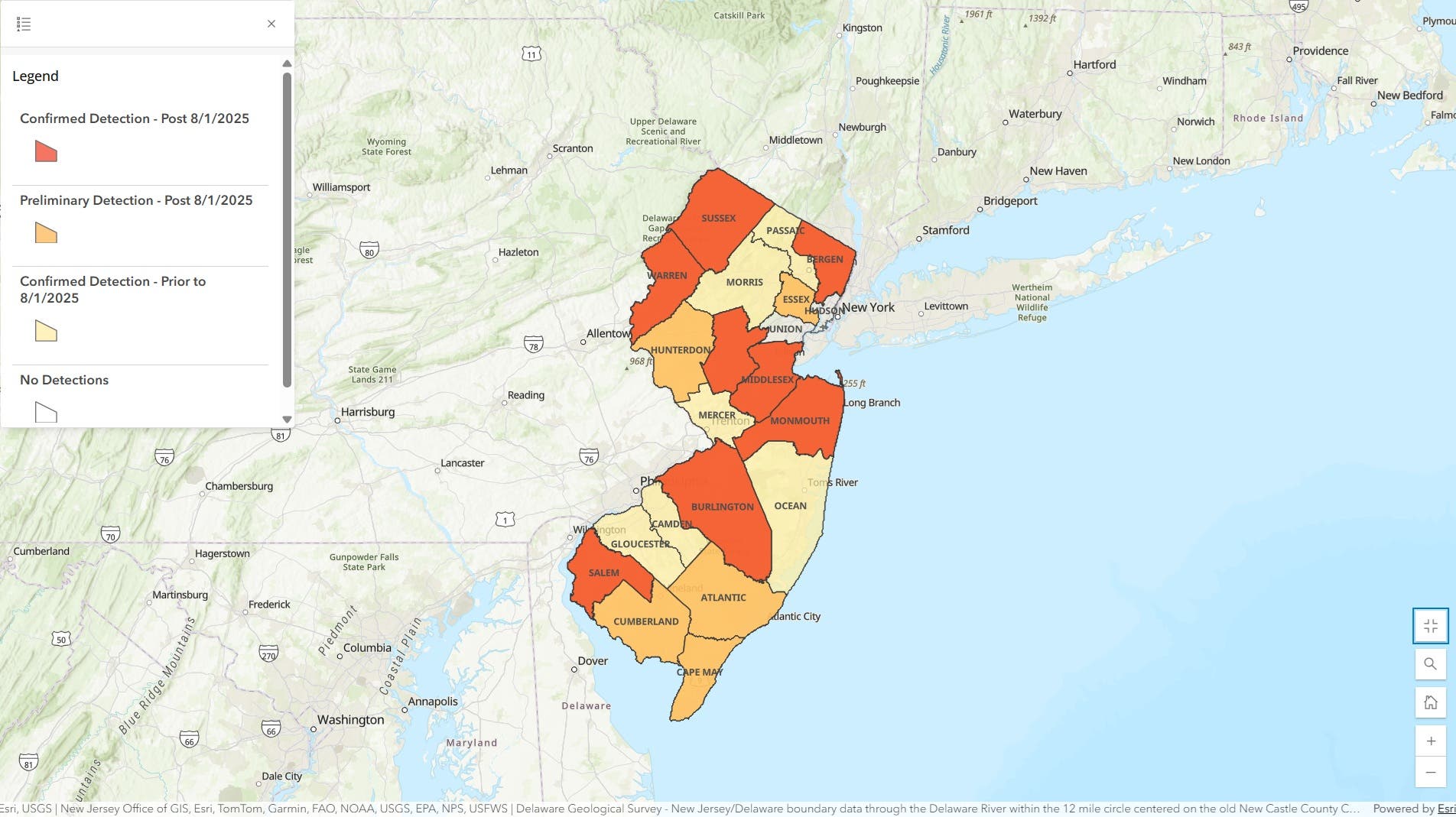
Red shown on the map above indicates "Confirmed Detection - Post 8/1/2025." Orange indicates "Preliminary Detection - Post 8/1/2025," and yellow indicates "Confirmed Detection - Prior to 8/1/2025."
The NJDEP Fish & Wildlife reports that in 2025, confirmed detections of avian influenza in wild animals have occurred in all counties except Hudson and Union.
The bird flu is a respiratory disease of birds caused by influenza A viruses. Wild birds, such as ducks, gulls, and shorebirds, can carry and spread these viruses but may show no signs of illness. However, avian influenza can kill domestic poultry (such as chickens, turkeys, ducks, and geese), according to the NJDEP.
To report sick or dead wild birds or for more information, visit NJDEP| Fish & Wildlife | H5N1 - Highly Pathogenic Avian Influenza.
— With reporting by June Bakan
Have a news tip? Email alexis.tarrazi@patch.com.
Get more local news delivered straight to your inbox. Sign up for free Patch newsletters and alerts.