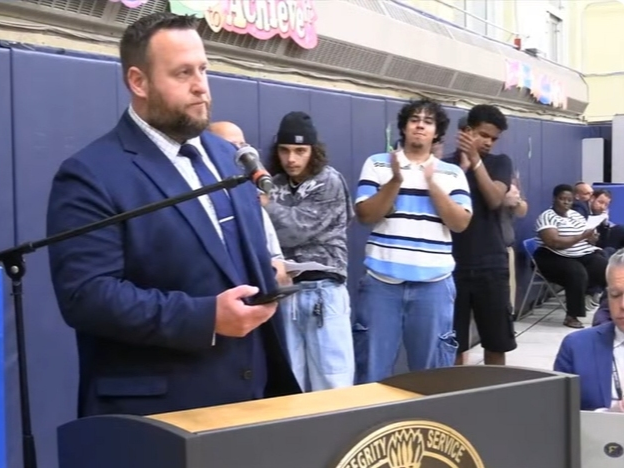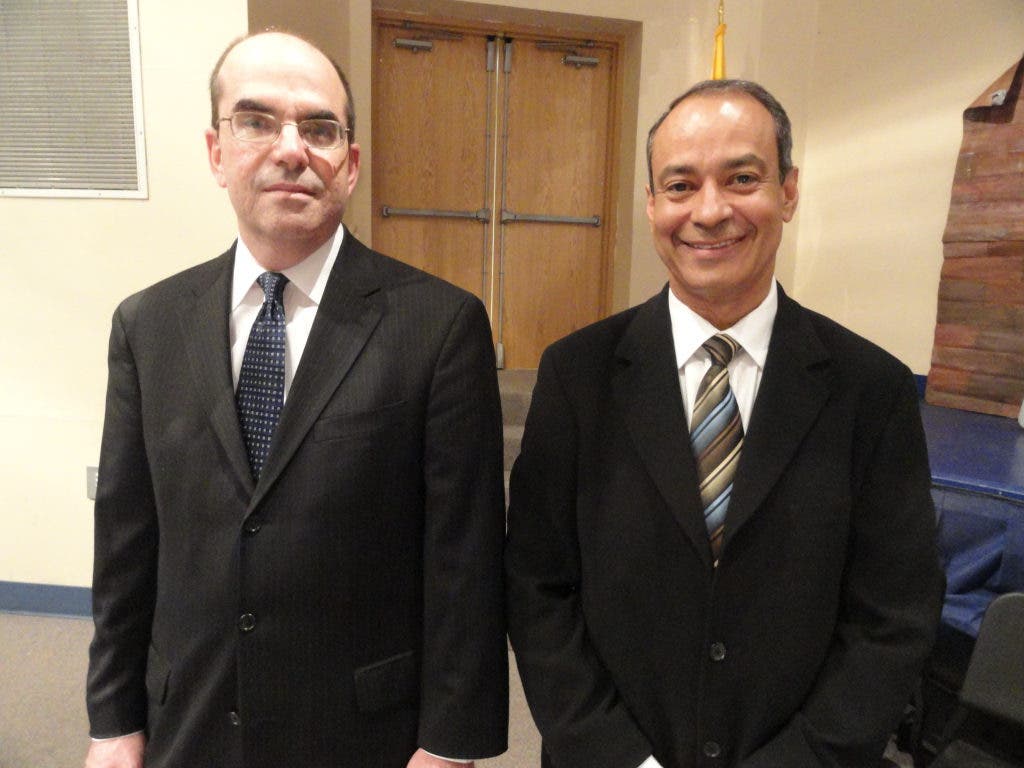
Two candidates running for seats on the Belleville Board of Education participated in a candidates’ forum last Thursday night, April 14, an event that grew heated at times as challenger Ralph Vellon repeatedly alleged that the board is unduly influenced by political considerations. Incumbent William Freda angrily denied those allegations and at one point asked Vellon directly if he believed Freda personally had violated any ethics rules.
The board of education election is April 27.
The wide-ranging discussion, held at Belleville High School’s Connie Francis Theater, touched on a number of other issues, from technology in the schools to teacher tenure. Audience members submitted questions on index cards to the moderator, Carlotta Rodriguez, the president of the Consolidated Association of the Belleville Public Schools. That organization sponsored the event.
A total of four candidates are seeking two seats on the board: Freda, Vellon, former board member Eric Schwartz and incumbent board member Joe Longo. Neither Longo nor Schwartz attended last week’s event, both citing family obligations. However, Longo and Freda are running a joint campaign, as are Vellon and Schwartz, so both campaigns were represented last week.
Under the format, audience members anonymously posed questions to either one or both of the candidates, with each candidate getting a chance to respond. Both candidates also were allotted time for opening and closing statements. A few times, however, one of the candidates deviated from this format to respond directly to comments made by the other.
Freda, the current board president, touted the board’s achievements during his three-year stint on the board. About $2 million in wasteful spending has been reduced, a grant writer hired by the district has won another $1.5 million in grants, a successful school uniform policy was introduced, and the board preserved all-day kindergarten, Freda said. Freda, whose professional expertise is in technology, also noted that laptop computers have been purchased for students at Belleville Middle School and the district has instituted a computerized emergency-alert system during his time on the board. The budget introduced this year under Freda’s presidency calls for no increase in the tax levy and does not touch academic programs.
Vellon, who has unsuccessfully run for a seat on the board twice before, said his decades of experience overseeing budgets as a nursing manager would enable him to see that funds are allocated efficiently and wisely. Having supervised 100 employees, Vellon said he has had experience managing accredited staff as well as with workplace policies and procedures. Vellon added that he would bring more transparency to board operations, including making sure the public’s questions are addressed when they’re raised at board meetings (current board policy is to respond to questions via email or by phone after board meetings).
Both candidates spoke about the policy of teacher tenure, which provides classroom staff with extra job security once they have worked for the district for a specified period of time. Also discussed were so-called “RIF” -- reduction-in-force - notices. Gov. Chris Christie and others have said that tenure policy across the state needs to be reformed so less-effective teachers can be terminated more easily.
“I think it’s a problem with the school district, it’s a problem at the state level, and boards like ours are in the crosshairs,” Freda said. Tenure serves to protect teachers from unfair termination, he said, but he also acknowledged that less-effective educators might be “hiding behind” tenure rules.
Vellon also said that tenure serves a valuable function in that educators are protected from politically motivated terminations, but there should be a “one-year” evaluation process so districts have the ability to remove bad teachers. Vellon also said, however, that too many RIF notices are “disruptive” and therefore detrimental to children’s education.
Both candidates were also asked what they would do to improve the district’s overall academic achievement. On some standardized exams, including tests administered to meet federal No Child Left Behind (NCLB) guidelines, some Belleville public schools have gotten less than “passing” grades for several years. Belleville Middle School, for instance, has failed to meet proficiency benchmarks for the last two years.
Vellon attributed declining test scores to a lack of leadership from the current board, which has resulted in too many changes in key staff positions, like superintendent and the head of special education. Principals too have been replaced repeatedly at some schools in the last few years, Vellon said.
“I think there has to be continuity and there has not been...there has to be a change, a change in values. Morale is low, and it’s affecting teachers’ ability to teach,” Vellon said.
But Freda defended the board, stating that the district has taken action to boost test scores, including hiring an outside consultant to advise the district on improving academic performance. The district has also instituted a teaching approach called “balanced learning,” a program where lessons are tailored for individual students instead of on a one-size-fits-all basis. Staff turnover, Freda added, was something that the board cannot always control, especially when employees simply decide to retire or leave the district.
Many of Vellon’s remarks throughout the night sounded a common theme -- that the board is beholden to outside influences and that important decisions, like staff hiring, are being made for “political” reasons and not in the best interests of the schoolchildren. Vellon also charges that the board has been dismissive of the public, with board members allowing speakers to get shouted down as they try to make comments at meetings, and board members bullying or ignoring those they disagree with. All of this, Vellon repeatedly alleged last Thursday, has been discouraging to the public and school staff alike, and has also ultimately resulted in poor academic performance.
Vellon, who described himself as “his own man,” said he would not be swayed by outside influences, including Richard Yanuzzi, who Vellon has described in past interviews as a “political boss.” Yanuzzi has long been active in local Republican politics and holds volunteer positions with school district organizations. He has also made public comments in support of Freda and Longo.
Freda, however, fired back, flatly challenging Vellon to accuse him of violating the board’s ethical standards, which state explicitly that board decisions be made solely with the best interest of the students in mind.
“Are you accusing me of violating the school ethics code?” Freda sharply asked Vellon at one point, repeating the question a few minutes later. Vellon declined to accuse Freda directly, stating instead that the board’s written standard of conduct is “higher than what I’ve seen from this board.”
Earlier, Freda also said that according to New Jersey School Board Association guidelines, board meetings are not “question and answer” sessions but opportunities for the public to comment (Vellon repeatedly accused the board of ignoring the public’s questions posed at board meetings). Freda said that if questions were allowed, meetings would get bogged down in “back and forth”. Since agendas are often lengthy, Freda said, “we have to keep the meetings moving forward.” Freda later added that he “has always been respectful” of people who speak at meetings.
Other issues touched on last Thursday:
Vocational Education. The tentative Board of Education budget introduced several weeks ago included a $302,000 referendum question, with the funds being earmarked for vocational education. This meant that if voters had rejected the question, vocational funding would have been reduced by $302,000 (although not eliminated entirely). The budget ultimately introduced by the board, however, restored the $302,000 and no referendum question appears on the budget going before voters next week.
Freda and Vellon both responded to a question asking why vocational education was considered for a referendum, but other programs, like music, were “not touched.”
Freda, who has already spoken publicly about this subject, repeated many of his earlier comments, noting that the budget never called for vocational education to be cut -- only that some funding be approved by voters -- and that the $302,000 was restored following the discovery that insurance costs had initially been over-estimated. A committee of three board members, Freda explained, met regularly to come up with a responsible budget. Freda, who said that there had been a lot of “confusion” about this issue, also noted that the process of creating a budget is “very fluid” and was always subject to change.
Vellon countered, however, that the question should not have ever been considered in the first place. Citing his own experience as an administrator, Vellon said that deep reductions should never be made in any one department, but that small reductions be made across the board, in several departments. Since $302,000 represents a tiny percentage of the approximately $60 million budget, no one department would have experienced a very deep cut using this approach, Vellon said.
Getting young people involved with board issues. Freda said that recently, a mock election was held at Belleville High School using actual voting machines from Essex County, an exercise that provided a real-world lesson in civics, Freda said. “Most students have probably never even seen a voting machine,” he noted. Freda also mentioned the student-run cable access station, Channel 34, as another way for youth to get involved.
“I would also like to see a little more attention to civics” in the curriculum, Freda added.
Vellon suggested creating more student advisory committees so that “stakeholders” have a greater say in the schools and more decisions are made with student input, instead of being imposed from above.
The importance of technology in the classroom. Here Vellon praised Freda, who has been actively involved in the district’s technology upgrades. Since technology evolves so quickly, Vellon said that money should be invested wisely so funds are not expended on equipment that will be “outdated in six months.”
Freda noted that education has changed greatly from the days when he himself was in school, and largely due to changes like the widespread use of computers. Describing today’s students as “very vision-oriented,” Freda said that measures like introducing Notebook computers at the middle school are a move in the right direction. “We’re getting there,” Freda said.
Reducing classroom size. Freda said that there is a “facility plan” on the drawing board that would create a K-5 classroom structure in the grade schools, a format in keeping with state recommendations. This would mean having the middle school serve grade six along with grades seven and eight, but first the middle school building would have to be expanded. That, in turn, would require millions in additional funding, which Freda said is the problem.
“If we had the money to build a new addition” we could implement the facility plan, Freda said. “But given the budget constraints, it would be difficult.”
Vellon countered that the School 1 site on Cortlandt Street would have been ideal for more classroom space. The large property -- which is in a poor state of repair and has not been used as a school in 30 years -- was recently turned over to the township for $1, after many unsuccessful attempts by the district to sell the land.
(Board of education officials have argued in the past that it would not be feasible to use School 1 for classes once again. In addition to its poor condition, the school would have to be completely renovated in order to meet modern requirements, including being handicapped-accessible, a point repeated by Freda last week.)
Teachers’ pension and benefits contributions. Neither candidate responded directly to a question asking whether teachers should make the same level of contributions to their pension and health insurance plans as police and firefighters do. Teacher pension and benefit packages are a hot-button issue across the state and the nation right now.
Vellon, however, expressed sympathy for teachers, who he said agreed to get an education for a line of work that does not pay much in salary but does offer good benefits. While acknowledging that “budgets are tight,” Vellon said, “We can’t just abandon them during the difficult times.” He said these issues should be resolved during collective bargaining.
Freda, pointing out that salaries and benefits are “80 percent of the budget,” said that this was a particularly difficult question because health insurance costs continue to rise dramatically. The board, and other school boards across the state, are “stuck in the middle” between state officials, who are pressuring districts to keep costs low, and the teachers. When state aid gets cut, as has happened in recent years, it only adds to the challenge, Freda said.
School uniforms. The Belleville school district has instituted a school uniform policy during the last few years, which Freda characterized as an unqualified success. There’s been a noticeable difference in the way “students carry themselves....They’re proud to be wearing that uniform. It’s one of the best things we [the board] did.”
Vellon, who said that he was among those working on this issue a few years ago, said that the school uniform policy was a triumph for the parents, who pushed for the policy. He also said that if the district solicited competitive bids for providers of uniforms, costs per family could be reduced dramatically.
Get more local news delivered straight to your inbox. Sign up for free Patch newsletters and alerts.