Politics & Government
Barnegat Bay Plume Caused By Silt, DOT Says; DEP Says Water Is Safe
The plume caught the attention of residents, officials and environmental groups, who questioned its source and raised safety concerns.


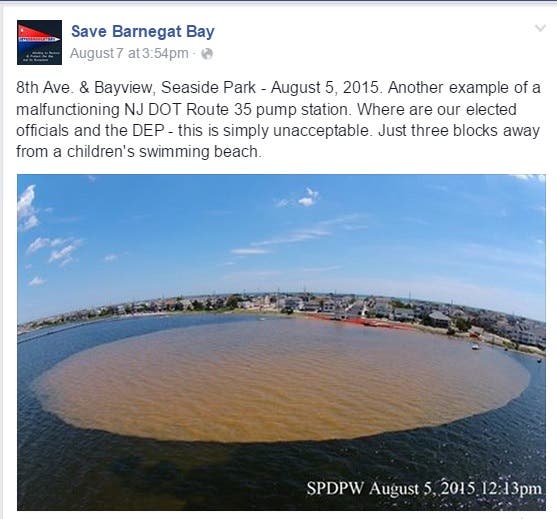
In response to concerns raised by residents, officials and environmental groups over a brown plume of water seen in Barnegat Bay last week off Seaside Park, state officials are offering assurances that the plume is not sewage or other contamination.
“I need to be crystal clear on this, the water coming from the pump on 8th Avenue was most certainly not sewage,” said Jamie Fox, commissioner of the state Department of Transportation. “The Department of Environmental Protection (DEP) and Ocean County both tested the water and found it safe. The public’s health and safety is always our first concern.”
The issue caught the public’s attention last week after a photo taken by the Seaside Park Department of Public Works surfaced on Facebook. The group Save Barnegat Bay shared the photo and raised concerns about the cause of the plume, including questions of whether it was caused by sewage.
Find out what's happening in Berkeleyfor free with the latest updates from Patch.
Save Barnegat Bay Executive Director Britta Wenzel raised those concerns Monday at a joint hearing in Lavallette of the Senate Environment and Energy and the Assembly Environment and Solid Waste committees, saying the group had taken samples from seven of the nine new pumping stations to test for nitrates, phosphorus , fecal coliform, mercury and lead, according to an NJ.com report on the meeting.
The plume is six blocks long, from just south of the Mathis-Tunney Bridge in Seaside Heights and is just blocks from a children’s swimming beach and the Seaside Park Yacht Club.
Find out what's happening in Berkeleyfor free with the latest updates from Patch.
The pumping stations, installed along Route 35 from Bay Head to Seaside Park to alleviate flooding problems, are part of $200 million in infrastructure work on the barrier peninsula.
The DEP sampled the water on Thursday, the day after the photo of the plume. The results, which can be found here, show low levels of three primary bacterial, with fecal coliform levels of 16 cfu/100 milliliters, E. coli of less than 3 cfu/100 ml, and 19 cfu/100 ml for Enterococci. Beaches are closed to swimming when the levels of any of those bacteria exceed 104 cfu, according to the Ocean County Health Department.
At the meeting, Wenzel said she was told the pipes to the pumps were supposed to be watertight and only operate during major storms, but that that has not been the case. Wenzel said the pumps run constantly, including one in town that gushes “like the Niagara Falls.”
“Unfortunately, now if something ends up in the storm drain, it gets immediately pumped into Barnegat Bay,” she said, according to NJ.com. “We need to know that these nine new point sources are not going to damage Barnegat Bay.”
Fox, in a news release, said the DOT’s Route 35 reconstruction project is not yet complete. While the reconstruction of the highway is nearly done, there is ongoing work on the drainage system and pump stations, as well as landscaping that needs to be completed.
“To help reduce runoff pollution to the Barnegat Bay, the new drainage system includes 76 manufactured treatment devices, or MTDs, that separate trash, oils, and sediment out of the water before it flows to the bay,” the news release said. “This is the first time runoff into the bay will be filtered and cleaned, improving the quality of water discharged into the bay.”
Fox said the DOT investigated the cause of the plume to ensure everything is operating properly and found it was a combination of silt built up in the system from the months of construction activity in the area and silt from the bay floor that was turned up by the force of the water exiting the outfall pipe.
“DEP and Ocean County tested the water and preliminary results have found that the water is safe (no increased levels of bacteria etc.),” the release said.
The DOT is now cleaning manholes and pipe joints and applying hydro-cement to ensure there are no leaks in the system, he said. ”Once the pipe sealing is complete, the pumps should run less frequently.” The DOT also will be trying to mitigate disturbance of the bay bottom by laying a broken stone/concrete matting on the bay floor.
Bob Considine, spokesman for the state DEP, said residents who are interested in the water samples and test results can check the DEP’s Bureau of Marine Water Monitoring website.
“The new underground storm water drainage system is a tremendous enhancement over what existed prior to this project,” Fox said in a news release. “This system is designed to handle 25-year storms, while the previous drainage could only handle 2-year storms.
“It is important for everyone to remember that we are still working on the system. As we continue to work on the system there is a possibility more silt is turned up, but we can ensure that there is no impact to the bay or the public, and that this is not dangerous,” Fox said.
Get more local news delivered straight to your inbox. Sign up for free Patch newsletters and alerts.