Business & Tech
'Don't Fukushima New Jersey,' Protestors Say
Opponents of aging Oyster Creek nuclear plant line Route 9 to raise awareness of alternative energies

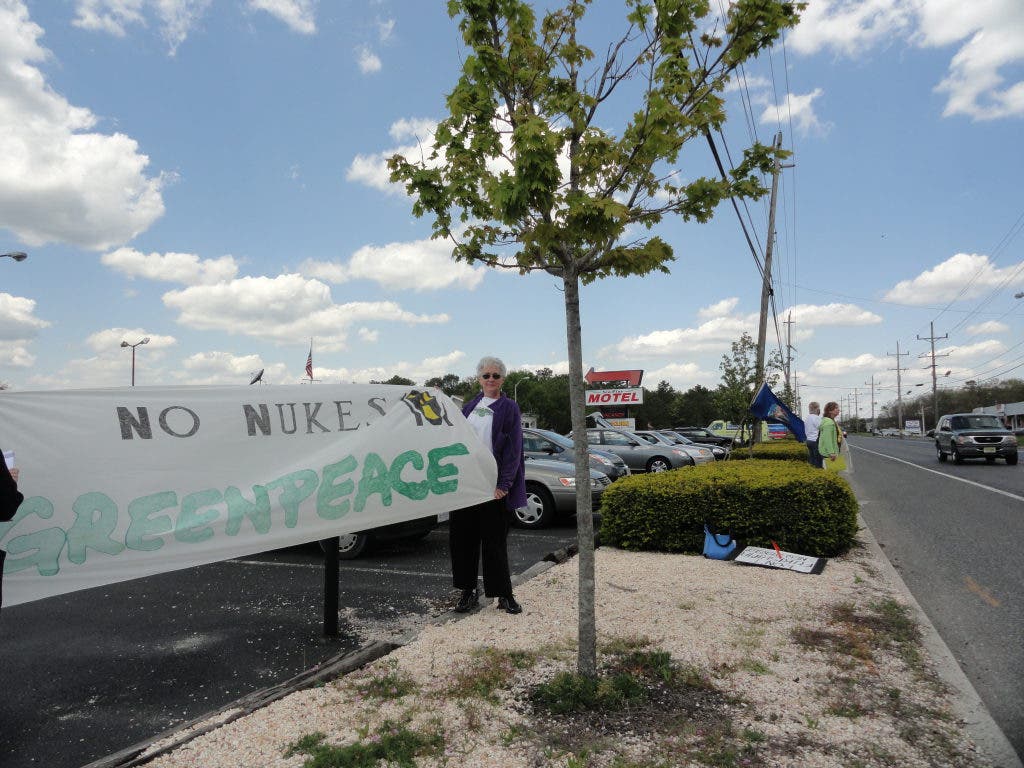
Liz Arnone parked her chair on the right shoulder of Route 9 South and held her sign aloft, prepared to settle in for a few hours.
"I'm trying to make sure everybody sees the sign," she said, as a parade of cars zipped down Route 9. Some drivers honked as they drove by.
"I think Fukushima really kind of tipped everything for me," said Arnone, a member of Greenpeace New Jersey and the Jersey Shore Nuclear Watch. "It made it so abundantly clear. No matter what they tell you, you can't anticipate what can happen. I don't think we should sit here and wait for something to happen."
Find out what's happening in Berkeleyfor free with the latest updates from Patch.
Arnone was one of a small, but stalwart group of protesters who came together to oppose the continued operation of the Oyster Creek Nuclear Generating Station, just a mile or two up the road.
They gathered to hold banners like "Don't Fukushima New Jersey" and promote awareness of alternative energies like solar and wind power.
Find out what's happening in Berkeleyfor free with the latest updates from Patch.
Tom Clerico, Manchester Township, said he has been against nuclear power for 30 years.
"I've been a big proponent of alternative energy," he said, holding up a sign that read, "No Nukes Is Good Nukes."
"I have 52 solar panels on my house, he said. "My last electric bill was $2.20."
Willie de Camp, executive director of Save Barnegat Bay, said he was there for one reason and one reason only.
"I'm here for Save Barnegat Bay to protest one aspect of the plant only," he said. "They are straining the life out of Barnegat Bay. It is just unconscionable what they are doing."
Not everyone who showed up at the Waretown Plaza on Saturday afternoon was happy to see the protesters.
One older man pulled his car over to near where they were standing and began yelling.
"Is this group going to compensate Lacey Township for our increase in taxes?" he said angrily. "Is this group going to help all the people that will lose their jobs? Is there a problem with tritium? No, there isn't."
Three Waretown police cars zoomed into the plaza at one point. One officer got out and spoke to Greenpeace member Michael Morton, who organized the event.
"Who's in charge here?" he asked.
"Nobody's in charge," de Camp replied.
Another officer later walked up to Arnone and asked her to move her chair farther away from Route 9.
"I just don't want a car coming by and hitting you on the shoulder," he told Arnone.
Robert Marshall, the executive director of the New Jersey Energy Coalition, said he was there to support nuclear power and the Oyster Creek plant.
"We are supportive of nuclear power as one element of reliable, affordable energy," Marshall said.
Oyster Creek is the oldest nuclear plant in the United States. It went online on Dec. 23, 1969. A coalition of citizen group's fought the plant's relicensing in court for several years. But the federal Nuclear Regulatory Commission relicensed the 40-year-old plant in May 2009, granting Exelon, the plant's owners, permission to operate Oyster Creek for another 20 years.
But Exelon decided to close the plant 10 years earlier, in 2019. The state Department of Environmental Protection made it a condition of Exelon's water discharge permit that the company install cooling towers at Oyster Creek. Exelon officials have said the cost of cooling towers would be too prohibitive. They opted instead to close the plant a decade before the license expires.
"Until that time, they will continue to operate it safely," Marshall said. "The unfortunate events in Japan don't mean things like that will happen here."
Dennis Zannoni, the DEP's former chief resident inspector at the Oyster Creek plant, also came to the event.
When Exelon asked for another 20 years to operate the plant, Zannoni, a nuclear engineer, reviewed documents that dealt with the aging plant's overall safety and its vulnerability to terrorist attacks. He didn't like what he saw.
But Zannoni was transferred from his position as site inspector for Oyster Creek to another section in the DEP's Bureau of Nuclear Engineering soon before he made his concerns public.
Storing spent fuel in casks on the plant's property was never meant to be more than a temporary solution, Zannoni said.
The spent fuel rods are actually the property of the federal Department of Energy. But it's Lacey Township's problem because the spent fuel rods are stored at the plant.
"When you live in Lacey, that's what you get," Zannoni said.
The vigil was co-sponsored by NJ Progressive Democrats of America, Ocean County Peace Flicks, Food and Water Watch, GRAMMES, and Jersey Shore Nuclear Watch.
Get more local news delivered straight to your inbox. Sign up for free Patch newsletters and alerts.