Politics & Government
Bedminster Solar Ordinance Still Being Written
Officials decide where ground-mounted solar panels will be allowed, design standards still to be reviewed.
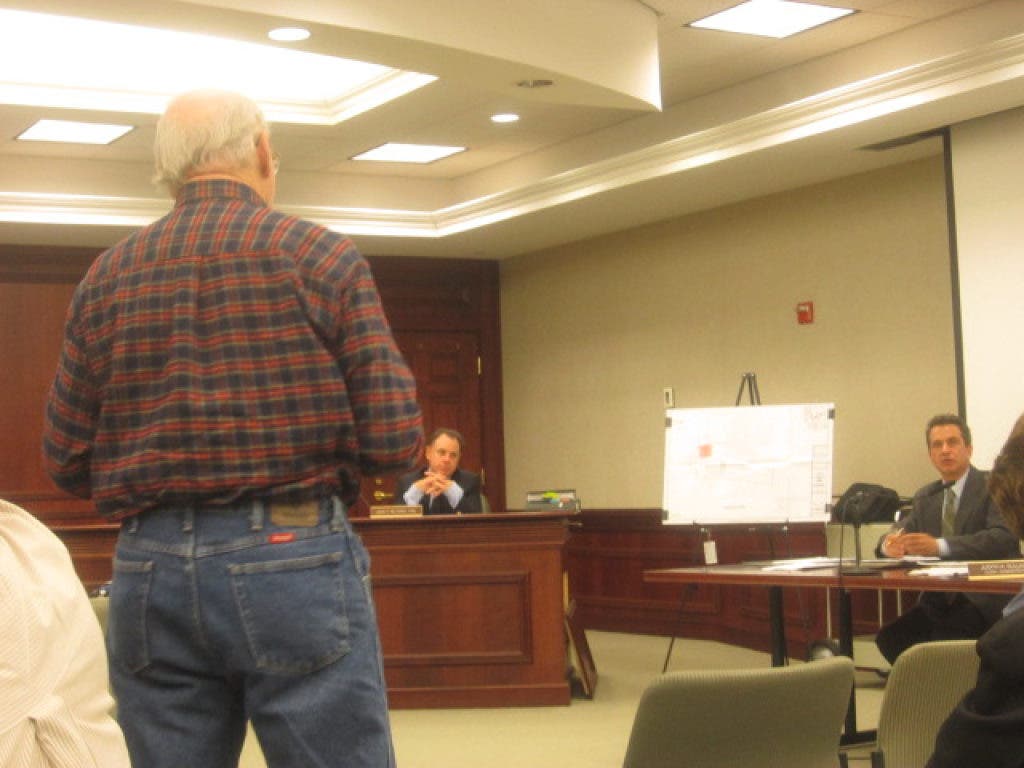
The Bedminster Township Committee will continue later this month to draft an ordinance regulating the installation of solar panels in Bedminster.
“We’re going to do it right,” Mayor Steven Parker said Monday in defense of the time it is taking to write the ordinance.
A key part of the proposed solar ordinance would prohibit the construction of any solar facility that would produce electricity for use off the facility’s property. Committee members want to include in the ordinance a standard that solar panels could only generate 110 percent of the power required on the property.
Find out what's happening in Bernardsville-Bedminsterfor free with the latest updates from Patch.
That provision would essentially eliminate solar farms in the township, unless a variance is granted.
But Parker has said the ordinance will have no impact on the controversial application before the township’s Land Use Board to construct a solar farm on the Kirby property on Country Club Road. That application, by KDC Solar of Bedminster, calls for the installation of a 55-acre, 49,000-panel industrial-scale solar power plant that would power only Sanofi-Aventis on Route 202/206 in Bridgewater.
Find out what's happening in Bernardsville-Bedminsterfor free with the latest updates from Patch.
The hearings on that project are scheduled to begin May 2.
The committee had originally introduced the ordinance last month. But when questions arose and substantive changes were proposed, the approval of the ordinance, and a possible reintroduction, was delayed until this month.
However, that timetable is not certain because committee members have not finished discussing the details of the ordinance, which still has to be reviewed by the Land Use Board before it can become law.
On Monday, the committee spent nearly two hours discussing the ordinance whose purpose, committeeman Lawrence Jacobs said, is “protecting the master plan and encouraging solar use.”
Committee members focused on which zones ground-mounted solar panels would be allowed in, while maintaining that roof-mounted panels will be allowed in all zones.
At the next meeting, scheduled for April 15, the committee will tackle the details of buffering and design requirements.
Ground-mounted solar panels will not be allowed in residential areas with smaller lot sizes, the officials decided. The ground-mounted panels will be allowed in the township’s R-10 zone, which calls for a minimum lot size of 10 acres, mostly in the western part of the township.
The ground-mounted panels will also be allowed in the R-3 zone, where lot sizes are at least 3 acres, and in the office zones in the Route 206 corridor.
The ground-mounted panels will be prohibited in all other zones, including the PUD zone, which covers most of the Hills community and the shopping center on Hills Drive. Committee members previously expressed concerns that ground-mounted panels in residential neighborhoods would detract from the nature of the area.
Township attorney John Belardo suggested that the township determine where the panels would be allowed, instead of relying upon other requirements, to eliminate ambiguity.
“I like bright lines,” he said.
However, the panels could still be restricted in the R-10 zone because a part of the ordinance prohibits ground-mounted panels on “farm soils,” township planner David Banisch said.
That restriction is in the section of the ordinance that outlines where the ground-mounted panels can be located and the buffering required to protect the “viewshed.” That part of the ordinance will be reviewed at the next meeting.
“We are not a decorating committee,” Parker said.
Banisch also explained that under the state’s land use law, ground-mounted panels cannot be used in the calculation of the impervious surface on a lot. That provision eliminated the possibility of using impervious coverage standards to regulate the panels, he said.