Community Corner
730 Days Later, It's Still Day Zero For Camp Osborn Man Left Homeless By Sandy
Nick Honachefsky says he feels stuck in a Catch-22 between Brick Township officials, homeowners association


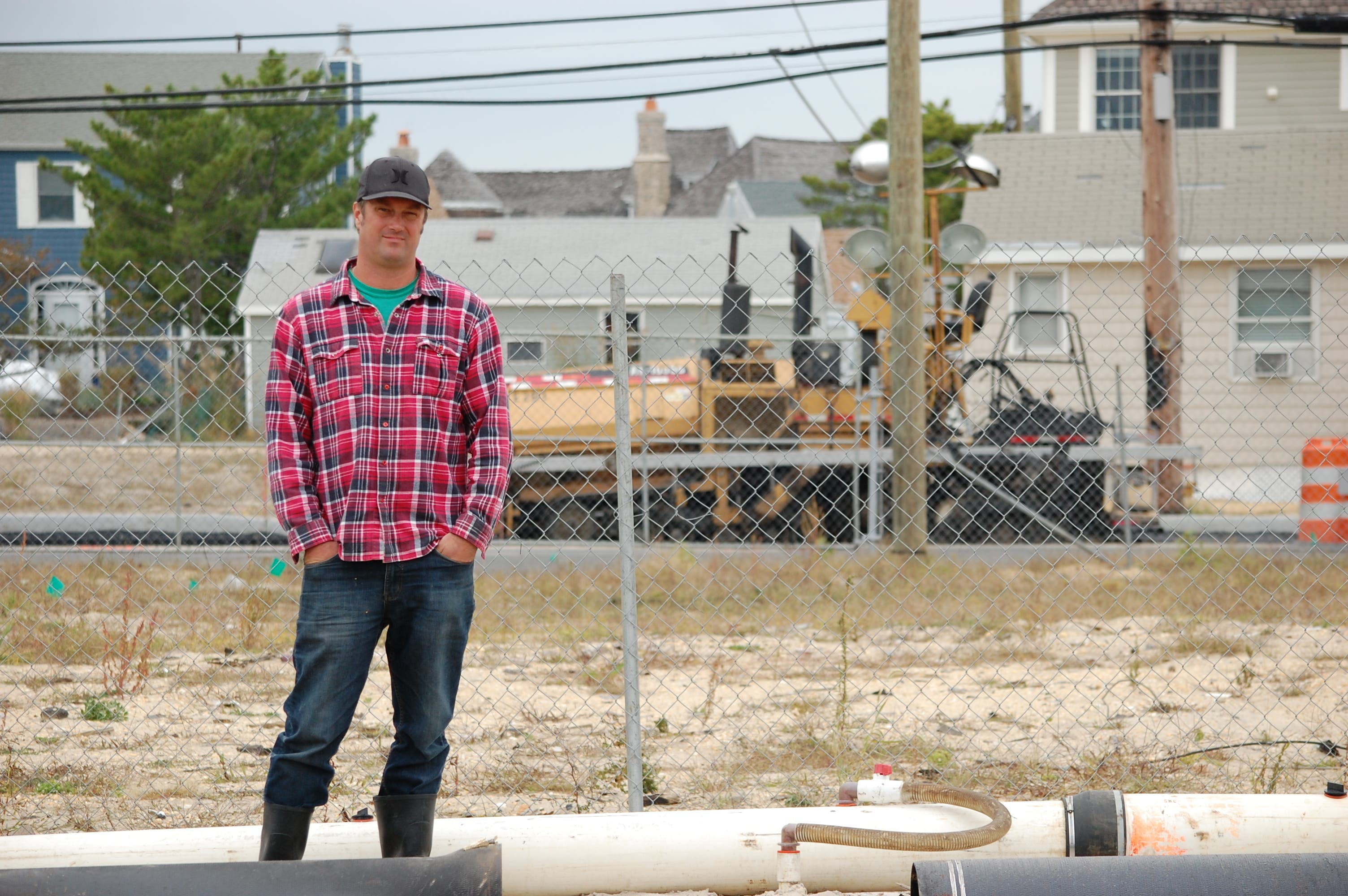
Nick Honachefsky points to a spot inside the chain-link construction fence.
“That’s where my house stood,” he says, indicating an area in the sand that is now indistinguishable from the rest of the area around it. Even though the lines aren’t visible, there’s a piece of land there that Honachefsky bought in 1998. Not a big one -- 40 feet by 40 feet, which once held a 750-square-foot bungalow. But it is his land.
The little plot of land behind the chain-link fence is all that remains of his life B.S. -- Before Sandy. That and his Jeep, and a few possessions he took with him when he evacuated on Oct. 28 two years ago, as Sandy was bearing down on the Jersey Shore. He calls the day Sandy hit “Day Zero,” the day his life started from scratch.
Find out what's happening in Brickfor free with the latest updates from Patch.
The Jeep, some clothing, a laptop computer and a handful of other items. And they were all he was left with when Sandy devastated the Shore 730 days ago, swallowing his home along with those of the 77 other property owners in Camp Osborn. The enclave of bungalows was flooded, then burned to the ground as a fire, fueled by natural gas from ruptured gas mains, consumed the community. Photos of the community burning were among the earliest and most enduring images of the tragedy of Superstorm Sandy, which damaged or destroyed hundreds of thousands of homes in New Jersey and New York two years ago today.
The rebuilding has been slow, but in most areas, those who’ve decided to stay and rebuild are beginning to make progress, getting funding through the Reconstruction, Rehabilitation, Elevation, and Mitigation Program if they haven’t already gotten help from their insurance companies. For most people, the process is a matter of seeking permits, getting approvals, and getting a contractor to work.
Find out what's happening in Brickfor free with the latest updates from Patch.
Not so in Camp Osborn, where Brick Township has determined that the what existed before Sandy -- tightly packed matchbox homes with little space from one to the next -- will not be permitted to return. For most of the 78 residents affected, it means delays in their return to their summer lifestyle.
For Honachefsky and a handful of others, however, it means one thing: homelessness.
“I stay with my parents in Clinton some of the time, and with friends,” said Honachefsky as he looked forlornly at his piece of land.
“I don’t know how much longer I can sleep on floors and couches,” he said, shaking his head. Two years of life as a transient has taken its toll. Every time he goes from one place to the next, he packs up everything -- his clothing, his laptop, his computer files, and his few possessions -- and loads it in the Jeep, where he admits he has slept, on occasion. The flannel shirt he wears is the same one he wore for a television interview in New York in the days after the storm.
“I haven’t bought anything with the insurance money because I have nowhere to put it,” he said. “What am I supposed to do, buy a refrigerator and pay rent on a storage unit?”
Just up Route 35, in Mantoloking and Bay Head, curbing was being replaced along the sides of the roads. Homes that are being replaced are nearing completion.
Across the street from Honachefsky’s parcel, a home on the oceanfront -- the only oceanside home in Camp Osborn to survive -- has been raised on pilings. There was enough of the house remaining on its footprint for the owner to receive permission to rebuild where it was -- a permission refused to those in Camp Osborn whose homes were completely destroyed.
“All I want is for them (the town) to let me rebuild my house where it was,” Honachefsky says, shaking his head. “I don’t understand why they won’t let me just rebuild on my footprint.”
* * * * * *
Camp Osborn has a long history. It sprung up in the 1920s as a fishing village of tents. Over time, the tents evolved into lean-tos and shanties, finally being replaced by bungalows. They were close together -- too close, by today’s standards -- but it was the closeness that brought about the sense of community there.
The community is made up of three pieces: a bayside section, the ocean section, and the median piece, on a sliver of land between the north and southbound lanes of Route 35. In total, it occupies about 3.5 acres of land.
There is an additional acre and a half on the ocean that belongs to Bob Osborn, who rented pieces of his land while people owned their homes on it, similar to a mobile home park, said Elyssa Commins, the Brick Township engineer. Osborn has a plan before the state Department of Environmental Protection for townhouses on his piece of it, which was home to 20-some families before Sandy struck.
“He was free to make decisions on the land because people owned only their houses,” Commins said.
The rest of Camp Osborn, however, is part of the Osborn Sea-Bay Association, a homeowners association that collectively includes 78 homes, including Honachefsky’s home. It is governed by a board of directors, but the board’s power is very limited, said Matthew Presutti, its president.
“We can only make decisions for the entire group on things like paving the road (within the development),” Presutti said.
The area is zoned, under current Brick Township zoning laws, as R-7.5 -- a residential zone that provides for lots of 75 by 100 feet. But in 1990, the township approved an ordinance defining a conditional use for the entire area, called a beach cottage community, “for structural alteration or rebuilding of these residential buildings only,” according Article XV, section 245-144 of the Brick Township municipal code book. It applied specifically to the lots that comprise Camp Osborn, and Commins said the reason it was created was to allow residents in that community to make repairs without having to seek a variance every time they did work on their homes, thereby reducing some costs to the homeowners.
But according to Commins, the protections of the ordinance ceased to apply when Sandy destroyed the homes.
“It didn’t permit new construction,” Commins said, “it just legalized what they had. Sandy eliminated that zoning.”
Honachefsky says the Osborn Sea-Bay association’s lawyer says there’s nothing on the books that formally says the BCC zoning would disappear in the event of mass destruction.
“The town never repealed it,” Honachefsky said.
Presutti, president of the homeowners association, said that is one reason the group has been slow to come up with a plan for rebuilding homes in Camp Osborn, because the board members hoped the change of mayors would result in a different approach from the town -- a hope that has not come to fruition.
“Most people in Camp Osborn want single-family homes,” Presutti said, but the town is not budging.
The BCC zoning does not meet fire codes, Commins said, which is the town’s primary objection.
“We’re not necessarily opposed to the density of units,” she said, “just the configuration.”
The homeowners all need to come together with a plan for rebuilding that they all can agree on, Commins said -- something that has proven impossible so far, Presutti said.
It’s an answer that does not sit well with Honachefsky.
“They (the town) have put us in a scenario where we’re battling each other,” Honachefsky said. “I own that footprint where my house was, but the township is refusing to let me rebuild. At the same time I’m still paying property taxes.”
“They’re gathering taxes on 78 units every day and telling us we can’t rebuild,” Honachefsky said. “It’s not right.”
Honachefsky is equally frustrated with the homeowners’ board because of the lack of progress. Of the three pieces, only homeowners in the bayside portion have received approval to rebuild -- in part, Commins said, because the homes there weren’t packed as tightly as the ones in the oceanfront piece.
But even getting that approved hasn’t been easy, Presutti said, as there have been issues and questions about how that parcel, which is 65 hundredths of an acre, would accommodate parking.
“We’ve been criticized,” Presutti said. “Some of it’s fair, some of it isn’t.” He said there is some movement at last.
“In the last 10 days we finally got word that those people on the bay will be able to put shovels in the ground soon,” Presutti said. But he knows a great deal of work remains, as the median and the oceanfront parcels still need to be addressed.
A site design for those pieces, which was proposed in 2013 and received much attention as a new start for Camp Osborn, was scrapped, Presutti said, because the costs to build it were simply not affordable for most homeowners.
“It was a beautiful concept,” he said, “but in the long run it was not practical,” from both the perspective of construction costs and maintenance costs.
As the bayside portion moved forward, Presutti said, the board hoped to parlay the success in getting that approved into approvals for the median and oceanfront portions, and the intent was to present one plan for both at once -- in part to cut costs for an organization that doesn’t carry a huge bank account.
“We expect to pay a separate application fee for each portion” that’s presented to the township Planning Board, Presutti said. The association board was trying to avoid that by coming up with a plan for both the median and the oceanfront section at one time.
It’s something Presutti says the board is rethinking.
“I don’t know that that’s practical,” he said of presenting both at once. “The ocean portion is much more complex. There is a broad variance between footprints.”
Part of the reason for the change in direction, Presutti said, is because a proposal the board had put forth to the homeowners in the median and oceanfront went nowhere. The board solicited proposals from builders for constructing multifamily housing on the two parcels, and presented three to the homeowners. But when it came time to vote, more than a third of the homeowners didn’t vote, and the ones who did were nearly evenly split.
“I didn’t feel right having one-third of the owners dictating to the other two-thirds what would happen for all of them,” Presutti said, and the board’s role is strictly an advisory one. It cannot take action without the approval of the members regardess.
“Maybe I was naive to think we could get a simple majority on something like this,” he said. “It set us back. I was crushed.”
So now the board is looking to address the pieces separately -- something Honachefsky had advocated for a while. His home was in the median, one of seven that sat on the parcel. There have been site plans proposed, but none have moved forward, Honachefsky said, because the board was focused on getting both parcels done at once.
“All these ideas get thrown around and nothing gets done,” he said, because of the requirement that everyone has to agree. “If even one deeded owner says no, we can’t move forward.”
While the lack of progress may be frustrating for those waiting to rebuild summer homes, Honachefsky said, he feels there is a lack of understanding from many about how acute the situation is for him and the other full-time residents. One couple is living with friends. Another is in a temporary home in Mercer County waiting for answers on when she can rebuild. And at least one of the full-time residents has died while they all were waiting for answers.
“I lost everything,” said Honachefsky, who makes his living as an outdoor writer. He lost more than 40,000 photos and copies of hundreds of articles he wrote for various publications before the internet became the place of record. He lost his entire collection of fishing rods and fishing tackle -- which are central to the writing he does. He lost his furniture.
In the days after Sandy, when residents were able to get in and scour the area for belongings, Honachefsky found two items: his dog’s food bowl, and the charred remains of the neck of his guitar.
“I lost my rosary from my first Holy Communion,” he said, “and my first bat from my first trip to a Yankees game.”
“It’s all the stuff that makes you, you,” he said.
Presutti said he realizes that Honachefsky and the other full-time residents have suffered deep losses.
“I feel terrible about it,” he said of the issue of them being homeless, two years later. He said he has a small inkling of what they are going through because when he was younger, he lost everything he had.
“I didn’t have much stuff then, but I lost everything,” Presutti said. “It was hard.
“I can’t imagine having half a lifetime worth of stuff and memories just washed away,” he said.
Honachefsky said others in the association have been less than sympathic, criticizing him for saying his homelessness is somehow more important than the fact that they lost their summer home.
It makes him angry.
“I’m not trying to diminish what they lost,” he said. “But I can’t even buy stuff because I have nowhere to store it. I don’t want to impose on people anymore.
“I feel like more of a victim now in this predicament than I did losing everything to Sandy,” Honachefsky said.
The town should be doing more to help, instead of telling the association to figure it out, he said.
“They should have to help us figure it out,” he said. “They keep collecting our taxes on it while they won’t let us do anything.”
Commins said the township can’t tell the association what to do.
“They have to show us something they’d like to do and then we can go from there,” she said. “We’ve really tried to talk to them. We’ve said, ‘Come in, let’s sketch something out,’ “ but as of a week ago, she said, township officials hadn’t discussed anything with the homeowners association in more than a year.
Presutti said he wishes the association could gain more traction with the town because of the fact that Honachefsky and others are homeless.
“If there were more people in that situation, there might be more movement,” he said. But that isn’t the reality. “It’s not something we take lightly.”
* * * * * * *
Honachefsky kept a journal during the storm, chronicling the hours leading up to Sandy as well as its aftermath, one he is now sharing on his website. Sandy is now “Day Zero” in his life.
Though his work has helped fill the void, keeping him on the road to exotic locales while he filmed a fishing show for the World Fishing Network called “Hooking Up with Nick and Mariko,” the desire to come home to his beloved Jersey Shore has never waned.
“It’s painful at this point,” he said earlier this month. “I don’t come down here as much, because it’s just too hard.” He is frustrated that 730 days after Day Zero, he is no closer to resuming something resembling a normal life than he was the day after Sandy hit.
“If I had a timeline on when it would end, I would have that hope to reach for,” Honachefsky said. “But I wonder, am I holding onto something that won’t happen for 10 or 20 years?”
His frustration with the lack of progress has led him to refuse to pay the special assessment the assocation imposed on all of the homeowners, which was put in place so the association could pay legal fees and engineering fees.
“We’ve spent a lot of money already and where are we?” Honachefsky said. “Nowhere.”
“We still haven’t collected from everyone,” Presutti said, noting that some refusals to pay reflected a philosophical objection on the part of those homeowners. “But this affects everyone.” It costs money to draw up plans, and it costs money to pay the lawyers to present it, he said.
Presutti said there is a homeowners association meeting this Saturday at 10 a.m. at town hall on Chambers Bridge Road, at which time the board will be presenting some information that Presutti believes will be positive.
“We hope to give people a little more confidence that something positive is going to happen,” Presutti said.
He believes there is a growing acceptance among the oceanfront property owners that a multifamily development is going to be the solution there.
“Some don’t like it, but most have accepted it as the direction we’re going,” he said. That will require those in that area signing over the rights to their footprint in exchange for the rights to one of the units.
It’s something both Presutti and Commins realize is difficult for people to do.
“You’re asking them to give up the property they own with the promise of getting something equal back in the future,” Commins said. “It’s a lot to ask of someone.”
Especially when it’s all they have left.
“I have been paying my mortgage and my property taxes all this time. My insurance money is running out. I can’t sell my land because you can’t build on it. I am in a Catch-22,” Honachefsky said.
“All I ask is let me rebuild my primary residence,” he said. “I want to get a life back. This isn’t cutting it.”
Get more local news delivered straight to your inbox. Sign up for free Patch newsletters and alerts.