Schools
Brick Schools Tackle Massive Project To Test Drinking Water For Lead
Nationwide concerns prompted state-mandated testing throughout N.J.; so far 3 Brick schools tested, more to come.


BRICK, NJ — William J. Kolibas Jr. opened a fat binder sitting on the table.
"This is all the information we have to compile," said Kolibas, director of facilities for the Brick Township School District. "The government requires a lot of paperwork."
The paperwork is for the district's screening of its drinking water for lead. Lead contamination in schools' drinking water exploded as a concern roughly 18 months ago, when children in Flint, Michigan, were becoming sick from lead poisoning, the result of lead leaching into the water in their homes and schools.
Find out what's happening in Brickfor free with the latest updates from Patch.
The crisis in Flint stirred concerns across the country and led to testing of water in some of New Jersey's inner-city schools; results from 30 schools in Newark found lead levels as high as 35 times above the federal action limit of 15 parts per billion, according to a report in NJ.com. In May, Gov. Chris Christie announced that all of the state's 3,000 schools would be tested for lead exposure, and the state appropriated $10 million to help cover the costs. The 15ppb is set by the U.S. Environmental Protection Agency as the maximum allowable level, as lead in drinking water can have serious health impacts, especially for children.
With the regulations and testing protocols in hand, Brick Township has been moving forward with testing at the district's 12 schools to address issues and fix them immediately.
Find out what's happening in Brickfor free with the latest updates from Patch.
"As soon as we got the regulations from the state, in August or September, we got moving," interim Superintendent Thomas Gialanella said Friday morning during an interview at the district's administration building. "We wanted to get out in front of it."
The district has had testing conducted through an independent private consultant with assistance from the Brick Township MUA, which Gialanella said offered the best price.
So far, the district has tested three schools: Lake Riviera Middle School, Drum Point Elementary School, and Midstreams Elementary School. Four more — Warren Wolf, Emma Havens Young, Osbornville and Herbertsville — will be tested after winter break, probably in mid-January, with the remaining schools — Brick Township High School, Brick Memorial High School, Veterans Memorial Middle School, Veterans Memorial Elementary School and Lanes Mill Elementary School — tested in February. The final five schools will likely be broken down into two groups because the high schools are so much larger than the other schools, Kolibas said. The protocols also urge the testing of schools with younger children first, and then older children, as younger children are more at risk from lead because of their smaller bodies and metabolisms.
It is a complex, detailed process.
Every source of drinking water — from hallway fountains to classroom bubblers to locker room water fountains to kitchen sinks — must be mapped out. Filters and what they filter must be indicated. The make and model of the drinking fountains must be detailed, including information that identifies of whether they are lead-lined or if they have been involved in any recalls, and whether they have aerators or chillers. Fountains that are out of service must be identified, as well as any that are leaking. Other drinking water outlets, such as the nurse's office, teachers' lounge, and "any other room or outside facility used for water consumption" has to be detailed.
Information on the school and its plumbing system must be detailed: what year the school was built, what kind of piping, what kind of connections, and even whether there are electrical wires grounded to copper piping. If there were repairs to or replacement of plumbing, that must be detailed with when, what type of repair and what materials were used. The age of the plumbing is relevant because in homes, businesses and schools built prior to 1986, copper piping was typically joined with lead solder, which was later found to be a significant source of lead leaching into drinking water. Newer construction uses a solder that is nearly lead free.
Kolibas said detailing all of that information takes a few weeks, because everything must be checked. No assumptions can be made, and water outlets that need repairs have to be fixed before the testing.
Once everything is mapped out, there is a walk-through conducted, with every fountain labeled for testing. Hot water must be turned off for outlets that have motion sensors, because the water must be cold. Then the school is shut down for a minimum of 8 hours, according to the testing protocols.
That allows the water to sit as though it would from the end of a school day to the next morning. The water cannot sit for more than 48 hours, however.
The testing then involves two water draws on each drinking water source: the first is the water that immediately comes out of the outlet — think of it as the water a child drinks if they're the first to use the fountain in the morning. All those samples have to be collected first. Then the water is allowed to run for 15 minutes, according to the district's lead sampling program documented here — and a second draw where the water runs for 30 seconds is taken.
It takes roughly two weeks for the test results to come back, Kolibas said.
On the first three schools, there were a total of 22 water outlets that tested above the 15ppb, according to the results published on the district's website, with levels ranging from 15.41ppb from a classroom bubbler to a high of 1081 on a food preparation sink. All of the drinking water fountains and bubblers that tested high were immediately disconnected, Kolibas said. Kitchen prep sinks in most cases were labeled with signs that say “DO NOT DRINK – SAFE FOR HANDWASHING ONLY."
The water bubblers (in-room drinking fountains) and hallway water fountains that were shut down have been repaired, with anything having old lead solder removed and replaced with connections made of ProPress, which Kolibas said has lead levels meeting the new state standard of less than 0.25 percent lead.
"There is no completely lead-free solder," he said.
Those repaired outlets remain out of service while the district awaits results of retesting on those fountains, Gialanella said. They expect to have the results of the retesting later this week, he said.
There were seven water outlets affected at Lake Riviera, just one of which was a fountain. At Midstreams, there were three outlets affected, two of which were bubblers. Drum Point had 12 outlets that tested high, eight of which were bubblers and one of which was a hallway water fountain. Most of the Drum Point outlets that tested high were not far above the EPA standard — 15.41 to 44.03 — but there were two that were far higher: one testing at 127.3 and one result of 523.8. The 1081 result was at Lake Riviera, and Gialanella said they believe the exceptionally high results on those outlets were an aberration.
Kolibas and Gialanella said the number of impacted water fountains was not great enough to warrant shutting down all fountains throughout the district.
"At Midstreams, it was two out of 27 water fountains tested," Kolibas said.
Because the state mandate for testing came down after the district's budget process was completed, there was no money budgeted for the testing, and while the state has promised reimbursement for at least part of the expense, Gialanella said it will be a while before the district sees the state money.
"Even if we finish and submit all of our paperwork, we have to wait for all of the districts in the state to do theirs," he said, and then the $10 million will be divided up.
So far, the project has cost about $8,000 or $9,000, Kolibas said, and he and Gialanella believe the final cost will be less than $40,000, barring something unforeseen.
Gialanella said the district's water was tested in 2013 and given a clean billing, but it's unclear what standard was being used at the time. The current lead standard is far more strict, he said.
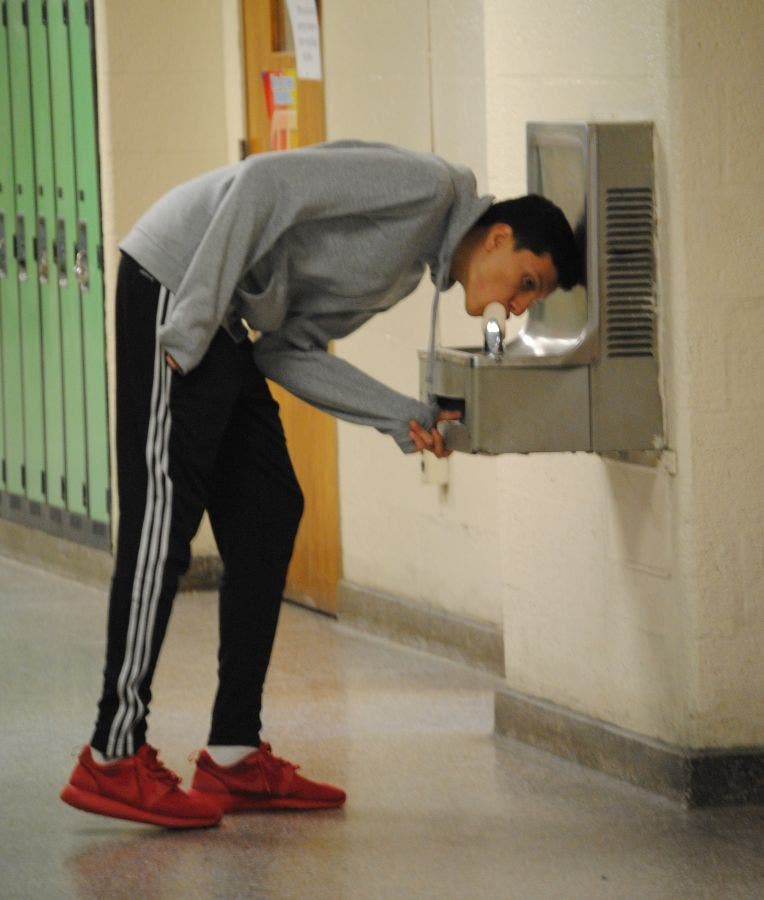
A student drinks from a newer water fountain at Brick Township High School. Karen Wall photo
Get more local news delivered straight to your inbox. Sign up for free Patch newsletters and alerts.