Crime & Safety
ICYMI: 'Swatting' in NJ: Real Threat or Empty Prank?
The incidents, at malls, schools and hospitals, have become more than a bunch of pranks, authorities say. They're becoming an epidemic.


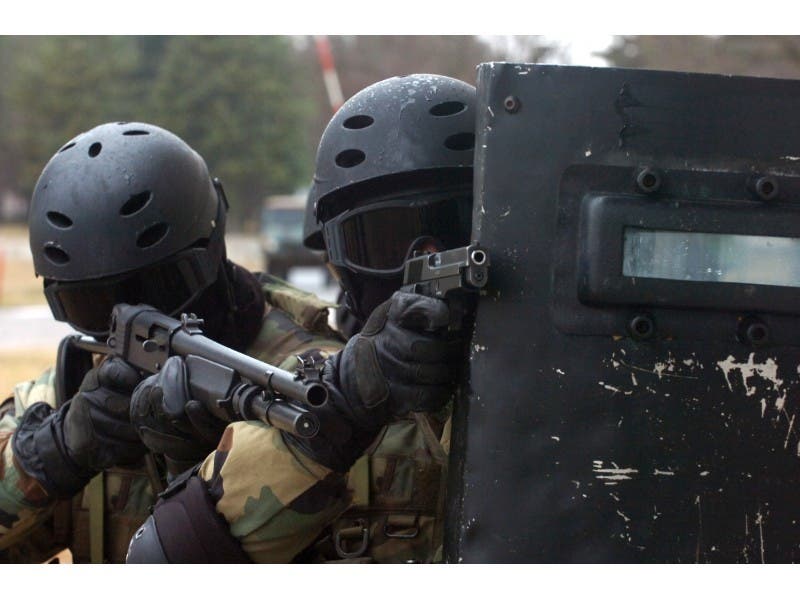
Each time, it’s three hours he never gets back.
Unfortunately for Richard Fitzpatrick, superintendent of Upper Freehold Regional Schools, there’s little he can change once the “swatting” incident starts.
Find out what's happening in Brickfor free with the latest updates from Patch.
First comes the report. “I am on the roof of the school and I’m going to kill as many people as I can,” was one of the latest threats that came Fitzpatrick’s way.
Then there’s the fear. Is this for real? Yes, he’s heard it before. But could this be the one?
Find out what's happening in Brickfor free with the latest updates from Patch.
“I said to myself [during a recent threat], ’If this guy is really up there, this could be the end of my life,’ “ Fitzpatrick said.
Either way, real or not, the schools must react. One actual incident would be too many.
Then comes the search, with police ”sweeping” the classrooms, the bathrooms, and every possible crevice on the school grounds.
Three hours later, Fitzpatrick hears what he expects to hear: “All clear,” the police say.
But dozens of schools, malls and other public places that have been impacted get little solace out of that declaration, because the calls keep coming. And more and more hours of valuable, productive time get lost, since the objective of “swatting” is to expend all the time-consuming resources law enforcement would use in a mass casualty incident.
Law enforcement officials estimate that about 400 swattings occur every year across the country, according to the Daily Mail, and many agencies don’t report incidents to prevent copycat acts. Some news organizations, such as The Asbury Park Press, no longer cover such incidents.
At least six incidents happened on Monday in New Jersey alone. And the fact that so many of the calls are coming from unknown places, some that could be barely traceable, has made this swatting something much worse than a bunch of pranks.
It’s becoming an epidemic.
“It’s significant,” said Al Della Fave, spokesman for the Ocean County Prosecutor’s Office. “They [schools and other public places impacted] should be as frustrated as we are.”
“Last time we closed Ocean County Mall, we had to sweep the entire mall from 7 p.m. until 12 midnight,” he said.
Last week, the Ocean County Courthouse in Toms River, Robert Wood Johnson University Hospital in New Brunswick and schools in Princeton, Cranford, Cresskill and West Milford were victims of possible swatting that led to hours-long investigations that turned up nothing.
The FBI is assisting local law enforcement in investigating swatting incidents, according to Celeste Danzi, a spokesperson for the FBI’s Newark office.
Although most swatting cases are handled by local and state law enforcement agencies, the FBI often provides resources and guidance in these investigations, said Kevin Kolbye, former assistant special agent in charge of the FBI in Dallas.
“The FBI looks at these crimes as a public safety issue,” said Kolbye, in an FBI release. “It’s only a matter of time before somebody gets seriously injured as a result of one of these incidents.”
There have been close calls across the country, he said. A police officer was injured in a car accident during an emergency response that turned out to be a swatting incident. Some victims who were caught off guard when SWAT teams arrived on their doorstep suffered mild heart attacks.
The rash of hoax calls could be causing schools and law enforcement to react more severely to incidents that, in the end, didn’t really resemble a threat.
For example, two people on Monday prompted the evacuation of 500 students from aSouth Brunswick school when they failed to stop at a visitors’ checkpoint. They were guest speakers who showed up at the wrong building, police said.
Most of the time, however, it’s not nearly that simple to detect the source.
Mark Fletcher, chief architect for public-safety solutions at the telecommunications company Avaya, said there are a number of ways to ”swat” an agency that answers 911 calls:
- With spoofing technology available online, a caller can mask their phone number that appears on a dispatching computer screen.
- A caller can access emergency dispatchers using TTD/TTY systems used by the deaf.
- A caller makes a masked call directly into a 911 system.
Fletcher said the system can be easily manipulated to prevent police from obtaining the ”swatter’s” telephone number. “I can have any number I want showing up” on the 911 dispatchers’ call identification system, he said. “The technology is openly available to do this.”
Fitzpatrick said he’s been told by law enforcement that the calls could be originating from other countries, and then they’re diverted several times before they reach their destination, making them hard to trace.
Della Fave acknowledged that some law enforcement agencies fear that someone is making swatting calls to observe SWAT teams and other police resources. Perhaps they’re planning for something more than a prank, he says.
“We’ve thought of that, that it could be beyond somebody trying to get some satisfaction,” he said. ”It may be individuals planning a real attack and operation.”
Kolbye, in the nj.com report, said he does not see a terrorism link. But he did note that one of the goals of terrorism is to create fear.
Timing of these events could be an issue, too. But it’s hard to tell.
Fitzpatrick said he got two swatting calls right around Memorial Day weekend - the second coming on the Tuesday after, right when most kids are in school. He said the voices sounded very similar.
“I don’t believe it’s kids trying to get out of testing,” he said. “I don’t believe it’s kids trying to get out of school.”
Then comes the lockdown. Usually, it runs smoothly. But there is an element of panic, especially when the school is crowded. Some parents feel compelled to go to the school, and even take their kids home.
“Mentally, it’s unnerving,” he said. “We don’t know what’s going on. The police don’t know what’s going on. We don’t know if it’s real or not. But we have to do something.”
Get more local news delivered straight to your inbox. Sign up for free Patch newsletters and alerts.