Health & Fitness
COVID, Flu, RSV Filling Hospitals: How The 'Tripledemic' Impacts NJ
It's a flu season unlike any New Jersey has seen in recent years, while COVID-19 hospitalizations hit their highest mark since mid-February.


NEW JERSEY — As New Jersey families gather for the holidays, they may come home with more than warm memories as Americans are being sickened by three viruses — seasonal flu, respiratory syncytial virus (RSV) and COVID-19.
RSV detections declined nationally during the week ending Saturday, after sharp rises since mid-October, according to the CDC. At the same time, seasonal influenza cases are ticking up in all but a handful of states, and COVID cases, hospitalizations and deaths are all trending upward as well.
In New Jersey, 42.2 percent of pediatric beds were occupied as of Thursday, according to an NBC News analysis of Department of Health and Human Services data. NBC News updates the tracker at 1 p.m. daily.
Find out what's happening in Brickfor free with the latest updates from Patch.
Nationally, the most overwhelmed states are Idaho at 104 percent, Arizona at 98 percent, Utah at 97 percent, Nevada at 96 percent, Rhode Island at 93 percent and Kentucky at 91 percent.
Overall, New Jersey's hospitals still have more space than the nation's, especially in terms of intensive care units, according to HHS data. As of Thursday, 73.6 percent of New Jersey's inpatient beds and 47.6 percent of its ICU beds are occupied. Across the United States, 80.5 percent of inpatient beds and 77.9 percent of ICU beds are filled.
Find out what's happening in Brickfor free with the latest updates from Patch.
But that doesn't mean New Jersey is in the clear. The state ended November with 1,236 hospital patients with confirmed or suspected COVID — the New Jersey Department of Health's highest tally since mid-February, when last winter's omicron wave waned. (During the omicron wave, New Jersey peaked at 6,089 people hospitalized with COVID on Jan. 11.)
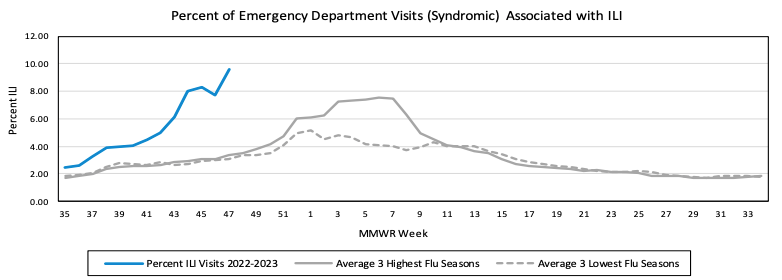
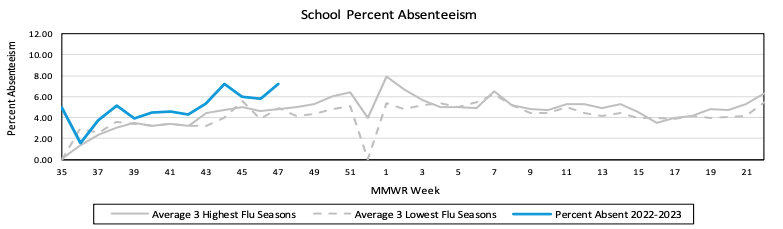
Additionally, every region of the state has "high" flu activity, according to the state health department's latest weekly report. Influenza-like illness accounted for nearly 10 percent of New Jersey's emergency-room visits in December, more than doubling the average rate of the state's three worst flu seasons in the past decade. And New Jersey's school absenteeism is on pace to surpass figures from flu seasons in the past 10 years.
No Declared Health Emergency Yet
Last month, pediatricians asked the Biden administration to declare a public health emergency that would give hospitals and providers more flexibility to care for children.
In their joint letter to President Joe Biden and Health and Human Services Secretary Xavier Becerra, the Children's Hospital Association and American Academy of Pediatrics said “significant capacity issues in pediatric hospitals and communities require flexibilities that can only be provided through a formal emergency declaration.
The flexibilities were provided to care providers at the height of the coronavirus pandemic, and “children’s providers require the same capacity support as they strive to keep up with increasing needs of infants, children and adolescents.”
As of Thursday, the HHS had not declared the health emergency. It would allow for the waiver of certain Medicare, Medicaid or Children’s Health Insurance Program requirements that would allow hospitals, physicians, and other health care providers to share resources and access emergency funding to keep up with the growing demands, specifically related to workforce support.
The reason for the so-called “tripledemic” threat? Months of hunkering down and avoiding contact with others during the COVID-19 pandemic weakened Americans’ immune systems, according to health experts.
“Public health officials have been bracing for this possibility since early in the pandemic,” Dr. Michael Mina, chief science officer at eMed and one of the nation’s leading epidemiologists, said in a statement to CBS MoneyWatch.
“The recent surges are fully expected ramifications of a new virus that caused massive swings in human behavior,” Mina said. “We know that immunity is working exactly as it was supposed to, and in this case, it means that we drained population-level immunity by not having exposures.”
Most children get an RSV infection by the time they’re 2, but people can be infected at any age and more than once in a lifetime, according to the CDC. The symptoms are typically similar to the common cold. But for the extremely young whose lungs aren’t fully developed, the very old and people whose immune systems are compromised, RSV can lead to breathing difficulties.
“Right now, the problem really is just the volume of sick children, Dr. Thomas Murray, a pediatric infectious diseases physician at Yale Medicine, said in a news release, “but we know how to help them.”
Get more local news delivered straight to your inbox. Sign up for free Patch newsletters and alerts.