Politics & Government
School Aid Cuts, Tax Cap Create Perfect Financial Storm For Districts, Brick Super Says
Superintendent Thomas Farrell says the state needs to look again at the funding formula, as it handcuffs districts being cut under S2.


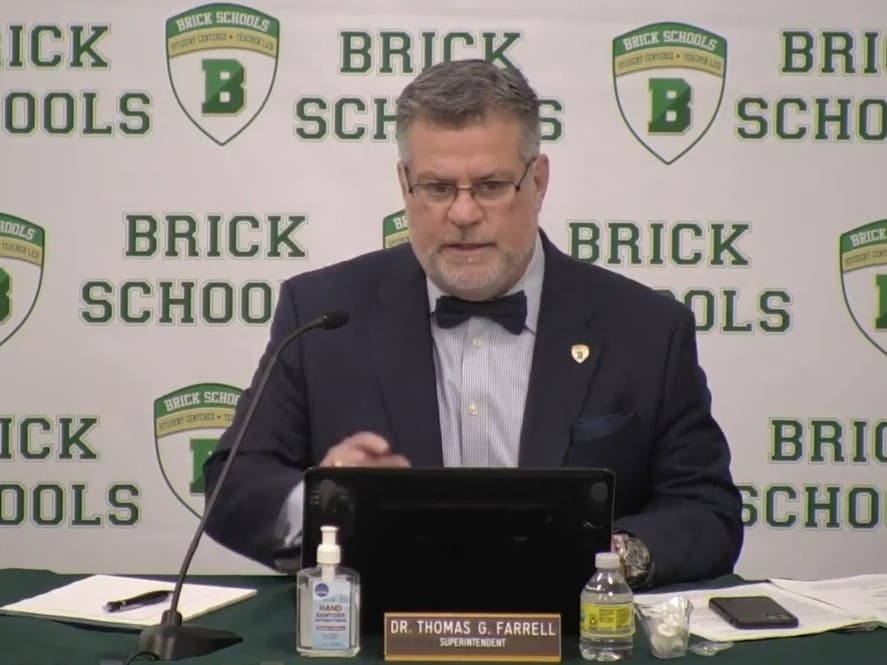
BRICK, NJ — The Brick Township School District is facing a paradox: Its state funding is being cut because, according to the state Department of Education, the district is not collecting its local fair share of property taxes.
At the same time, the district cannot achieve the level of taxation the state Department of Education says it must as an “under adequacy” district because state law limits the district to a maximum 2 percent increase in the property tax levy.
It’s a problem Brick Schools Superintendent Thomas Farrell has been highlighting in a white paper he distributed explaining how New Jersey’s school funding is putting some districts, including Brick, in an untenable position, of being unable to provide a thorough and efficient education to their students. (Read the full white paper at the bottom of this article.)
Find out what's happening in Brickfor free with the latest updates from Patch.
Farrell has been sharing his white paper as the Brick Township Board of Education prepares to submit a tentative budget to the state for the 2023-24 school year that potentially will have to be slashed before it is finalized in April. The board meets at 7 p.m. Thursday in the professional development center at the district’s administration building, 101 Hendrickson Ave.
“School funding and its impact on school districts’ budgets have its tentacles in everything fiscal,” Farrell wrote in his white paper. “Districts that are below ‘adequacy’ and face major reductions in state revenue sources due to ‘Senate Bill 2’ (S2) have no mechanism for relief.”
Find out what's happening in Brickfor free with the latest updates from Patch.
Adequacy is the number defined by the state Department of Education as the minimum a school district must spend per student to provide a “thorough and efficient” education, as spelled out by state law.
“Each year S2 is active, these districts are driven further away from adequacy, with many now millions ‘below adequacy,’ ” Farrell wrote. “We need an equitable solution, such as a plausible existing mechanism for relief in the form of ‘Adequacy Aid’ for those districts under adequacy and negatively affected by S2.”
The Brick Township Schools are among those districts that are under adequacy, Farrell said; the number was $9.4 million in 2022-2023, and is projected to reach $17 million below adequacy in 2023-2024.
The district’s cost-per-pupil is $15,500, and has had its state funding cut 49 percent — a total of $23 million — under S2, he said. That includes the $2.5 million aid cut scheduled for 2023-24. Read more: Job Cuts Coming As Brick Schools Cope With $2.5M State Aid Loss
“S2 claimed that aid would be cut commensurate with enrollment decreases, but that is not true for Brick, with an enrollment having only decreased 10 percent,” Farrell said.
Because of the 2 percent cap on increases in the property tax levy, Brick cannot close the adequacy gap; Farrell said it would take Brick a minimum of seven years, if there were no additional cuts.
“Meanwhile, class sizes will continue to increase, with Brick averaging around 30 in elementary classes with some as high as 34. In addition, staff will be reduced and programs will be cut to balance a budget (which is the law),” he wrote.
“With inflation, cost-of-living increases, and other costs increasing substantially, we are in the ‘perfect storm’ fiscally,” Farrell wrote. “These are dire times financially and Brick Schools is bleeding budgetarily.”
“Over the last 5 years, the State of New Jersey’s fiscal budget went from $36 billion to a present $53 billion, a 40-plus-percent increase!” Farrell wrote.
In that time, the state Department of Education’s budget has increased 32.3 percent, he wrote, and taxes have “increased the state coffers to allow to increase state aid for school districts.”
“Where is the money going? Not to Brick!” Farrell wrote.
“The state funding formula is not equitable and flawed,” he wrote. “The loss in state aid under S2 to certain districts has been further compounded budgetarily by extreme inflation that has increased major budget categories such as healthcare, transportation, energy, etc. These fixed cost increases have far exceeded the 2 percent tax levy cap. This is the ‘perfect storm’ and we need the state’s help. The state can change this.”
Farrell urged state officials to use some of the “unspent billions in federal dollars received, in reserve, and re-allocate to those districts negatively affected by S2 and below adequacy.”
He said the state needs to give another look to adequacy aid and how it is dispersed presently as immediate relief, “re-purposing that money based on change in school aid funding over the last five years (revision of N.J.S.A. 18A:7F-58).”
“A long-term solution is that the State MUST re-evaluate the school funding formula so as to provide a thorough and efficient education for ALL students in New Jersey by striving to bring ALL public school districts to adequacy — the State’s base threshold established constitutionally.”
“Some districts, such as Brick, are simply running out of time,” Farrell wrote. “We need to save these districts from falling off the financial cliff. The time is now for us to advocate for our efficient and effective school districts left behind from S2. We cannot allow the NJDOE’s education malpractice and Trenton’s insouciance to continue.”
Have a comment, a question or a news tip? Email karen.wall@patch.com
Get more local news delivered straight to your inbox. Sign up for free Patch newsletters and alerts.